Fix 2026 Mulch Washout with This $20 Border Trick
Fix 2026 Mulch Washout with This $20 Border Trick
Stop wasting money on dyed wood chips that end up on your sidewalk after every spring thunderstorm. If you are tired of seeing your landscaping investment float away, you need to stop thinking like a gardener and start thinking like a civil engineer. Mulch washout is not a weather problem; it is a grading and friction problem. Most homeowners try to solve this with those flimsy plastic strips from big-box stores. They fail. I have spent two decades fixing these mistakes. I recently got called out to tear up a $30,000 patio that was sinking because the previous contractor failed to manage the surface runoff from the adjacent mulch beds. The mulch had clogged the perimeter drains, causing hydrostatic pressure to build up under the pavers. It was a total failure of basic site engineering. We had to excavate the entire base, replace the saturated subgrade, and install a proper mechanical border. It cost the homeowner a fortune for something that could have been prevented with a $20 spade and some technical knowledge.
The Physics of Mulch Migration
Mulch washout occurs when surface water velocity exceeds the friction coefficient of the organic material, leading to buoyant transport of the wood fibers. To prevent this, you must either increase the weight of the material or create a physical catchment area that breaks the water’s momentum before it exits the bed.
“Mulch stability is directly proportional to the interlocking nature of the organic fibers and the underlying soil texture.” – Cornell Waste Management Institute
Every time it rains, water follows the path of least resistance. If your flower beds are mounded higher than your lawn without a recessed border, you have created a vertical slip-plane. The water picks up speed, lifts the light wood chips, and deposits them on your driveway. It is simple fluid dynamics.
How deep should a landscape border be to stop mulch?
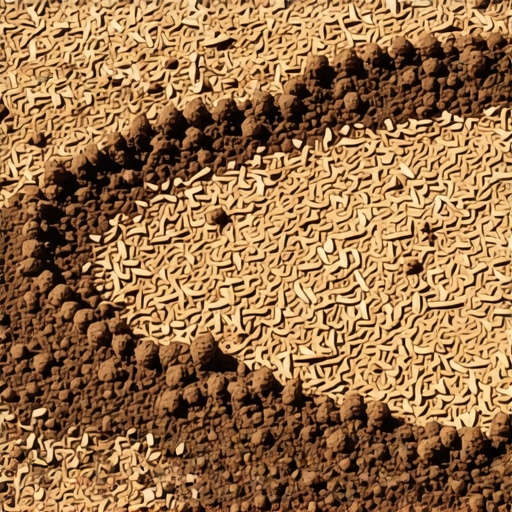
A professional landscape border should maintain a minimum depth of 3 to 4 inches to effectively capture sediment and manage water velocity. This depth creates a dedicated reservoir for heavy rainfall to pool and percolate rather than sheet-flow over the edge of the turf. This is what we call the V-trench. It costs nothing but sweat equity and it is more effective than any $50 metal edging. You take a sharp spade and cut a 45-degree angle into the turf, sloping back toward the bed. This creates a literal moat. When the rain hits, the water carries the mulch into the bottom of the trench instead of over the grass. The mulch stays in the hole. The water slows down. Problem solved.
What is the best mulch for slopes to prevent washout?
For inclined surfaces, double-shredded hardwood mulch is the superior choice because the jagged fibers interlock to create a stable, woven mat. Avoid pine nuggets or cypress chips on hillsides as their high buoyancy and rounded shapes allow them to float and roll easily during heavy precipitation events. Hardwood mulch has a higher bulk density. It stays put. If you are dealing with a slope greater than 10 degrees, you might even consider a tackifier, which is a botanical glue that binds the fibers together without harming the soil biology. Don’t use rock on a slope unless you want a rock-slide in three years. Stone lacks the internal friction to hold itself against gravity when the soil underneath becomes saturated.
The Engineering Logic of the V-Trench
The V-trench works because it addresses the hydrostatic pressure at the soil surface. By cutting a clean vertical edge against the grass and a sloped edge toward the bed, you create a structural break. This break stops the capillary action of water moving across the surface.
| Edging Type | Average Cost | Hydraulic Efficiency | Lifespan |
|---|---|---|---|
| Plastic Strip | $1.50/ft | Low | 2-3 Years |
| Steel Edging | $4.00/ft | Medium | 15+ Years |
| V-Trench | $0.00 | High | Indefinite (Maintenance required) |
| Paver Border | $6.00/ft | High | 10+ Years |
Professionals never rely on the plastic stuff. It heaves during freeze-thaw cycles. In the midwest, I have seen plastic edging pop out of the ground like a spring because the soil moisture expanded. The V-trench is different. It moves with the earth. It is a biological solution to a physical problem.
How to Install the $20 Professional Edge
Follow these steps to ensure your mulch stays where you put it. You will need a sharpened half-moon edger or a flat-head spade. Do not use a powered weed whacker for this; it won’t give you the depth you need.
- Identify the Drip Line: Mark your edge at least 6 inches beyond the reach of your plants’ foliage to avoid root damage.
- The Vertical Cut: Drive the spade 4 inches straight down into the turf to create a clean wall.
- The Angled Excavation: Move 3 inches into the flower bed and drive the spade at a 45-degree angle to meet the bottom of your first cut.
- Remove the Spoils: Pull out the wedge of dirt and grass. Do not throw this away; compost it.
- Compaction: Use the back of your spade to firm up the sloped side of the trench.
- Mulch Application: Fill the bed, but leave the bottom inch of the trench empty to act as a water channel.
“A retaining wall doesn’t fail because of the stone; it fails because of the water trapped behind it.” – Hardscape Engineering Axiom
This same principle applies to your edging. If water cannot escape or be absorbed, it will destroy your design.
Soil Health and Friction
The state of your soil determines how fast water moves. If you have heavy clay, your infiltration rate is near zero. This means all water becomes surface runoff. To fix this, you need to incorporate organic matter into the top 2 inches of your soil before mulching. This increases the soil’s porosity. Sandy soil has the opposite problem; it drains so fast it can wash away the soil under the mulch. In both cases, the V-trench acts as a buffer. It will rot if you leave too much organic debris in the bottom, so clean it out once a year. That is the only catch. You have to maintain the line. Every spring, I take my spade and spend 20 minutes re-cutting the edge. It is the cheapest and most effective maintenance task in the yard. It keeps the grass roots from invading the bed and keeps the mulch from invading the grass. Don’t buy the hype of ‘permanent’ borders. The earth is not permanent; it moves. Your borders should be able to move with it. Stop buying plastic junk. Buy a better shovel. Your lawn will thank you, and your wallet will too.
![Stop Killing 2026 Lavender: Drainage Rules [Zone 8]](https://lawnmajesty.com/wp-content/uploads/2026/06/Stop-Killing-2026-Lavender-Drainage-Rules-Zone-8.jpeg)