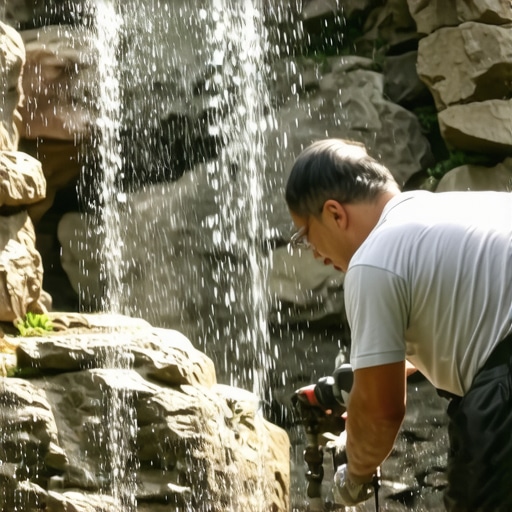
![Stop Your 2026 Fountain from Leaking [30-Min Fix]](https://lawnmajesty.com/wp-content/uploads/2026/06/Stop-Your-2026-Fountain-from-Leaking-30-Min-Fix.jpeg)
Stop Your 2026 Fountain from Leaking [30-Min Fix]
The Forensic Autopsy of a Failed Water Feature
I recently got called out to tear up a $30,000 patio that was sinking because the previous contractor failed to realize that a leaking fountain isn’t just a water bill problem; it is a structural hazard. The hydrostatic pressure of escaping water had liquified the fines in the modified gravel base, turning a high-end entertaining space into a literal mud pit. This was not a slow leak. It was a failure of the EPDM liner integration and a complete misunderstanding of capillary action. Most contractors think a tube of kitchen-grade silicone is a fix-all. It is not. It will fail. If you see your water level dropping more than two inches a week, you aren’t looking at evaporation; you are looking at a structural breach that will rot your foundation. To stop a fountain leak in 2026, you must identify the structural breach by isolating the pump chamber from the spillway. Most leaks occur at the bulkhead fitting or the liner-to-concrete transition, requiring a polyurethane sealant rather than standard silicone to ensure a chemical bond that withstands UV degradation and constant submersion.
“A retaining wall doesn’t fail because of the stone; it fails because of the water trapped behind it.” – Hardscape Engineering Axiom
How do I find a hidden leak in my fountain?
To find a hidden leak, perform the Bucket Test: fill a 5-gallon bucket with water and place it next to the fountain, marking the water levels in both. If the fountain level drops faster than the bucket over 24 hours, you have a structural leak. Next, turn off the pump. If the water stops dropping, the leak is in the plumbing lines or the upper spillway. If it continues to drop, the breach is in the basin liner. This is physics, not guesswork. Most homeowners ignore the relative humidity impact and assume every drop is a leak, but the surface area of your water feature dictates the evaporation rate. Check your PSI on the pump; a sudden drop often indicates a split PVC line underground. Don’t skip the diagnostic.
What is the best sealant for concrete water features?
The best sealant for concrete water features is a high-modulus polyurethane or a butyl rubber tape. Standard silicone does not adhere to porous concrete or stone veneer over the long term because it cannot handle the thermal expansion of the substrate. You need a material that maintains elasticity down to -20 degrees Fahrenheit. We use 45-mil EPDM liners exclusively because they resist UV rays and ozone. If you are patching concrete, use an integral waterproofing admixture mixed with a Type S mortar to ensure the patch doesn’t just sit on the surface but becomes part of the structure. It will rot if you use cheap materials.
| Material Type | Expected Life (Years) | PSI Resistance | Best Use Case |
|---|---|---|---|
| EPDM Rubber Liner | 25+ | High | Primary containment basins |
| Polyurethane Sealant | 10-15 | Moderate | Joints and Bulkhead seals |
| Standard Silicone | 1-2 | Low | Temporary aesthetic fixes only |
| Liquid Rubber Coating | 5-8 | Variable | Refurbishing concrete shells |
The 30-minute fix often centers on the union connection at the pump. Over time, vibration from the submersible pump loosens the threaded fittings, allowing water to spray out of the conduit. This isn’t a liner failure; it is a mechanical one. Tighten the hose clamps and apply a PTFE thread sealant. If the leak is a small puncture in an EPDM liner, an underwater-rated patch kit using a primer and pressure-sensitive tape is the only way to go. Clean the area with acetone first. If you skip the cleaning, the patch will peel within a month.
“Water is the primary agent of deterioration in the built environment; managing its movement is the essence of hardscape longevity.” – ICPI Technical Manual
The 30-Minute Leak Diagnostic Checklist
- Check the spillway: Ensure no water is wicking over the back of the stones due to algae buildup.
- Inspect the pump union: Look for spray patterns inside the pump vault.
- Clear the auto-fill: A stuck float valve can cause constant overflow.
- Examine the edges: Look for wet soil or settling pavers around the perimeter.
- Verify the liner height: Soil should never be lower than the liner edge.
Stop looking for magic sprays. If your fountain is losing water, it is either capillary action pulling water over the side via a piece of mulch or a mechanical failure in the plumbing. We see a lot of “pro” installs where the liner was cut too short. The water wicks up the fabric underlayment and disappears into the subgrade. This isn’t just lost water; it is erosion. It will collapse your retaining wall. Fix it now or pay ten times more next year to rebuild the entire hardscape. Proper compaction and drainage are the only things standing between a beautiful garden and a structural nightmare. Call 811 before you dig to find any leaks in buried lines. Don’t be the homeowner I have to charge $10k to fix a $50 problem. Maintenance is cheaper than reconstruction.

![Why Your 2026 Pond Pump is Making Noise [Easy Fix]](https://lawnmajesty.com/wp-content/uploads/2026/07/Why-Your-2026-Pond-Pump-is-Making-Noise-Easy-Fix.jpeg)