
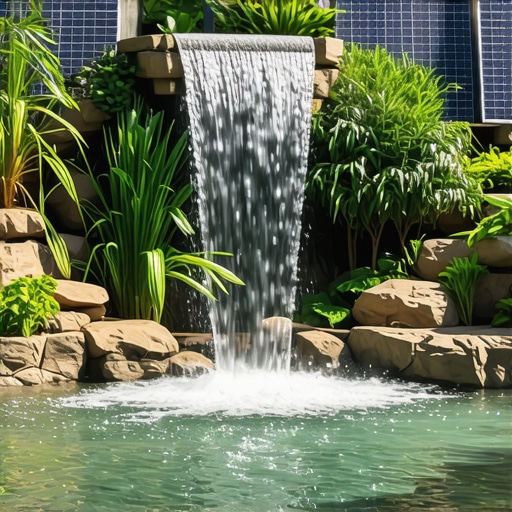
Build a $300 Solar Waterfall for a 2026 Pond
The Physics of Solar Hydrology in Modern Pond Design
A solar waterfall depends entirely on the photovoltaic conversion rate and the brushless motor efficiency of the pump to move water against gravity. To stay under a $300 budget in 2026, you must calculate the total dynamic head, which includes the vertical lift and friction loss in the tubing, to ensure the water actually crests the spillway rather than just trickling. Every inch of vertical rise requires specific pressure. If your pump is underpowered, the water fails to break the surface tension at the spillway lip. This results in a messy drip rather than a clean fall. I always drill into my new crew members: if you don’t fix the soil grading first, every plant you put in the ground is just expensive compost. This applies to water features too. If your pond shelf is not perfectly level, your liner will be exposed to UV degradation. If the base is not compacted, the weight of the rocks will shift. This ruins the hydraulic seal. You are not just stacking rocks. You are managing hydrostatic pressure and fluid dynamics. I have seen countless DIY jobs fail because the homeowner ignored the angle of repose for their stone stacks. It will fail. It will leak. Do not be that guy. Use a level.
“A retaining wall doesn’t fail because of the stone; it fails because of the water trapped behind it.” – Hardscape Engineering Axiom
How many watts do I need for a solar pond pump?
For a standard backyard waterfall with a 12 inch spillway, you need a solar array providing at least 50 to 60 watts to power an 800 GPH brushless DC pump. This ensures the gallons per hour flow remains constant even during periods of solar intermittency or slight cloud cover common in 2026 climates. Most people buy the $40 kits. They are junk. You need a dedicated N-type monocrystalline panel. These have a higher efficiency for the footprint. A 50 watt panel is the sweet spot for a $300 budget. It provides enough voltage to overcome the initial friction of the pump impeller. Below this, the pump may hum but not spin. This burns out the motor. Check the wattage before you buy. If the box does not list the Max Head Height, walk away.
Material Breakdown for a $300 Budget
| Component | Estimated Cost | Technical Specification |
|---|---|---|
| Solar Array | $85 | 50W Monocrystalline (N-Type) |
| Brushless DC Pump | $70 | 800 GPH / 10ft Max Head |
| 45 mil EPDM Liner | $50 | 5ft x 5ft / UV Resistant |
| PVC Flexible Tubing | $25 | 1 inch ID / Non-kink |
| Native Fieldstone | $70 | Basalt or Granite (Local) |
Calculating the Hydraulic Requirements for Spillway Flow
To calculate hydraulic requirements, you must determine the vertical head height from the pump surface to the highest point of the waterfall and add friction loss for every foot of tubing. For every 10 feet of 1 inch pipe, add 1 foot of effective head to ensure the GPH output meets your design goals. Most people forget the pipe friction. It is a rookie mistake. A pump rated for 5 feet of lift will barely move a cup of water if you use thin 1/2 inch tubing over a long distance. Use 1 inch Schedule 40 flexible PVC. It reduces friction and resists crushing. When you calculate your head, be honest. If the waterfall is 3 feet high, your total dynamic head is likely closer to 4.5 feet once you factor in the elbows and the filter box resistance. Precision matters here.
“The efficiency of a solar-powered hydraulic system is dictated by the peak sun hours and the resistance of the delivery conduit.” – Renewable Energy for Agriculture Manual
The Installation Checklist: Ground-Up Build
- Verify the pond base is level within 1/8 inch using a transit or laser level.
- Excavate a 6 inch deep plumbing trench to protect lines from frost heave.
- Compact the spillway foundation using a hand tamper until it is rock hard.
- Lay an 8 ounce non-woven geotextile underlayment to protect the EPDM.
- Position the solar panel at an angle equal to your latitude for maximum irradiance.
How much modified gravel do I need for a pond base?
For a stable pond and waterfall base, you need approximately 2 to 3 inches of modified gravel (2A or 2B) compacted thoroughly to prevent the 45 mil EPDM liner from puncturing under the weight of the rocks. Do not use sand. Sand washes away during a leak or heavy rain. Gravel locks together. It creates a stable structural sub-base. If your soil is heavy clay, you may need a deeper base to handle the freeze-thaw cycles. In 2026, we see more extreme weather. Build for the worst-case scenario. If the ground moves, your waterfall leaks. It is that simple. Spend the money on the gravel now or spend it on a new liner later. Your choice.
Managing the Biological Nitrogen Cycle
Every waterfall serves as a bio-filter by oxygenating the water and providing surface area for nitrifying bacteria to convert ammonia into nitrates. Use porous stones like lava rock or native vesicular basalt in the upper spillway to maximize this biological surface area. This prevents algae blooms. In a solar-only system, your pump stops at night. This is a problem for oxygen levels. You must ensure the pond has enough submerged aquatic vegetation to maintain O2 levels during the dark hours. Do not rely on the waterfall alone if you have fish. If you are just doing it for the sound, the solar cycle is fine. The bacteria will survive the night as long as the stones stay damp. Don’t let the spillway dry out completely in the sun.
Final Grading and Hydrostatic Pressure Relief
The area surrounding your waterfall must be graded to divert surface runoff away from the pond to prevent fertilizer and silt from contaminating the aquatic ecosystem. Use a 2 percent slope away from the water edge and consider a French drain if you are at the bottom of a hill. Water is lazy. It takes the path of least resistance. If that path is into your pond, your water will turn into pea soup. I have seen $10,000 ponds ruined by a 50 cent bag of lawn fertilizer that washed in during a storm. Fix the grade. Use tamped soil and cover with river rock to prevent erosion. This is the difference between a pro job and a hack job. Don’t skip the dirt work. It is the most important part of the build. Once the rocks are in place, you cannot go back and fix it easily. Get it right the first time.
![Why Your 2026 Pond Pump Keeps Clogging [Fix]](https://lawnmajesty.com/wp-content/uploads/2026/06/Why-Your-2026-Pond-Pump-Keeps-Clogging-Fix.jpeg)
![Build a $60 Solar Powered Bird Bath [2026 DIY]](https://lawnmajesty.com/wp-content/uploads/2026/06/Build-a-60-Solar-Powered-Bird-Bath-2026-DIY.jpeg)
![Stop 2026 Pond Leaks: 3 Sealing Tape Rules [Fix]](https://lawnmajesty.com/wp-content/uploads/2026/06/Stop-2026-Pond-Leaks-3-Sealing-Tape-Rules-Fix.jpeg)
![Build a $200 Solar Pond Fountain [2026 DIY Project]](https://lawnmajesty.com/wp-content/uploads/2026/05/Build-a-200-Solar-Pond-Fountain-2026-DIY-Project.jpeg)