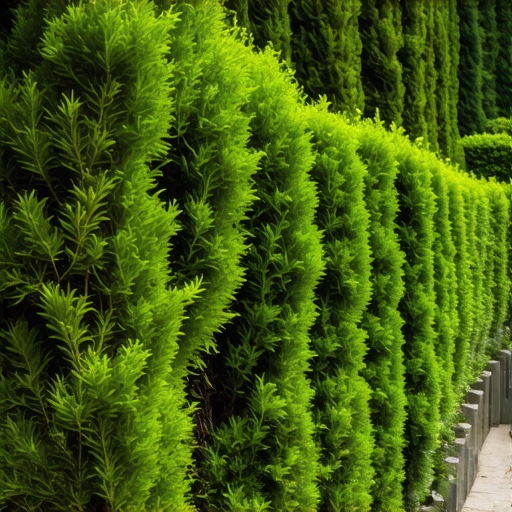
The Best Evergreens for a Narrow Living Fence
I always drill into my new crew members: if you don’t fix the soil grading first, every plant you put in the ground is just expensive compost. Most rookie contractors think they can just dig a hole, drop a Thuja occidentalis in it, and walk away with a check. They forget that a narrow living fence is a biological machine. If you don’t respect the root flare, or if you ignore the compaction levels of the subsoil, that $10,000 screen will be a row of brown skeletons in eighteen months. I have spent two decades digging up ‘dead’ hedges that were actually murdered by their installers. We don’t just plant trees; we engineer living barriers that must withstand hydrostatic pressure, wind shear, and the brutal reality of limited root zones. Success starts with the soil’s cation exchange capacity and ends with a precise irrigation schedule that accounts for ET rates. If you want a ‘vibe,’ call a decorator. If you want a functional, permanent living fence, listen to the biology.
What are the best evergreens for a narrow living fence?
The best evergreens for a narrow living fence are Thuja occidentalis ‘Smaragd’, Juniperus scopulorum ‘Skyrocket’, and Taxus x media ‘Hicksii’. These cultivars are selected for their genetic predisposition toward vertical growth and tight branch structures, allowing them to provide a dense visual barrier in footprints as narrow as three feet.
Site Preparation: The Engineering of the Root Zone
Proper site preparation for a narrow living fence requires a comprehensive soil analysis and mechanical de-compaction to ensure long-term health in confined spaces. You cannot skip the percolation test. If your site has heavy clay with a percolation rate of less than one inch per hour, your evergreens will drown in a bathtub of their own making. I see this constantly in new suburban developments where the topsoil was stripped and the remaining ‘soil’ is basically low-grade concrete. We use a penetrometer to measure PSI levels in the soil before we even unload the nursery stock. If the resistance is over 300 PSI, the roots won’t penetrate; they will just circle the hole until the plant chokes itself out.
“Planting a tree too deep is the leading cause of landscape tree mortality. The structural roots should be at or just below the soil surface.” – Penn State Extension
We advocate for a trenching method rather than individual holes for narrow fences. This creates a continuous ‘root highway’ of friable soil. We amend the backfill with no more than 20 percent organic matter to avoid the ‘container effect,’ where roots refuse to leave the pampered environment of the hole. We also focus heavily on the nitrogen cycle. High-nitrogen fertilizers are a trap for narrow evergreens; they force rapid, weak growth that sags under snow loads. We prefer slow-release 10-10-10 or 12-6-6 formulations that prioritize root density over vertical speed.
How much room do narrow evergreens really need?
Narrow evergreens typically require a minimum of 36 inches of horizontal width to maintain foliage density down to the ground level. While the canopy can be sheared, the root system needs a volume of at least twice the width of the mature crown to provide sufficient stability against wind-loading and nutrient uptake.
Selecting the Right Cultivars: A Technical Breakdown
Not all evergreens are created equal. You need to look at the growth habit: is it columnar, fastigiate, or pyramidal? For narrow applications, we almost always lean toward fastigiate varieties. These plants have branches that grow nearly parallel to the main trunk, which minimizes the need for aggressive pruning later. The ‘Emerald Green’ Arborvitae is the industry workhorse for a reason: it holds its color in winter and caps out at about 4 feet wide. However, it is a magnet for bagworms and spider mites if the airflow is poor. If you are in a high-salt environment or deal with heavy deer pressure, you might need to pivot to something like a ‘Taylor’ Juniper.
| Cultivar Name | Mature Width | Growth Rate | USDA Zone | Sun Requirement |
|---|---|---|---|---|
| Thuja ‘Smaragd’ | 3-4 Feet | 8-12″/Year | 2-7 | Full Sun/Part Shade |
| Juniperus ‘Skyrocket’ | 2-3 Feet | 12-18″/Year | 4-9 | Full Sun |
| Taxus ‘Hicksii’ | 3-4 Feet | 6-10″/Year | 4-7 | Shade/Full Sun |
| Cupressus ‘Blue Cone’ | 4-5 Feet | 10-15″/Year | 6-9 | Full Sun |
The Juniperus scopulorum ‘Skyrocket’ is the narrowest option on the market, but it has a fatal flaw: it hates wet feet. If your drainage is even slightly suspect, the roots will rot before the first season is over. On the other hand, the Taxus (Yew) is the most versatile for tight, shaded corridors. It can be sheared into a literal green wall, but every part of the plant is toxic, which is a liability if you have livestock or pets that chew on the landscape.
Does Emerald Green Arborvitae need a lot of water?
Emerald Green Arborvitae requires one inch of water per week delivered via deep, infrequent cycles to encourage downward root migration. In the first two years of establishment, the soil must remain consistently moist but never saturated, as anaerobic conditions will trigger Phytophthora root rot.
The Installation Process: Precision over Speed
When we move to the installation phase, the most common mistake is the ‘mulch volcano.’ I see it everywhere. People pile mulch six inches deep against the trunk. This creates a moist environment that invites fungal cankers and girdling roots. We follow a strict protocol. [image_placeholder] The hole must be twice as wide as the root ball but no deeper. In fact, we plant about one inch ‘high’ to account for settling. We use a hand-tamp to firm the soil in lifts, ensuring there are no air pockets. Air pockets kill roots instantly by drying them out.
“A retaining wall doesn’t fail because of the stone; it fails because of the water trapped behind it.” – Hardscape Engineering Axiom
While that quote refers to masonry, the logic applies to living fences near hardscaping. If you are planting a narrow hedge against a patio or a property line wall, you must account for the reflected heat and the lack of lateral water movement. We often install a perforated pipe or a French drain behind narrow screens if they are positioned at the base of a slope. You cannot expect a plant to thrive in a bog created by your neighbor’s runoff.
- Step 1: Flag utility lines (Call 811) and measure the center line.
- Step 2: Perform a perc test; dig a 12-inch hole, fill with water, and ensure it drains in under 12 hours.
- Step 3: Score the sides of the trench to prevent ‘glazing’ in clay soils.
- Step 4: Inspect nursery stock for circling roots; prune any that are woody and pointing inward.
- Step 5: Position the tree with the best side facing the primary viewpoint.
- Step 6: Backfill with native soil, tamping every 4 inches.
- Step 7: Apply 2 inches of aged arborist wood chips, keeping it 3 inches away from the trunk.
Maintenance: Protecting the Investment
Maintenance is not just about pruning. It is about monitoring the soil chemistry. Narrow evergreens in high-density plantings compete fiercely for resources. We recommend a soil test every two years. If your pH drifts above 7.5, your evergreens will struggle to uptake iron and manganese, leading to chlorosis. We also check for ‘winter burn.’ This happens when the ground is frozen but the sun and wind pull moisture out of the needles. Because the roots can’t pull up frozen water, the plant desiccates. We use anti-desiccant sprays in late fall for exposed sites. Don’t skip the late fall watering. The trees need to enter dormancy with full hydration.
How do you prune a narrow evergreen fence?
To prune a narrow evergreen fence, use sharp bypass shears to remove no more than 20 percent of the new growth in early spring. Always keep the base of the hedge wider than the top; this ‘taper’ ensures that sunlight reaches the bottom branches, preventing the dreaded ‘leggy’ look where the bottom of the fence goes bare.