
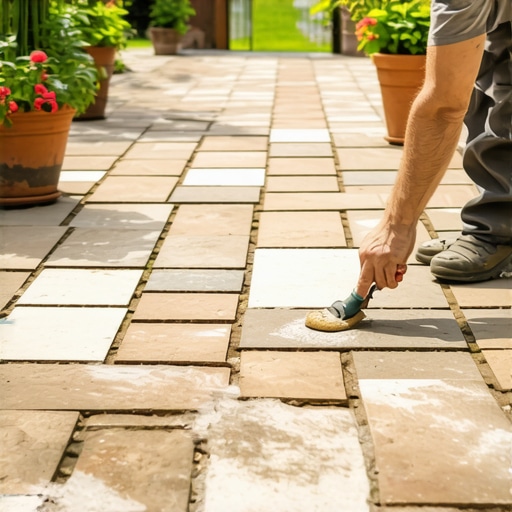
The Best Way to Seal a Flagstone Patio for Long-Term Beauty
To seal a flagstone patio effectively, you must utilize a breathable penetrating sealer that facilitates moisture vapor transmission while creating a hydrophobic barrier against external contaminants. High-end hardscaping demands an understanding of sedimentary rock porosity and the chemical bonding of silane-siloxane blends within the mineral matrix of the stone.
I recently got called out to tear up a $30,000 patio that was sinking because the previous contractor ignored the fundamental laws of drainage and sealing. They had used a cheap, big-box store acrylic film-former on a Pennsylvania Bluestone surface that was installed over a poorly compacted, wet base. Because the sealer was non-breathable, it trapped hydrostatic pressure rising from the soil. Within two winters, the stone was delaminating like wet cardboard, and the underlying base had turned into a slurry. It was a $30,000 autopsy of incompetence. If you do not respect the physics of water movement, your patio is just expensive compost. Don’t skip the engineering for the sake of a shiny finish.
“A retaining wall doesn’t fail because of the stone; it fails because of the water trapped behind it.” – Hardscape Engineering Axiom
The Microscopic Reality of Flagstone Porosity
Flagstone is a generic term for various sedimentary rocks, primarily sandstone, slate, or limestone. These stones are composed of layers of minerals bonded together over eons, resulting in a capillary network that naturally draws in moisture. This capillary action is how stains from tannins, grease, and fertilizers penetrate deep into the stone. To prevent this, we must alter the surface tension of the stone at a molecular level.
How do I choose the right sealer for my flagstone type?
Choosing a sealer depends on the absorption coefficient of the specific stone and your local climate’s freeze-thaw cycles. For dense stones like slate, a solvent-based penetrating sealer is required to achieve depth, whereas porous sandstones can benefit from water-based siloxane emulsions that provide a heavier solids load for better protection against salt-pitting and efflorescence.
| Stone Type | Porosity Level | Recommended Sealer Chemistry | Estimated Longevity |
|---|---|---|---|
| Pennsylvania Bluestone | Medium-Low | Solvent-Based Silane | 5-7 Years |
| Arizona Flagstone | High | Siloxane Water-Based | 3-5 Years |
| Quartzite Flagstone | Very Low | Fluorinated Impregnator | 8-10 Years |
| Limestone | High | Oleophobic Impregnator | 4-6 Years |
The Ground-Up Build: Preparation Engineering
Before a single drop of sealer touches the stone, the surface must be forensically clean and chemically neutral. We use a pH-balanced stone soap and avoid acidic cleaners like muriatic acid, which can dissolve the calcium carbonate in limestone or etch the surface of sandstone. If you use a pressure washer, keep it below 1,500 PSI. High-pressure jets will destroy the stone’s natural patina and force water deep into the fissures where it can’t easily evaporate. It will rot if you are not careful.
After cleaning, the stone must dry. Not just “look dry.” We use moisture meters to confirm the internal moisture content is below 5%. This usually requires 48 to 72 hours of clear weather. If you seal damp stone, the moisture will react with the sealer to create blushing—a permanent white cloudiness trapped under the surface. This is a common failure point for DIY hacks.
“Joint sand stabilization and stone sealing are critical components of a pavement system’s longevity, preventing both weed growth and substrate erosion.” – ICPI Tech Manual
How long does flagstone sealer take to dry?
Flagstone sealers typically reach a tack-free state within 2 to 4 hours, but full chemical curing takes 24 to 72 hours. During this window, any moisture—including dew or irrigation—can ruin the bond. You must disable all sprinkler heads and keep foot traffic off the surface to ensure the molecular cross-linking of the sealer is not disturbed.
The Application Process: Saturation and Back-Rolling
We utilize a wet-on-wet application technique. We apply the first coat using a low-pressure, solvent-resistant sprayer with a fan tip. Before that coat fully dries, we apply a second. This ensures the stone is saturated to its maximum holding capacity. We then use a 3/8-inch nap roller to “back-roll” the surface, picking up any puddles in the natural depressions of the flagstone. Puddles lead to sticky spots and uneven gloss levels.
- Inspect all joints for polymeric sand integrity before sealing.
- Test the sealer in an inconspicuous 1×1 foot area to verify color enhancement.
- Monitor the ambient temperature; sealing in 90-degree heat causes flash-drying.
- Use a micronized polymer additive if applying a film-former to prevent slip hazards.
- Maintain a wet edge during application to avoid lap marks.
Does sealing flagstone make it slippery?
Sealing with a penetrating impregnator does not change the Coefficient of Friction (COF) of the stone, meaning it won’t be slippery. However, film-forming “wet-look” sealers create a plastic-like layer that can be dangerously slick when wet. For high-traffic pool decks or steps, always stick to natural-look penetrating sealers or use an anti-skid grit additive in the topcoat.
The Interaction of Soil Biology and Hardscape Chemistry
A patio is a living system. If your lawn care regimen involves heavy nitrogen fertilizers, those salts can leach onto the patio and cause sub-florescence—where salt crystals grow beneath the sealer and pop the stone’s surface. Your garden design should include proper swales or French drains to direct water away from the patio edges. We recommend a 12-inch stone buffer between the lawn and the patio to prevent soil microbes and organic tannins from attacking the sealer’s bond. Landscaping isn’t just about plants; it is about managing the hydrostatic relationship between the soil and the structure. Neglecting the soil pH near your patio can lead to premature sealer failure as alkaline runoff breaks down the chemical bonds of the protective coating.
How often should I reseal my flagstone patio?
In high-traffic areas or regions with heavy snowfall, you should perform a bead test every two years. If water stops beading and begins to soak into the stone, it is time for a maintenance coat. Typically, high-quality siloxane-based sealers will last 5 years, while premium fluorinated sealers can protect for nearly a decade. Do not over-seal. Applying too many layers of film-forming sealer will cause plasticization and peeling. More is not better; better is better.
![Build a $400 Flagstone Walkway in One Weekend [DIY]](https://lawnmajesty.com/wp-content/uploads/2026/06/Build-a-400-Flagstone-Walkway-in-One-Weekend-DIY.jpeg)
![Fix Sinking Pavers with This $40 Poly-Sand Trick [2026 DIY]](https://lawnmajesty.com/wp-content/uploads/2026/05/Fix-Sinking-Pavers-with-This-40-Poly-Sand-Trick-2026-DIY.jpeg)