Kill 2026 Backyard Thistles Without Using Poison
I always drill into my new crew members: if you don’t fix the soil grading and chemistry first, every plant you put in the ground is just expensive compost. I have seen guys spend thousands on high-end nursery stock only to watch it get choked out by Cirsium arvense (Canada Thistle) because they didn’t understand the biological machine they were fighting. Thistles are not just weeds; they are structural indicators of soil failure. If you have a thistle problem in your 2026 backyard, you don’t have a ‘weed problem,’ you have a compaction and nutrient imbalance problem that no amount of superficial spraying will fix. My firm hasn’t touched glyphosate in five years for residential lawns, and we achieve higher kill rates through engineering and biology than any ‘mow-and-blow’ hack with a backpack sprayer. [image placeholder]
Identifying the Thistle Siege: More Than Just Prickles
To kill 2026 backyard thistles without poison, you must focus on starving the root system through repeated mechanical exhaustion, soil pH correction, and physical light deprivation. Understanding that thistles are biological indicators of compacted, nutrient-deficient soil is the first step toward permanent eradication without using industrial-grade glyphosates. Thistles operate via a massive subterranean network. A single plant can send a taproot down 15 feet. Severing the top is like cutting the head off a hydra; if you don’t handle the root biology, you are just pruning it.
The Forensic Autopsy: Why Your Thistles Are Winning
Thistles thrive where your grass is weak. When a lawn is scalped too short (under 3 inches) or the soil is so compacted that it has the PSI of a concrete sidewalk, turf grass roots cannot penetrate. Thistles, however, have a specialized taproot designed to punch through heavy clay and low-oxygen environments. They are the pioneers of the plant world. They show up to ‘fix’ compacted soil by driving holes into it.
“Mechanical control of Canada thistle requires persistent removal of top growth to deplete the plant’s energy reserves in the root system. One-time cutting is rarely effective due to the massive carbohydrate storage in lateral roots.” – Penn State Extension
This biological reality means your removal strategy must be more persistent than the plant’s storage capacity. If you allow the plant to reach 6 inches in height, it begins photosynthesizing enough energy to recharge the root. You must intervene when the plant is in its ‘rosette’ stage.
How deep do thistle roots go in compacted soil?
In standard residential grade soil, a primary thistle taproot typically reaches 2 to 6 feet, but in search of the water table, they have been documented at depths exceeding 15 feet. This is why ‘pulling’ them by hand usually fails. You leave behind 90% of the biomass, which then fragments into dozens of new clones.
Can you kill thistles with boiling water?
Boiling water can effectively denature the proteins in the crown of a thistle, but it rarely penetrates deep enough to kill the entire root system. It is best used for thistles emerging from hardscape joints where you can pour large volumes directly into the crack to cook the upper 4 inches of the root.
The Non-Toxic Eradication Protocol
To truly win, you need to use the Forensic Autopsy blueprint. We start at the bottom.
Step 1: The Mechanical Depletion Phase
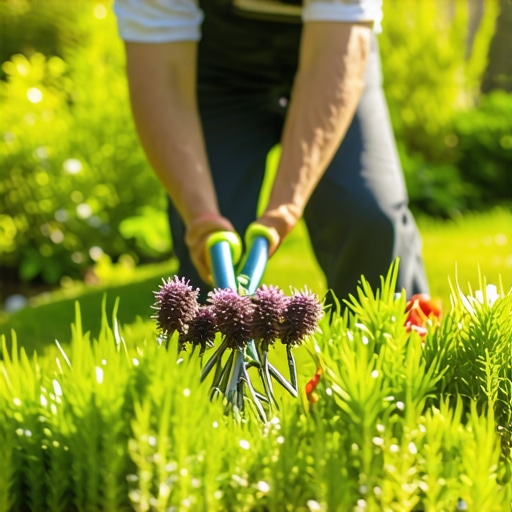
Forget pulling. Use a sharpened ‘Cape Cod’ weeder or a narrow-tined fork. The goal is to sever the taproot as deep as possible without tilling the soil. Tilling is the enemy. One root fragment the size of a fingernail will grow a new plant. You must use a ‘cut and starve’ method. Every 14 days, you must walk the property and excise the green growth. This forces the plant to use its stored sugars to rebuild. Eventually, the root ‘goes dark’ and rots.
Step 2: Soil pH and Nutrient Adjustment
Thistles love a high pH (alkaline) and low phosphorus. Most ‘hacks’ keep adding nitrogen, which just makes the thistle grow faster. I tell my clients to test their soil. If the pH is above 7.2, we add elemental sulfur to bring it down to 6.5. This makes the environment hostile to the thistle while allowing fescue or bluegrass to dominate the rhizosphere.
Step 3: Solarization and Smothering
For heavy infestations, we use 6-mil UV-stabilized black polyethylene. This isn’t just ‘covering’ the weeds. It is a thermodynamic process. Under the summer sun, the temperature between the plastic and the soil reaches 140 degrees Fahrenheit. This literally cooks the adventitious buds on the root crowns. Leave it for 6 weeks. It will kill everything, including the thistle.
Hardscaping and Design as a Defense
In high-end garden design, we use hardscaping principles to prevent re-infestation. If thistles are growing in your patio, your polymeric sand has failed. We use a high-density, cementitious-based sand that cures to a 3,000 PSI strength. This creates a physical barrier that no thistle can penetrate.
“A retaining wall or patio doesn’t fail because of the stone; it fails because of the water trapped behind it, creating the perfect anaerobic environment for invasive taproots.” – Hardscape Engineering Axiom
Comparison of Non-Toxic Control Methods
| Method | Root Depth Efficacy | Labor Intensity | Primary Weakness |
|---|---|---|---|
| Manual Excision | Top 6-12 inches | Extreme | Root fragmentation risk |
| Solarization | Top 4 inches (Heat) | Low | Kills beneficial microbes |
| Acetic Acid (20%) | Surface Only | Medium | Does not kill taproot |
| Soil Modification | Systemic | Medium | Takes 1-2 seasons |
The Professional Maintenance Checklist
- Set mower deck to 4 inches to shade out thistle rosettes.
- Core aerate every fall to reduce the compaction thistles love.
- Apply 1 inch of water per week in a single session to encourage deep turf roots.
- Overseed with ‘Aggressive’ cultivars of turf-type tall fescue.
- Hand-excavate any thistle that reaches the 3-leaf stage immediately.
Conclusion of Strategy
Eradication is a war of attrition. You are fighting a plant that has been engineered by evolution to survive. By using biological stressors instead of chemical shortcuts, you build a backyard ecosystem that is naturally resistant to invasion. Don’t skip the soil test. It is the most important tool in your shed.
![Stop 2026 Leaf Rust on Hydrangea Shrubs [Fix]](https://lawnmajesty.com/wp-content/uploads/2026/07/Stop-2026-Leaf-Rust-on-Hydrangea-Shrubs-Fix.jpeg)

![Build a $60 Backyard Composter [2026 DIY]](https://lawnmajesty.com/wp-content/uploads/2026/07/Build-a-60-Backyard-Composter-2026-DIY.jpeg)