The Secret to a Lush Green Lawn Without Chemical Fertilizers
The Chemical Autopsy: Why Your Lawn is Addicted to the Bag
To achieve a deep green lawn without chemicals, you must build soil organic matter (SOM) through core aeration, top-dressing with high-quality compost, and fostering beneficial soil microbes. This approach focuses on nutrient cycling and cation exchange capacity (CEC) rather than direct feeding, ensuring a self-sustaining ecosystem that resists pests and drought naturally.
A homeowner called me in a panic last August after they completely torched their front lawn by applying a triple-dose of 10-10-10 synthetic fertilizer during a heatwave. The grass wasn’t just yellow; it was literally crispy, desiccated by the high salt index of the chemical salts. When I pulled a soil core, it looked like gray, lifeless ash. There wasn’t a single earthworm in sight. This is the ‘Chemical Nightmare’—a cycle where you destroy the soil biology to get a quick green-up, which then requires more chemicals to keep the grass alive because the soil can no longer function on its own. The lawn was effectively on life support, and the plug had been pulled. We had to start from the dirt up.
“Synthetic nitrogen fertilizers can lead to a decrease in soil organic matter and a reduction in the diversity of the soil microbial community, which are essential for long-term turf health.” – Penn State Center for Turfgrass Science
The Microscopic Reality of Soil Compaction
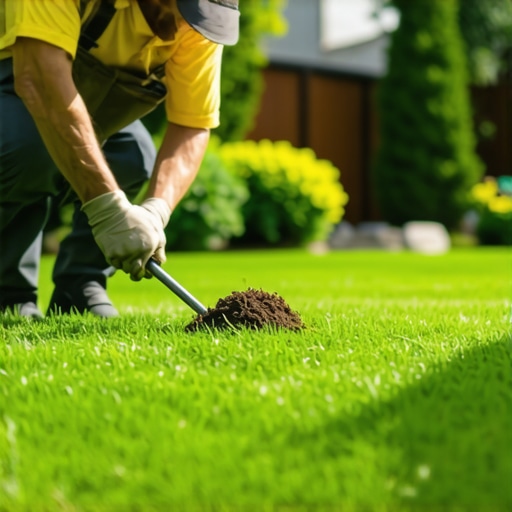
Soil is not just dirt; it is a living, breathing biological filter. Most residential lawns suffer from extreme compaction, which is the primary enemy of organic lawn care. When the bulk density of the soil rises above 1.5 g/cm³, root elongation stops. Oxygen cannot penetrate the surface. Carbon dioxide cannot escape. In this anaerobic environment, beneficial fungi die, and pathogenic bacteria thrive. You see this as ‘dead spots’ or thinning turf. I tell my crew: if you don’t fix the breathing, the feeding doesn’t matter. You need a hollow-tine aerator that pulls a 3-inch plug. If the machine isn’t pulling a plug that looks like a cigar, you’re just punching holes and compacting the sides further. Use a machine that hits at least 40 holes per square foot. It is labor-intensive. It is necessary.
How do I fix a lawn burned by fertilizer?
Fixing a chemical burn requires immediate heavy irrigation to leach salts past the root zone, followed by an application of liquid humic acid and kelp meal. These organic compounds help stabilize the soil chemistry and provide a carbon source for surviving microbes. Avoid adding more nitrogen for at least 45 days. Instead, focus on soil remediation. You are essentially flushing a system that has been poisoned. It takes time. Don’t rush it.
| Metric | Synthetic Lawn Care | Organic Soil Management |
|---|---|---|
| Primary Nutrient Source | Water-soluble urea/salts | Decomposing organic matter |
| Soil Biology | Suppressed by high salt index | Enhanced by carbon inputs |
| Water Retention | Low (fast runoff) | High (due to humus content) |
| Root Depth | Shallow (2-3 inches) | Deep (6-10 inches) |
| Thatch Accumulation | Rapid (requires dethatching) | Controlled by microbial breakdown |
Engineering the Nitrogen Cycle via Trifolium Repens
The obsession with a monoculture of Kentucky Bluegrass is a 1950s relic that makes organic care difficult. If you want a green lawn without buying nitrogen, you need White Clover (Trifolium repens). Clover is a legume. It has a symbiotic relationship with Rhizobium bacteria that live in nodules on its roots. These bacteria take atmospheric nitrogen—which makes up 78% of the air—and ‘fix’ it into a form the grass can use. A lawn with 5-10% clover coverage can provide up to 2 pounds of nitrogen per 1,000 square feet annually. That is free fertilizer. It stays green in droughts. It feeds the bees. Stop killing it.
“A retaining wall doesn’t fail because of the stone; it fails because of the water trapped behind it, and a lawn fails because the soil structure cannot hold the life that supports it.” – Hardscape Engineering Axiom
The Anatomy of Organic Top-Dressing
Top-dressing is the act of spreading 1/4 inch of finished compost over the entire lawn surface. This isn’t the wood-chip heavy ‘mulch’ you find at big-box stores. This is screened, thermophilic compost. It introduces billions of beneficial microbes—including Mycorrhizae and Trichoderma—that hunt down lawn pathogens. This material must be ‘watered in’ or raked into the aeration holes. This increases the soil’s Cation Exchange Capacity (CEC), which is the soil’s ability to hold onto nutrients like potassium and magnesium. Without a high CEC, your nutrients just wash into the storm drain. You are wasting money.
How long does it take to switch to organic lawn care?
A full transition from a chemical-dependent lawn to a self-sustaining organic system typically takes three growing seasons. In the first year, you focus on mechanical aeration and pH adjustment. By the second year, the microbial population rebounds, and by the third year, the thatch layer is being processed naturally, significantly reducing the need for external inputs. Be patient. Nature doesn’t work on a quarterly earnings schedule.
- Step 1: Perform a soil test to check pH. Aim for 6.5.
- Step 2: Core aerate in the fall when the grass is actively growing.
- Step 3: Overseed with a mix of Turf-Type Tall Fescue and Clover.
- Step 4: Top-dress with 1/4 inch of screened compost.
- Step 5: Set mower height to 4 inches. Tall grass shades the soil.
- Step 6: Water deeply but infrequently. 1 inch per week, all at once.
Mowing Physics: The 1/3rd Rule is Law
If you scalp your lawn, you are killing the engine. Grass blades are the solar panels of the plant. When you cut off more than 1/3 of the blade length, the plant goes into shock and stops root production to focus on foliage regrowth. This makes the lawn susceptible to grubs and heat stress. I see guys out there with dull blades ripping the grass. A dull blade leaves a jagged edge that loses moisture and invites fungi. Sharpen your blades every 10 hours of mowing. No excuses. Keep it tall. Four inches is the gold standard for organic turf. It crowds out crabgrass. It keeps the soil cool. It works. Don’t skip this. Your lawn is a biological system, not a carpet. Treat the soil like an investment account, and the grass will pay the dividends.
![Fix 2026 Grass Burn from Pet Waste [3-Step Fix]](https://lawnmajesty.com/wp-content/uploads/2026/05/Fix-2026-Grass-Burn-from-Pet-Waste-3-Step-Fix.jpeg)