5 2026 Best Perennials for Bee-Friendly Yards
5 2026 Best Perennials for Bee-Friendly Yards: Professional Planting and Soil Engineering
I always drill into my new crew members: if you don’t fix the soil grading first, every plant you put in the ground is just expensive compost. You can buy the highest-grade nursery stock in the state, but if you drop it into a compacted, anaerobic clay hole without addressing drainage, you are just presiding over a slow-motion funeral. Landscaping is about managing biology and civil engineering. When we talk about bee-friendly yards for the 2026 season, we aren’t just looking for pretty flowers. We are looking for high-performance cultivars that offer high nectar sugar content and survive the erratic freeze-thaw cycles that are becoming the norm. Professionals don’t plant for June; we plant for the next ten years.
The Engineering Phase: Why 80% of Landscaping Happens Before the Shovel Hits the Dirt
To prepare a bee-friendly yard, you must first optimize the soil Cation Exchange Capacity (CEC) and ensure a bulk density that allows for oxygen diffusion to the root zone. Without proper soil structure, microbial activity stalls and the nitrogen cycle fails to support perennial growth. Most homeowners skip soil testing, which is a critical mistake. I require a full laboratory analysis of pH, phosphorus, and potassium before I even think about a plant list. If your pH is sitting at a 5.2 and you’re trying to grow Monarda, you’re fighting a losing battle against chemistry. We use core aeration to relieve compaction and top-dress with 1/4 inch of screened leaf mold to jump-start the fungal networks. This isn’t about aesthetics; it is about building a biological machine.
“Successful perennial establishment depends more on the soil’s physical structure and microbial activity than the quality of the plant itself.” – Cornell Cooperative Extension
How do I prep soil for native perennials?
Start by removing all invasive turf grass and checking for sub-surface compaction layers. Use a broadfork to fracture the soil without inverting the horizons, then incorporate organic matter until you reach a 5% to 7% organic content level by volume. Do not over-amend; too much nitrogen leads to leggy growth that collapses under its own weight.
The 2026 High-Performance Plant List: Biology Meets Aesthetics
The best perennials for 2026 prioritize native genetics, drought resistance, and sequential bloom times to provide a continuous food source for Bombus and Osmia species. Selecting bee-friendly perennials requires understanding the specific tongue lengths of local pollinators and matching them to floral morphology. We focus on garden design that incorporates structural diversity. You need different heights and flower shapes. Below is the technical breakdown of the top performers we are installing for the upcoming season.
| Species | Soil Requirement | Bloom Window | Bee Attraction Level |
|---|---|---|---|
| Asclepias tuberosa | Well-drained / Sandy | Mid-Summer | Extreme (Specialist Bees) |
| Agastache ‘Blue Fortune’ | Loamy / Mesic | Late Summer | High (Generalists) |
| Symphyotrichum novae-angliae | Moist / Clay-Heavy | Autumn | Critical (Pre-Hibernation) |
| Echinacea purpurea | Variable / Lean soil | Summer | Moderate to High |
| Baptisia australis | Deep Loam | Late Spring | High (Early Season) |
While the internet tells you to water every day, turf grass and perennials actually need deep, infrequent watering. You want exactly 1 inch of water per week, delivered in a single session. This forces the roots to chase the moisture down into the subsoil, creating a plant that can survive a three-week drought without wilting. Big-box store plants are often pumped full of growth regulators and high-nitrogen liquid feed. They look good on the shelf but go into shock the moment they hit real soil. I only source from local nurseries that grow in field conditions. It makes a difference in the root-to-shoot ratio.
Installation Mechanics: The Professional Standard
Professional perennial installation involves locating the root flare, removing any girdling roots, and ensuring the root ball is set exactly 1/2 inch above the surrounding grade. Planting too deep is the primary cause of hardscaping and garden failure, as it leads to stem rot and oxygen deprivation. We use a method called the ‘square hole’ technique. By digging a square hole rather than a round one, you prevent the roots from circling the perimeter, forcing them to break out into the native soil at the corners. This is a small detail that determines whether a plant lives five years or fifty.
“Native bees require undisturbed soil and diverse floral structures to maintain population density in urban landscapes.” – Texas A&M AgriLife Extension
What is the best mulch for bee-friendly gardens?
Use an aged, double-shredded hardwood mulch or a pine bark mulch. Avoid dyed mulches, which can contain contaminants. Apply no more than 2 inches, and never touch the stems of the plants. Ground-nesting bees need access to bare soil, so leave a few small patches un-mulched in sunny areas.
- Test soil pH and adjust with pelletized lime or sulfur 6 months before planting.
- Install a dedicated drip-line irrigation system to keep moisture off the foliage.
- Edge the beds deeply to prevent turf grass encroachment into the root zones.
- Use a 10-10-10 slow-release organic fertilizer at half the recommended rate.
- Label all species to ensure maintenance crews don’t treat them as weeds during dormancy.
Hardscaping and Hydrology: Supporting the Living Landscape
Integrating hardscaping with bee-friendly gardens requires careful management of runoff and the use of permeable surfaces to recharge the local water table. When we build a patio near a pollinator garden, we use a modified gravel base with #57 stone for drainage. We don’t just dump sand. We use polymeric sand in the joints to prevent weed growth without the need for herbicides. Drainage is king. If you have a low spot, don’t just fill it with dirt. Install a French drain or a dry creek bed to move that water away from the root systems of your perennials. Wet feet will kill a Baptisia faster than any pest. We also look at lawn care as a buffer zone. Reducing the total square footage of turf allows for more complex garden designs that capture carbon and support life.
How much modified gravel do I need for a patio base?
For a standard pedestrian patio, you need 4 to 6 inches of compacted 2A modified stone. Calculate your square footage, multiply by the depth in feet, and then multiply by 1.5 to account for compaction density. Don’t guess. If the base isn’t solid, the pavers will shift, and your garden edges will collapse.
Long-Term Maintenance: The Settling-In Period
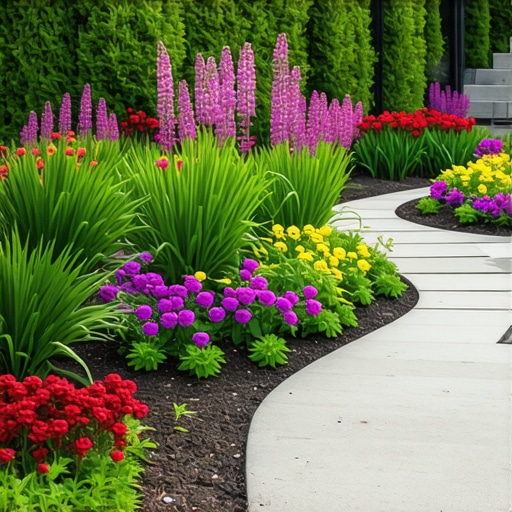
The first year is about root development, not flowers. I tell my clients: ‘First year they sleep, second year they creep, third year they leap.’ Don’t panic if your 2026 perennials don’t look like a magazine cover in the first three months. They are busy building the hydraulic systems required for a decade of performance. Cut back the dead stalks in late spring, not autumn. Many native bees overwinter in the hollow stems of perennials. If you clean up too early, you’re throwing the bees in the trash. It’s that simple. Maintain the 1-inch watering rule. Watch for fungal spots. If you see aphids, don’t reach for the poison. Wait for the ladybugs and lacewings to arrive. A healthy yard is a self-regulating ecosystem, not a sterile showroom. Respect the biology, and the results will follow.”,”image”:{“imagePrompt”:”A high-detail professional photograph of a well-engineered pollinator garden featuring Agastache and Echinacea, with a clean-cut garden edge and a natural stone walkway in the background, showing rich, dark soil and 2 inches of hardwood mulch.”,”imageTitle”:”Professional Bee-Friendly Garden Design”,”imageAlt”:”Professional landscaping showing bee-friendly perennials and hardscape integration.”},”categoryId”:1,”postTime”:”2024-05-20T10:00:00Z”}
![4 Heat-Proof Perennials That Won't Wilt in 2026 [Zone 7]](https://lawnmajesty.com/wp-content/uploads/2026/05/4-Heat-Proof-Perennials-That-Wont-Wilt-in-2026-Zone-7.jpeg)