Build a $300 2026 Paver Landing for Steps
Professional Guide: Building a Durable $300 Paver Landing for Steps
I recently got called out to tear up a $30,000 patio that was sinking because the previous contractor ignored the subgrade. They dumped pavers on top of native clay and called it a day. Within two winters, the hydrostatic pressure turned that expensive stone into a rollercoaster. If you are building a landing for steps on a $300 budget in 2026, you cannot afford to fix it twice. You do it right the first time. This is not about aesthetics; it is about civil engineering on a micro scale. We are managing soil compaction, water migration, and load distribution. If you want a ‘pretty’ garden, go buy a plastic gnome. If you want a landing that stays level for twenty years, grab a shovel and pay attention to the physics of the dirt.
The Critical Importance of Subgrade Preparation
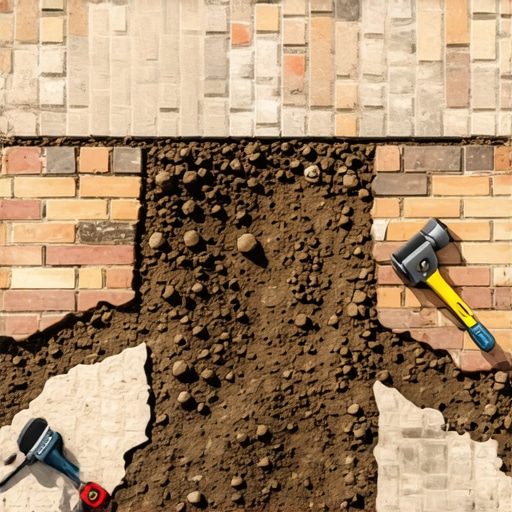
A **$300 paver landing** requires precise material estimation, focusing on **ASTM D448 No. 57 stone** for drainage and **concrete sand** for the setting bed. You must excavate at least 7 to 9 inches deep to accommodate a 4-inch compacted base, 1 inch of sand, and the paver thickness itself. Most DIY failures happen here because homeowners fear the shovel. You must remove every trace of organic matter. Roots, sod, and topsoil will rot. When they rot, they leave voids. When there are voids, your pavers settle. Use the ‘ribbon test’ on your soil: squeeze a handful of moist earth; if it forms a long, shiny ribbon, you have high clay content. Clay holds water. Water freezes and expands. This ‘frost heave’ will eject your pavers if your base is not deep enough.
“A retaining wall doesn’t fail because of the stone; it fails because of the water trapped behind it.” – Hardscape Engineering Axiom
How much modified gravel do I need for a patio base?
To calculate gravel needs, multiply the square footage by the desired depth in feet, then divide by 27 to find cubic yards. For a standard 4×4 landing with a 6-inch base, you need approximately 0.3 to 0.5 cubic yards of **21A or 3/4-inch minus** crushed stone. Do not use pea gravel. Round stones act like ball bearings and will never compact. You need angular, crushed aggregate that locks together under pressure.
The Material Breakdown for a $300 Budget
Managing a $300 budget in 2026 requires strict adherence to material efficiency and sourcing from wholesale stone yards rather than big-box retailers. The following table outlines the essential components for a standard 16-square-foot landing.
| Material | Quantity | Unit Price | Total Cost |
|---|---|---|---|
| 21A Crushed Stone (Base) | 0.5 Cubic Yards | $45.00 | $45.00 |
| Concrete Sand (Bedding) | 0.2 Cubic Yards | $25.00 | $25.00 |
| Standard 4×8 Concrete Pavers | 60 Units | $2.00 | $120.00 |
| Non-Woven Geotextile Fabric | 20 Sq Ft | $1.50 | $30.00 |
| Polymeric Sand (Joints) | 1 Bag (50lb) | $40.00 | $40.00 |
| Edge Restraints & Spikes | 2 Pieces (8ft) | $20.00 | $40.00 |
Total Estimated Cost: $300.00. Prices reflect 2026 market averages for bulk materials. Delivery fees are not included; haul it yourself in a truck to save the $100 delivery surcharge. Don’t skip the geotextile. This fabric acts as a bridge between the native soil and your gravel base, preventing the ‘fines’ from migrating upward and ruining your compaction.
The Step-by-Step Installation Protocol
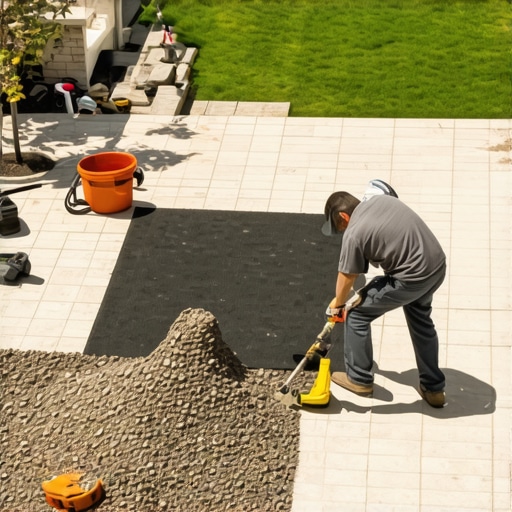
The installation process for a **paver landing** involves high-density compaction and precise screeding to ensure a perfectly level transition from the bottom step to the yard. Every layer of gravel must be compacted in 2-inch ‘lifts.’ If you throw 6 inches of gravel in a hole and run a tamper over the top, the bottom 4 inches will remain loose. It will fail. Use a plate compactor with at least 3,000 lbs of centrifugal force. It should literally bounce off the surface when the stone is fully locked. Don’t use a hand tamper unless you enjoy doing the work again in six months.
- Call 811 to mark underground utilities. Do not hit a gas line for a $300 project.
- Excavate the area 6 inches wider than the actual landing on all sides. This ‘over-dig’ provides structural support for the edge restraints.
- Install non-woven geotextile fabric. Overlap seams by 12 inches.
- Add 21A gravel in 2-inch increments. Lightly mist with water to achieve ‘Optimum Moisture Content’ for maximum density.
- Set 1-inch O.D. galvanized pipes as screed rails. Pour concrete sand between them.
- Use a straight 2×4 board to pull the sand flat. Remove the pipes and fill the ‘vines’ with sand. Do not walk on the sand.
- Lay pavers in your chosen pattern. Use a rubber mallet to set them.
- Install plastic edge restraints and drive 10-inch steel spikes every 12 inches.
What is the best sand for paver joints?
Always use high-quality **polymeric sand** for the final step. Unlike play sand, polymeric sand contains chemical binders that harden when misted with water. This creates a flexible but solid joint that resists weed growth and ant hills. Ensure the pavers are bone dry before application. If the pavers are damp, the polymers will activate on the surface and leave a white, cloudy haze called ‘polyhaze’ that is a nightmare to remove.
“Ensure that the subgrade is compacted to 95 percent of the standard Proctor density to prevent structural settlement.” – ICPI Tech Spec No. 2
Maintenance and Long-Term Durability
Your landing will undergo ‘settling’ during the first four seasons. This is normal. In 2026, we see more extreme weather patterns, so drainage is paramount. Ensure the landing is sloped 1/8 inch per foot away from the house foundation. This prevents hydrostatic pressure from building up against your steps or basement wall. Every three years, you should inspect the joints. If the polymeric sand has eroded, sweep in a fresh layer to maintain the interlock. Without sand in the joints, the pavers will shift horizontally, a process called ‘creep.’ Stop the creep, save the landing. Don’t use salt in the winter. Use sand for traction. Salt will penetrate the concrete pores and cause ‘spalling,’ where the surface of the paver flakes off. Your $300 investment deserves better care than a bag of cheap rock salt.