
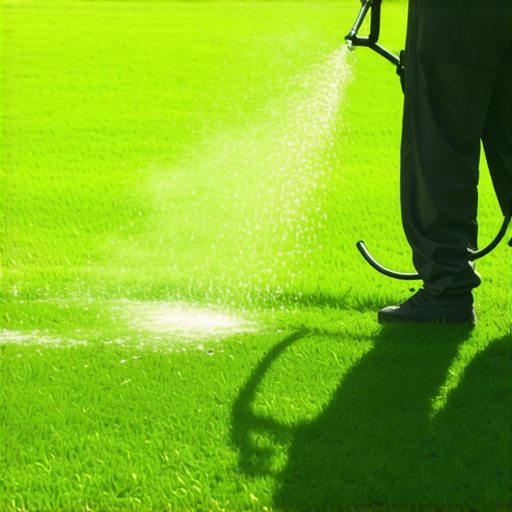
Stop 2026 Lawn Heat Stress with Deep Watering
Stop 2026 Lawn Heat Stress with Deep Watering: The Science of Hydraulic Lift and Soil Saturation
I have spent two decades looking at dead turf. Most of the time, the homeowner blames the sun. They are wrong. The sun is just the trigger; the actual cause of death is almost always a fundamental misunderstanding of soil physics and root architecture. When you see a lawn turning that brittle, straw-colored brown in mid-July, you aren’t looking at a weather victim. You are looking at a management failure. Most irrigation systems are programmed by people who should stay in the office, not out in the field. They set timers for 10 minutes every morning, which is the horticultural equivalent of giving a marathon runner a thimble of water every mile. It feels good for a second, but it never reaches the vitals.
The Irrigation Disaster: Why Your Smart Controller is Killing Your Grass
Lawn heat stress occurs when the rate of evapotranspiration exceeds the roots’ ability to pull moisture from the soil matrix. A homeowner called me in a panic last August after they completely torched their front lawn—a $12,000 sod installation of high-end Kentucky Bluegrass—by applying light, daily misting during a 98-degree heatwave. They thought they were keeping it cool. In reality, they were steaming the crown and keeping the roots trapped in the top two inches of the soil. When the real heat hit, those shallow roots fried instantly because they had no access to the cooler, moist subsoil horizons. I had to tell them the truth: their ‘smart’ controller was the dumbest tool on the property.
“Turfgrass irrigation should be based on the principle of replacing the moisture lost through evapotranspiration, focusing on deep, infrequent applications to promote a robust root system.” – Penn State Center for Turfgrass Science
Why Shallow Watering is the Enemy of 2026 Turf Resilience
Shallow watering forces turf grass roots to stay near the surface where soil temperatures fluctuate violently and moisture evaporates within hours. To survive the projected 2026 heat stress, you must train your lawn to hunt for water in the deeper soil profile, which requires deep saturation that reaches 6 to 8 inches below the surface. This creates a resilient ecosystem that can withstand days of high heat without wilting.
How much water does a lawn actually need in July?
In peak summer conditions, most cool-season grasses require 1 to 1.5 inches of water per week. This should not be delivered in daily increments; rather, it should be split into two deep sessions. This volume ensures that the capillary pores in the soil are filled, providing a reservoir that the roots can tap into via osmotic pressure as the surface dries out.
What is the best time of day to water to prevent fungus?
The optimal window for irrigation is between 4:00 AM and 8:00 AM. Watering at this time minimizes evaporative loss due to wind and sun while ensuring the leaf blade dries quickly as the sun rises. Watering at night is a death sentence; it leaves the turf canopy wet for 10+ hours, creating a breeding ground for Rhizoctonia solani (Brown Patch) and other fungal pathogens. Don’t do it.
The Physics of Soil Saturation: Understanding Your Intake Rate
Every yard has a different infiltration rate. If you have heavy clay soil, you can’t just dump an inch of water at once; it will just run off into the street, wasting money and starving the roots. You have to understand the percolation limits of your specific site. This is where engineering meets horticulture. We use a ‘cycle and soak’ method for clay: run the zone for 15 minutes, let it sit for an hour to move through the soil pores, and then run it again.
| Soil Type | Water Retention | Infiltration Rate | Watering Strategy |
|---|---|---|---|
| Heavy Clay | High | 0.1 – 0.2 inches/hour | Cycle & Soak (Multiple starts) | Sandy Loam | Low | 0.5 – 1.0 inches/hour | Deep, single session | Silt/Loam | Medium | 0.3 – 0.5 inches/hour | Deep, twice weekly |
The 1-Inch Standard and the Tuna Can Test
You cannot manage what you do not measure. Most homeowners have no idea what their irrigation output is in terms of inches per hour. They talk in minutes. Minutes are irrelevant. To accurately fight heat stress, you need to perform a catch-can test. Place empty tuna cans or professional rain gauges across your zones. Run your system for 20 minutes. Measure the depth. If you only have a quarter-inch, you need to run that zone for 80 minutes total to hit your one-inch weekly target. It is simple math, but nobody does it. They just guess. And guessing leads to dormancy or desiccation.
“A retaining wall doesn’t fail because of the stone; it fails because of the water trapped behind it, just as a lawn fails not from the heat, but from the lack of hydraulic depth in the soil.” – Hardscape Engineering Axiom
The 2026 Heat Stress Prevention Checklist
- Core Aeration: Perform this in the fall or spring to reduce soil compaction and allow water to bypass the thatch layer.
- Mower Height: Raise your blades to 4 inches. Taller grass shades the soil, reducing surface evaporation and keeping root zones cooler.
- Sharpen Blades: A dull blade tears the grass, increasing the surface area for moisture loss. A clean cut heals faster.
- Soil Testing: Check your pH levels. If your soil is too acidic or alkaline, the plant cannot efficiently take up water, regardless of how much you pour on it.
- Wetting Agents: For hydrophobic soils (common in hardscaping borders), use a professional-grade surfactant to break the surface tension of the water.
Hydrophobic Soil and the Hardscape Interface
If you have patios or walkways adjacent to your lawn, those areas are heat sinks. They radiate thermal energy back into the soil long after the sun goes down. This creates a localized micro-climate where the grass dries out twice as fast. When we design hardscaping, we always account for this by installing drip irrigation or high-efficiency rotators specifically for the margins. If you don’t account for the hydrostatic pressure and heat radiation of your pavers, your edges will always look like burnt toast. It is a structural reality, not an aesthetic choice. Deep watering is even more critical here to counteract the wicking effect of the stone base.
Stop treating your lawn like a houseplant. It is a biological engine. If you don’t provide the fuel—deep, cold, sub-surface moisture—it will seize up when the 2026 heat hits. Do the work now. Measure your output. Fix your soil. If you don’t, you’ll be calling someone like me to haul away your expensive compost next September.
![3 Fertilizer Rules to Stop 2026 Summer Lawn Burn [Tested]](https://lawnmajesty.com/wp-content/uploads/2026/05/3-Fertilizer-Rules-to-Stop-2026-Summer-Lawn-Burn-Tested.jpeg)
![Fix 2026 Grass Burn from Pet Waste [3-Step Fix]](https://lawnmajesty.com/wp-content/uploads/2026/05/Fix-2026-Grass-Burn-from-Pet-Waste-3-Step-Fix.jpeg)