5 2026 Best Shrubs for Compact Side Yard Spaces
I always drill into my new crew members: if you don’t fix the soil grading first, every plant you put in the ground is just expensive compost. I have seen too many homeowners waste thousands on high-end nursery stock only to watch it drown in a side-yard ‘bathtub’ because they didn’t understand soil porosity or hydrostatic pressure. Side yards are the most challenging environments in residential landscaping. They are often narrow wind tunnels with poor light penetration and soil that has been compacted into concrete by construction equipment. Before you even think about picking out a shrub, you have to understand the engineering of the space. We are looking for species that can handle the ‘squeeze’—both literally in terms of square footage and biologically in terms of reduced airflow and light.
The Engineering of Small-Space Landscaping
Designing for compact side yards requires prioritizing cultivars with terminal growth control, high shade tolerance, and non-aggressive root systems to prevent structural damage. The best 2026 selections like Taxus x media ‘Beanpole’ and NewGen Boxwoods prevent structural encroachment while maintaining biological health in narrow, low-airflow corridors. Most contractors fail here because they plant for the ‘now’ instead of the five-year mature spread. If a shrub’s genetic footprint exceeds 3 feet in width, it has no business in a 4-foot-wide side yard. You will end up ‘meatballing’ the plant with shears, which destroys its natural defense mechanisms and leads to pest infestations. We select for columnar or dwarf genetics that thrive without constant human interference.
“Planting in compacted side-yard soils without remediation is simply installing a slow-motion burial.” — Cornell Agricultural Extension
1. Taxus x media ‘Beanpole’ (Narrow Yew)
The Beanpole Yew is a workhorse for the 2026 season because it solves the ‘deep shade’ problem of narrow alleys. It maintains a strictly columnar form, rarely exceeding 2 feet in width, which allows for a walking path even in the tightest setbacks. Unlike other yews, its needle density remains high even in low-light conditions. You must ensure the soil isn’t soggy; Taxus will develop phytophthora root rot if the Cation Exchange Capacity (CEC) of the soil is skewed by standing water. Dig your hole twice as wide as the root ball and check your drainage before backfilling.
2. Ilex crenata ‘Sky Pointer’ (Japanese Holly)
This is the surgical tool of the hardscaping world. It looks like a formal boxwood but grows in a tight, vertical spear. It is ideal for 2026 designs because it handles the reflected heat from concrete foundations better than most soft-tissue shrubs. When we install ‘Sky Pointer’ near a foundation, we monitor the soil pH closely. These plants prefer a slightly acidic range (5.5 to 6.5). If your concrete foundation is leaching lime into the soil, your Holly will chlorose and die. Test your soil. Don’t guess.
3. Hydrangea paniculata ‘Little Lime Punch’
If you want color in a side yard without the sprawling mess of traditional hydrangeas, this is the 2026 standard. It stays under 3 feet and offers massive structural stability. Most hydrangeas flop over when they get wet; ‘Little Lime Punch’ was bred for thicker stem tissue to support its blooms. It requires a decent amount of light—at least 4 to 6 hours—so this is your ‘sunny side’ solution. Use a drip-line irrigation system; overhead watering in a narrow side yard is a recipe for powdery mildew due to the lack of air circulation.
“Root flare visibility is the single most important indicator of long-term woody plant survival.” — ISA Arboriculture Manual
4. Physocarpus opulifolius ‘Tiny Wine’ (Ninebark)
Ninebark is the ‘tough-as-nails’ option for areas with high wind or poor soil quality. ‘Tiny Wine’ is the dwarf version that brings a dark purple foliage to the mix. It is particularly resistant to the pests that plague other compact shrubs. Its root system is fibrous and non-invasive, making it safe for proximity to utility lines or French drains. I tell my crews that if a client can’t remember to water, we plant Ninebark. It is drought-tolerant once established, but don’t ignore it during the first 90 days. It needs deep, infrequent watering to force roots downward.
5. Buxus ‘NewGen Independence’ (Boxwood)
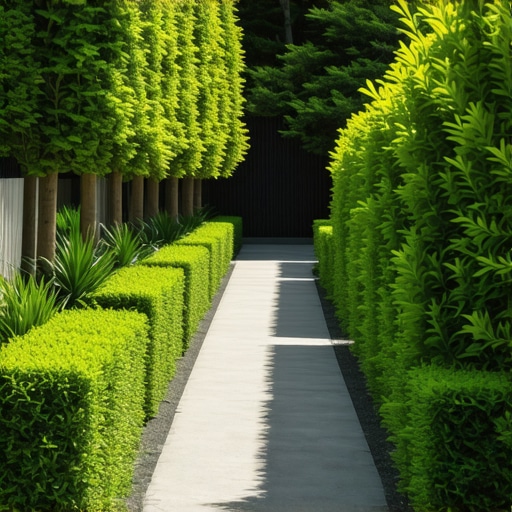
Traditional boxwoods are dead to me because of Boxwood Blight. ‘NewGen Independence’ is the 2026 answer to that fungus. It is bred specifically for high resistance and a fast growth rate compared to English boxwood. It maintains a rounded, compact shape that works perfectly for framing a stone path. When planting these, never bury the root flare. I see hacks burying boxwoods up to their first branches all the time. It will rot. Keep that flare exposed to the air.
Shrub Comparison and Technical Specs
| Shrub Variety | Mature Width | Light Requirement | Primary Benefit |
|---|---|---|---|
| Beanpole Yew | 1.5 – 2 Feet | Deep Shade to Sun | Extreme narrowness |
| Sky Pointer Holly | 2 Feet | Part Sun to Sun | Heat tolerance |
| Little Lime Punch | 3 Feet | Full Sun | Structural blooms |
| Tiny Wine Ninebark | 3 Feet | Full Sun to Part Sun | Disease resistance |
| NewGen Boxwood | 3 Feet | Part Shade to Sun | Blight resistance |
How much modified gravel do I need for a patio base?
Calculations for a side-yard patio base must account for 4 inches of 2A modified gravel compacted in 2-inch lifts. To find your tonnage, multiply your square footage by 0.33 (for 4-inch depth) and divide by 27 to get cubic yards, then multiply by 1.5 for tonnage. Do not skip compaction. Use a plate compactor until the machine literally bounces off the surface. If you don’t compact, your pavers will shift, and your drainage will fail, eventually drowning your new shrubs.
How do I prevent root damage to my foundation in a side yard?
To prevent root-related foundation issues, select shrubs with non-aggressive, fibrous root systems rather than taproots or invasive woody roots. Maintain a 12-inch air gap between the shrub’s mature drip line and the foundation wall. This prevents moisture from being trapped against the masonry and allows for visual inspection of both the root flare and the foundation’s parge coat.
Pre-Planting Side Yard Checklist
- Check for 811 utility markings before excavating any trench.
- Perform a percolation test: fill a 12-inch hole with water and ensure it drains within 4 hours.
- Amend heavy clay with 20% organic compost to improve Cation Exchange Capacity.
- Install a 1-inch mulch layer, but never let it touch the bark of the shrub.
- Set up a dedicated drip irrigation zone with pressure-compensating emitters.
Landscaping a side yard isn’t about decoration; it is about managing a micro-ecosystem. If you treat it like a ‘leftover’ space, it will look like one. Focus on the soil, choose the right genetics, and stop over-watering. Your yard isn’t a swamp; don’t turn it into one.