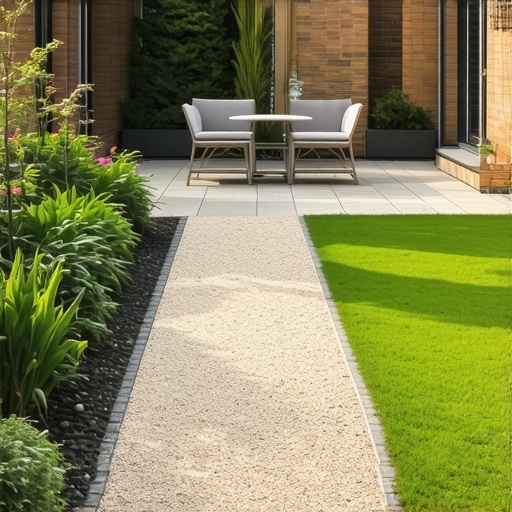
Build a $400 2026 Paver Walkway for Suburban Yards
Building a durable paver walkway on a $400 budget in 2026 requires prioritizing structural engineering over aesthetic flourishes. A high-quality installation relies on a compacted aggregate base, precise screeding of the bedding sand, and the use of polymeric jointing sand to create a monolithic surface that resists shifting and weed growth. Success is measured in inches of excavation and PSI of compaction, not just the color of the stones.
The Hardscape Autopsy: Why Cheap Installs Fail
I recently got called out to tear up a $30,000 patio that was sinking because the previous contractor ignored the basic physics of the sub-base. The homeowner was devastated, but the diagnosis was simple: they laid expensive pavers directly on top of native clay soil with only an inch of pea gravel for ‘drainage.’ Within two winters, the freeze-thaw cycles turned that expensive stone into a roller coaster. I see this every day in suburban yards where ‘mow-and-blow’ crews try their hand at hardscaping. They don’t understand that the soil is a living, moving entity. If you don’t excavate deep enough to reach stable subgrade and replace it with engineered lifts of crushed stone, you are essentially throwing your money into a hole in the ground. For a $400 project, you can’t afford a $10,000 mistake. You must do the grunt work. Dig deep. Compact harder. Do not skip the geotextile. It is the only thing separating your investment from the mud. It will rot if you don’t drain it. Don’t be that homeowner.
“A retaining wall doesn’t fail because of the stone; it fails because of the water trapped behind it.” – Hardscape Engineering Axiom
The $400 Budget Breakdown for 2026
Maximizing a $400 budget for a suburban walkway involves sourcing standard 4×8 concrete pavers and focusing expenditures on 21A or 57 crushed stone and polymeric sand. Professional-grade results are achieved by allocating 60% of the budget to sub-surface materials and 40% to the visible surface. Use this table to track your material costs:
| Material Item | Estimated Quantity (30 sq ft) | Estimated Cost (2026 USD) |
|---|---|---|
| Standard 4×8 Pavers | 150 Units | $160 |
| 21A Crushed Stone (Base) | 1.5 Tons | $75 |
| Coarse Bedding Sand | 0.5 Tons | $45 |
| Polymeric Sand | 1 Bag (50lb) | $50 |
| Paver Edging & Spikes | 20 Linear Feet | $40 |
| Tool Rental (Plate Compactor) | 4-Hour Rental | $30 |
How much modified gravel do I need for a patio base?
To calculate the required modified gravel, multiply the total square footage by the depth of the base (minimum 4 inches for walkways) and divide by 324 to find the cubic yardage needed. For most suburban soils, a 4-to-6-inch base of 21A (crushed run) provides the necessary structural integrity to support pedestrian loads without settling. Failure to calculate this correctly leads to structural voids. Use a string line. Check your math twice. Precision saves money.
Site Preparation and The Physics of Excavation
Excavation for a 2026 paver walkway must reach a depth of at least 7 to 8 inches to accommodate the base, sand, and stone thickness. This process removes the organic horizon of the soil, which contains decomposing matter that will eventually collapse and cause the walkway to dip.
“Base thickness is determined by the load-bearing capacity of the subgrade soil and the expected traffic; for pedestrian walkways, a 4-inch compacted base is the industry minimum.” – ICPI Tech Spec No. 2
In heavy clay regions, you must go deeper. Clay holds water. Water expands when it freezes. This creates hydrostatic pressure that heaves your pavers upward. To prevent this, over-excavate by 2 inches and backfill with extra crushed stone. It is a simple insurance policy. Use a flat-head shovel for the edges. Keep the bottom of the trench smooth. Don’t leave loose dirt at the bottom. Compact the raw earth before adding stone. This is where most DIYers fail. They assume the dirt is ‘hard enough.’ It never is. Use a hand tamper or a rented plate compactor. It should bounce off the ground when you are done. That is the sound of success.
The Critical Importance of the Screeding Process
Screeding is the technique of using 1-inch diameter pipes and a straight edge to create a perfectly level bed of coarse sand for the pavers to sit on. This layer must be exactly 1 inch thick; any thicker and the sand will eventually shift, causing ‘rutting’ in the walkway path. Place your screed pipes directly on the compacted stone base. Pour your bedding sand over them. Pull a 2×4 board across the pipes. This gives you a flat plane. Do not walk on this sand. If you step on it, you compress it unevenly. The pavers will follow that unevenness. It is a game of millimeters. Use a torpedo level to check the pitch. You need a 1/8-inch drop per foot away from your home’s foundation. Water is the enemy of the home. Never slope a walkway toward a wall. It will cause basement leaks. You have been warned.
What is the best sand for paver joints?
The best sand for paver joints in 2026 is a high-performance polymeric sand that contains specialized polymers which harden upon contact with water to create a flexible, weed-resistant bond. Unlike standard play sand, polymeric sand prevents ant hills and washout during heavy rain events, significantly reducing long-term maintenance. Ensure the pavers are bone dry before application. If the pavers are damp, the polymers will activate on the surface and leave white hazy stains. These are nearly impossible to remove. Sweep the sand into the joints. Use a leaf blower to remove excess dust. Then, mist it lightly. Don’t flood it. Just mist it. This triggers the chemical bond. It locks the system together.
The 2026 Hardscape Checklist
- Call 811 to mark underground utility lines before digging.
- Excavate to a minimum depth of 7 inches for a standard walkway.
- Install a non-woven geotextile fabric to separate soil from stone.
- Compact the 21A stone base in 2-inch ‘lifts’ to reach maximum density.
- Set a 1/8-inch per foot slope for proper drainage.
- Use professional-grade edge restraints to prevent lateral shifting.
- Apply polymeric sand only when a 24-hour dry window is forecasted.
The Long-Term Forecast: Maintenance and Settling
In the first year, your walkway will undergo a ‘settling-in’ period where the polymeric sand fully cures and the aggregate base reacts to the first full cycle of seasons. Check the joints every spring. If you see cracks in the sand, top it off. Do not use salt for ice removal; the chemicals can degrade the surface of concrete pavers over time. Use sand for traction instead. Landscaping is a marathon. You are building for 2036, not just 2026. Precision now means relaxation later. [image placeholder]