Stop 2026 Garden Mildew with Air Flow Pruning Technique DIY
Stop 2026 Garden Mildew with Air Flow Pruning Technique DIY
I always drill into my new crew members: if you dont fix the soil grading first, every plant you put in the ground is just expensive compost; the same applies to the canopy. I remember a job in late 2023 where a homeowner had spent four figures on high-end Monarda and Phlox, only to have them look like they had been dusted with flour by mid-July. They wanted a chemical fix. I told them the truth: their garden was a stagnant box. We didnt spray a single ounce of fungicide. We pruned for air. We cut out thirty percent of the interior mass, opened up the center, and by the next season, the mildew was a memory. Landscaping is not about making things look pretty for a photo; it is about managing the biological and physical forces that dictate life and death in the dirt.
The Physics of Fungal Infection in the 2026 Garden
Garden mildew thrives in high-humidity microclimates where stagnant air allows fungal spores to settle on leaf surfaces. To prevent 2026 outbreaks, gardeners must implement air flow pruning, which physically removes internal branches to reduce the leaf boundary layer and increase ultraviolet light penetration. When air stands still, the relative humidity immediately surrounding a leaf can be 20 percent higher than the ambient air. This is the danger zone. Spores of Podosphaera xanthii or Erysiphe cichoracearum require that thin film of moisture or high humidity to germinate. By thinning the canopy, you increase the wind speed through the plant, which physically strips away that humid boundary layer. It is basic fluid dynamics applied to horticulture. Stop thinking about aesthetics and start thinking about wind tunnels.
“Powdery mildew is favored by high humidity at night and low humidity during the day, with temperatures between 70 and 80 degrees Fahrenheit.” – University of Minnesota Extension
How do you stop powdery mildew naturally?
To stop powdery mildew naturally, you must mechanically alter the environment to be inhospitable to fungal spores by increasing solar radiation and air movement. This involves thinning cuts at the base of the plant to ensure that no two leaves are touching in a way that traps moisture. Sanitizing your tools with 70 percent isopropyl alcohol between every cut is mandatory to prevent the mechanical transfer of pathogens. Most people think they are helping by watering more; in reality, they are often just increasing the vapor pressure deficit in a way that favors fungal growth. Deep, infrequent watering at the soil level, never the foliage, is the only way to manage hydration without inviting infection.
| Plant Species | Required Spacing (Inches) | Pruning Intensity | Mildew Risk Level |
|---|---|---|---|
| Monarda (Bee Balm) | 18 to 24 | High (Remove 1/3 of stems) | Severe |
| Garden Phlox | 24 to 30 | Medium (Thin centers) | High |
| Zinnia Elegans | 12 to 18 | Low (Thin for airflow) | Moderate |
| Hydrangea Macrophylla | 36 to 48 | Moderate (Remove old wood) | Low |
The Engineering of a Healthy Canopy: Thinning vs. Heading
Pruning for health is different from pruning for shape. Most “mow-and-blow” contractors take hedge trimmers to everything, creating a dense outer shell of foliage. This is a death sentence. That thick outer layer acts as a wall, trapping stagnant, humid air inside the plant. You need to perform thinning cuts. A thinning cut removes a branch at its point of origin from the main stem. This opens the interior. A heading cut just stimulates more 2026 growth at the tips, making the problem worse. You want the plant to be a sieve, not a sail. If you cannot see light through the middle of your shrub, it is not pruned correctly. It will rot. Don’t skip the interior work.
“Effective canopy management requires maintaining a leaf area density that allows at least 20 percent sunlight penetration to the inner canopy.” – International Society of Arboriculture (ISA) Best Management Practices
What is the best tool for air flow pruning?
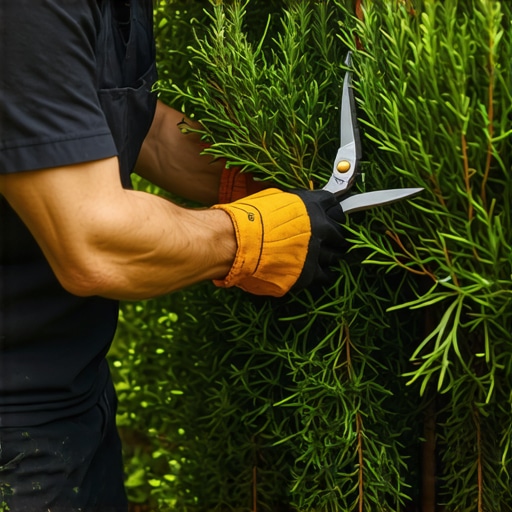
The best tool for air flow pruning is a pair of high-quality bypass pruners with a high-carbon steel blade that can maintain a surgical edge. Unlike anvil pruners, which crush the vascular tissue (the xylem and phloem), bypass pruners act like scissors, leaving a clean wound that the plant can compartmentalize quickly. For larger interior branches, a folding pruning saw with a tri-edge tooth design is necessary to ensure a smooth cut without tearing the bark. Tearing bark creates a pocket where water and spores can sit. If you are using cheap tools from a big-box store, you are doing more harm than good. Precision matters when you are performing surgery on a living organism.
- Step 1: Identify the “Three Ds”: Dead, Damaged, or Diseased wood and remove them immediately.
- Step 2: Locate crossing branches that rub against each other; these create entry points for pathogens.
- Step 3: Remove one-third of the oldest stems at ground level to encourage fresh, vigorous growth.
- Step 4: Thin out the center of the plant to allow a bird to fly through it.
- Step 5: Clean all debris from the base of the plant to remove overwintering spores.
Soil Chemistry and the Nitrogen Trap
Many homeowners think they are doing their garden a favor by dumping high-nitrogen fertilizer every spring. They are actually setting a trap. Nitrogen forces rapid, succulent growth. This new growth has thin cell walls that are incredibly easy for fungal hyphae to penetrate. I tell my clients to use slow-release organic amendments that build soil structure rather than just pumping the plant full of chemical salts. Check your soil pH. If your pH is off, the plant cannot uptake calcium, which is the primary building block of strong cell walls. A plant with weak cell walls is a buffet for mildew. Measure your inputs. Stop guessing. Your garden is not a trash can for fertilizer. High nitrogen levels also increase the transpiration rate, which ironically increases the humidity in the very canopy you are trying to dry out. It is a vicious cycle of poor management. If you want a healthy 2026 garden, you have to look at the chemistry beneath the surface as much as the branches in the air.
![Why Your 2026 Drip Emitters Keep Clogging [Fix]](https://lawnmajesty.com/wp-content/uploads/2026/06/Why-Your-2026-Drip-Emitters-Keep-Clogging-Fix.jpeg)