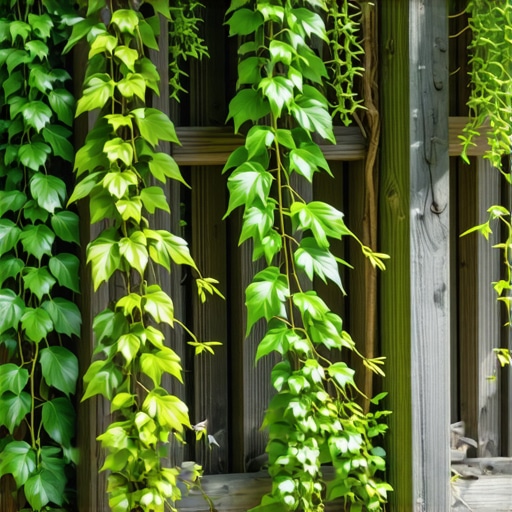
3 Fast-Growing 2026 Vines for Privacy Trellises
The Engineering of Privacy: Why Planning Beats Planting
For 2026, the most effective fast-growing vines for privacy include Cross-vine, Carolina Jessamine, and Trumpet Honeysuckle. These species provide dense foliar coverage and rapid vertical extension within two growing seasons, provided the soil pH and structural support are engineered to handle mature weights exceeding 50 pounds per linear foot. If you think you can just throw a plant in a hole and walk away, you are mistaken. I always drill into my new crew members: if you don’t fix the soil grading and structural integrity first, every plant you put in the ground is just expensive compost. Most homeowners see a bare fence and want it green by Tuesday. They run to a big-box store, buy a root-bound ‘mow-and-blow’ special, and wonder why the vine dies in August. It failed because they ignored the hydrostatic pressure of the site or the Cation Exchange Capacity (CEC) of their dirt. We don’t do that here. We build biological walls that last decades, not weeks. Real landscaping is about understanding the intersection of civil engineering and botany. It starts with the load-bearing capacity of your trellis and ends with the microscopic fungal networks in your rhizosphere.
“A vertical garden system must be engineered to withstand not just the dead load of the plant material, but the live load of wind and accumulated precipitation trapped within the foliage.” – Hardscape Engineering Axiom
How fast do privacy vines grow?
Most fast-growing perennial vines can establish 8 to 15 feet of linear growth per season once their root systems have reached the ‘leap’ phase of their development cycle. In the first year, they sleep; in the second, they creep; in the third, they leap. This isn’t just a catchy phrase; it is a biological reality of carbohydrate allocation within the plant. While the internet tells you to water every day, turf grass and woody vines actually need deep, infrequent watering—exactly 1 inch per week—to force roots to chase the water down into the lower soil horizons. This deep rooting creates a resilient specimen that can survive the 100-degree spikes we expect in 2026. If you shallow-water, you are training your plants to be weak. Weak plants attract aphids. Aphids bring soot mold. Now your privacy screen is a sticky, black mess. Do it right the first time.
The 2026 Privacy Selection: Top Three Performers
Selecting a vine is not about aesthetics; it is about mechanical attachment. You have twiners, clingers, and tendril-wrappers. If you put a clinger on a wooden fence, it will rot the wood. If you put a twiner on a flat wall, it will collapse. You need to match the plant’s morphology to your hardscape structure. Here are the three best options for the upcoming seasons.
| Vine Species | Growth Rate (Ft/Year) | Attachment Method | Required Support Strength |
|---|---|---|---|
| Bignonia capreolata (Cross-vine) | 12-15 | Adhesive Disks/Tendrils | High (Heavy Weight) |
| Gelsemium sempervirens | 6-10 | Twining Stems | Medium (Tension Cables) |
| Lonicera sempervirens | 8-12 | Twining Stems | Medium (Lattice) |
1. Bignonia capreolata (Cross-vine)
The Cross-vine is the heavy-lifter of the 2026 landscape. It uses branched tendrils with adhesive disks that can scale brick, stone, or heavy timber. This is not for a flimsy plastic trellis. By year three, the lignified woody base of this vine can be two inches thick. It requires a significant nitrogen-rich soil profile during its establishment phase. I recommend a 10-10-10 slow-release fertilizer applied at the drip line, not against the stem. If you pile mulch against the stem—the infamous ‘mulch volcano’—you are inviting crown rot. Stop doing it. The root flare must be visible. Oxygen exchange at the base of the plant is just as important as sunlight on the leaves.
2. Gelsemium sempervirens (Carolina Jessamine)
This is a twiner. It needs a structure to wrap around, like a 3/16-inch stainless steel cable or a heavy-duty hog-panel trellis. It stays evergreen in many zones, which is vital for winter privacy. However, it is toxic if ingested. If you have a client with goats or curious dogs, skip this. From a soil perspective, this vine is tolerant of the heavy red clays often found in the Piedmont regions, but it cannot stand ‘wet feet.’ If your soil doesn’t drain, the anaerobic conditions will kill the root hairs in forty-eight hours. We always test for percolation. Dig a hole, fill it with water; if it is still there in an hour, you have a drainage problem that needs a French drain, not a plant.
3. Lonicera sempervirens (Trumpet Honeysuckle)
Do not confuse this with the invasive Japanese Honeysuckle. The ‘Major Wheeler’ cultivar is a 2026 staple because it is nearly immune to powdery mildew. It provides dense privacy screening and attracts pollinators without destroying the local ecosystem. It needs a garden design that allows for air circulation. If you jam this against a solid fence with no gap, the humidity will breed fungus. Use standoff spacers to keep your trellis at least 4 inches off the fence line. This gap creates a chimney effect, pulling cool air up through the foliage and keeping the plant dry.
“Soil compaction is the number one killer of urban landscape plants, reducing pore space and preventing the gas exchange necessary for root respiration.” – USDA Forest Service Technical Manual
What is the best support for heavy vines?
The best support for heavy privacy vines is a structural trellis built from pressure-treated 4×4 posts set in 24 inches of compacted 3/4-inch crushed stone. Do not use concrete to set posts if you can avoid it. Concrete traps moisture against the wood and accelerates rot at the soil line. Use a ‘modified’ gravel base and tamp it in 6-inch lifts. The post should be so solid that the tamper bounces off the ground. For the infill, use 4-gauge galvanized cattle panels. They won’t sag under the weight of a mature Cross-vine. Cheap lattice from a big-box store will be kindling within three years. Buy quality or buy it twice. That is the rule of the foreman.
Installation Checklist for Maximum Privacy
- Soil Testing: Verify pH is between 6.0 and 7.0 for optimal nutrient uptake.
- Structural Anchor: Ensure all eye-bolts are 316-grade stainless steel to prevent rust streaks on masonry.
- Root Flare Visibility: Plant the vine so the top of the root ball is slightly above the surrounding grade.
- Irrigation: Install a dedicated drip line with 1.0 GPH emitters at the base.
- Initial Pruning: Cut back 20% of the top growth at planting to balance the root-to-shoot ratio.
Once these vines are in the ground, the first year is all about root establishment. Don’t expect a wall of green in month two. You are building a biological machine. By year two, you will start to see the extension. By year three, you’ll be pruning it back to keep it from taking over the gutters. Maintenance isn’t a chore; it’s a calibration. Prune for airflow. Fertilize for root health, not just green leaves. Keep the mulch back. If you follow these engineering principles, your privacy trellis will be the envy of the neighborhood, and more importantly, it won’t fall down in a summer thunderstorm. It’s about biology. It’s about physics. It’s about doing the job right.