The right way to sharpen mower blades
The Anatomy of a Shattered Blade: Why Your Lawn Looks Brown After Mowing
The right way to sharpen mower blades involves more than just grinding steel; it requires maintaining a 30-degree bevel, ensuring rotational balance, and understanding that a razor-sharp edge is actually a liability on a high-speed spindle. By following professional grinding standards, you prevent the ragged leaf tearing that leads to turfgrass pathogens and excessive moisture loss in 100-degree heat.
I always drill into my new crew members: if you don’t fix the soil grading first, every plant you put in the ground is just expensive compost, but if you don’t sharpen your blades, you’re just a glorified weed-whacker technician. I remember an apprentice, eager but green, who thought he was doing me a favor by sharpening our commercial Scag blades to a literal razor edge. By noon, the blades had rolled over like soft lead because they couldn’t handle the impact of a single thick fescue clump. He didn’t understand the metallurgy. A mower blade is a blunt-force instrument that needs a working edge, not a surgical one. If the edge is too thin, it chips. If it is too dull, it shreds. Shredded grass is dead grass.
The Biological Cost of a Dull Blade
When a dull blade strikes a blade of Kentucky Bluegrass or Zoysia, it doesn’t cut the vascular tissue; it crushes it. This is the difference between a clean surgical incision and a road rash injury. At a microscopic level, a dull blade shatters the xylem and phloem, the plant’s plumbing. This ragged wound increases the surface area for transpiration, causing the grass to lose moisture rapidly. Within 48 hours, you will see a white or tan ‘haze’ across the top of the lawn. That isn’t a lack of water. It is a million tiny scabs. These open wounds are the primary entry point for Dollar Spot and Brown Patch fungi. A clean cut seals in minutes. A shred stays open for days.
“A mower blade must be balanced within a fraction of an ounce; otherwise, the centrifugal force at 3,600 RPM will destroy the spindle bearings and the engine’s main seal.” – Small Engine Mechanics Manual
How much modified gravel do I need for a patio base?
While the question of gravel bases applies to hardscaping, the same engineering principles of weight and friction apply to mower decks. A mower deck creates a vacuum. If your blades are dull, you have to slow your ground speed, which reduces the lift (the ‘vacuum’ effect). This results in the grass not standing up straight, leading to an uneven cut and poor dispersal of clippings. Don’t skip the cleaning. Dried grass caked under the deck ruins the airflow regardless of how sharp the steel is.
| Tool Type | Pros | Cons | Best For |
|---|---|---|---|
| Mill File | No heat buildup, precise | Slow, physically demanding | Touch-ups in the field |
| Bench Grinder | Fast material removal | Easy to overheat the steel | Serious blade repair |
| Mag-1200 Sharpener | Fixed 30-degree angle | Extremely expensive | High-volume pro shops |
| Angle Grinder | Portable and versatile | Hard to maintain angle | Experienced operators |
The Metallurgy of the Edge: Understanding HRC and Temper
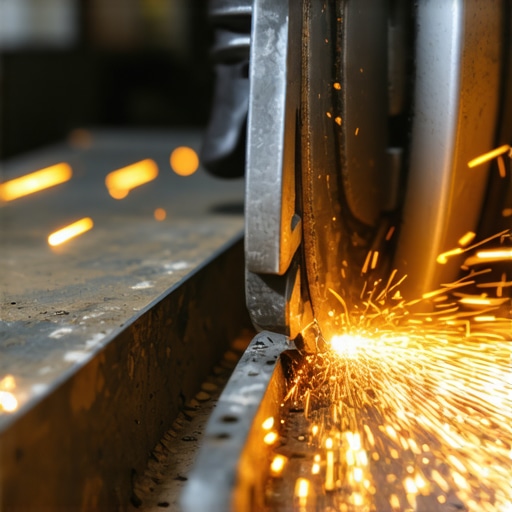
Most commercial mower blades are made from high-carbon steel, usually tempered to a Rockwell Hardness (HRC) of 38 to 45. If you see sparks flying and the metal turning blue while you grind, you have just ruined the blade. That blue color indicates you have ‘drawn the temper.’ You have softened the steel at a molecular level. That section of the blade will now dull in twenty minutes. To prevent this, you must use light passes and keep a bucket of water nearby to quench the steel. It must stay cool to the touch. If it’s too hot to hold, you’re destroying the metallurgy.
The Professional Sharpening Checklist
- Inspect for Cracks: Never sharpen a blade that has a vertical crack near the bolt hole. It will explode at high speeds.
- Clean the Blade: Use a putty knife to scrape off every ounce of dried grass. You cannot balance a dirty blade.
- Set the Angle: Lock the blade in a vice and maintain a consistent 30-degree angle. Follow the factory bevel.
- The Butter Knife Rule: The edge should be about 1/64th of an inch thick. You should be able to run your thumb across it without getting a deep cut.
- Static Balance Test: Use a cone balancer. If one side dips, remove more metal from the ‘heavy’ side’s back edge, not the cutting edge.
Can you sharpen a mower blade without removing it?
No. Do not even try it. Any contractor who tells you they can sharpen blades while they are still on the mower is a hack. You cannot verify the balance, you cannot clean the underside of the deck, and you cannot maintain a consistent bevel. More importantly, it is a massive safety risk. One slip and you are at the ER. Remove the spark plug wire, tip the mower (carburetor side up), and pull the bolt with an impact wrench. Do the job right or don’t do it at all.
“Turfgrass recovery time is directly proportional to the sharpness of the cutting implement and the ambient humidity during the 12 hours following the cut.” – Agronomy Extension Research
The Forensic Autopsy of a Failed Cut
If you look at your lawn and see ‘flags’—individual blades of grass where the top half is missing but the bottom is shredded—your blade is dull. If you see a ‘step-cut’ where one side of the mower is lower than the other, your blade is bent or your deck is out of level. A bent blade cannot be straightened. The structural integrity of the steel is compromised. Toss it in the scrap pile. It will vibrate. It will break your machine. It will ruin your lawn. Maintenance isn’t a suggestion; it’s a requirement. Stop buying the cheap $10 blades at the big-box store. They’re stamped from soft, low-carbon steel that won’t hold an edge through a single residential lot in August. Spend the $30 on a high-lift, heat-treated blade. Your turf will thank you.

![Stop Leaf Spot from Killing Your 2026 Roses [Fast Fix]](https://lawnmajesty.com/wp-content/uploads/2026/05/Stop-Leaf-Spot-from-Killing-Your-2026-Roses-Fast-Fix.jpeg)