
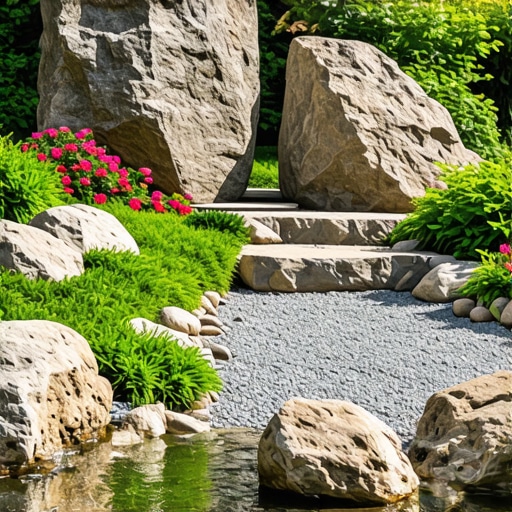
7 Ways to Use Large Boulders in Your Garden
Engineering the Landscape: Why Boulders Require More Than Just a Skid Steer
Integrating large boulders into a professional garden design is an exercise in civil engineering and geological logic rather than simple decoration. Most contractors fail because they treat a three-ton piece of granite like a piece of furniture, placing it on top of the turf where it eventually settles, shifts, or causes drainage nightmares. I recently got called out to tear up a $30,000 patio that was sinking because the previous contractor tried to build a boulder retaining wall on top of uncompacted topsoil. The hydrostatic pressure from a single heavy rain event pushed the entire wall two inches forward, buckling the pavers and creating a safety hazard. This is what happens when you ignore the structural requirements of hardscaping. Real landscaping involves managing the weight, the soil’s load-bearing capacity, and the way water moves around these massive objects. You need to understand the frost line, the angle of repose, and the density of the rock you are installing. If you do not bury at least a third of the stone, it will look like a marble dropped on a carpet. It lacks permanence and structural integrity.
1. Strategic Grade Stabilization with Boulder Retaining Walls
Boulder retaining walls stabilize steep slopes by using mass and gravity to counter soil pressure. Proper installation requires burying the bottom course (the “toe-in”) and using a non-woven geotextile fabric behind the stones to prevent soil migration while allowing water to escape through aggregate backfill. Unlike modular block walls, boulders provide a variable face that can handle minor soil shifts without showing cracks. However, the engineering must be precise. For every foot of height, you need a corresponding depth of base material. We use 3/4 inch clean crushed stone behind the boulders to ensure that water does not build up. Water is the primary cause of wall failure. If you do not provide a path for it to leave the hillside, the freeze-thaw cycle will eventually eject your stones from the earth.
“A retaining wall doesn’t fail because of the stone; it fails because of the water trapped behind it.” – Hardscape Engineering Axiom
How much modified gravel do I need for a patio base?
To calculate the base for any hardscaping project involving heavy stones, you must account for a minimum of 6 inches of compacted 2A modified gravel. For a standard 10×10 area, this equates to roughly 2.5 to 3 cubic yards of material, compacted in 2-inch lifts to ensure a Proctor density of 95 percent or higher. This prevents the boulder from sinking into the subgrade over time.
2. Outcropping for Naturalized Slope Management
Outcropping uses large boulders to mimic natural rock veins emerging from the earth, which effectively manages lawn care on difficult inclines. By strategically placing weathered-edge limestone or fieldstone into a hillside, you create natural tiers that slow down surface runoff and prevent erosion. This is not about scattered rocks; it is about creating a structural skeleton for the garden. Each stone must be “keyed” into the slope. We dig a shelf into the hillside, pitch it slightly back toward the hill, and set the stone so its center of gravity is pulling into the earth, not away from it. This technique allows for the planting of deep-rooted perennials between the rocks, which further stabilizes the soil through biological reinforcement.
3. Water Feature Anchor Points and Splash Logic
In garden design, boulders serve as the structural anchors for waterfalls and ponds, requiring careful consideration of hydrostatic pressure and capillary action. The largest stone, the “monolith,” should be placed at the point of highest water impact to prevent erosion of the liner or base. You cannot just stack rocks and hope they stay. We use professional-grade waterfall foam to divert water over the face of the stone rather than letting it leak behind the feature. This ensures the water stays in the system and the surrounding landscaping does not become a swamp. You must also consider the splash zone. Constant moisture on certain types of sandstone can lead to rapid scaling and degradation. Granite or basalt are preferred for high-flow areas due to their low porosity and high PSI strength.
4. Specimen Focal Points and Geological Diversity
A single, massive specimen boulder acts as a permanent architectural element that defines the visual weight of a landscaping plan. Choosing the right rock involves understanding the local geology. In the Northeast, we often use glacial erratics: rounded granite boulders that look like they belong in the local soil. In the South, you might see more angular limestone. The goal is to make the stone look like it has been there for ten thousand years. We often use a crane to set these stones because the placement must be perfect on the first try. You also need to consider the “sun-side” of the rock. Large stones have significant thermal mass, meaning they absorb heat during the day and radiate it at night. This creates a micro-climate that can help marginal plants survive a surprise frost.
| Rock Type | Density (lbs/cu ft) | Best Use Case | Durability Level |
|---|---|---|---|
| Granite | 165-175 | Retaining walls, Water features | Extreme |
| Limestone | 150-160 | Outcroppings, alkaline gardens | High |
| Sandstone | 130-150 | Decorative accents, low-traffic | Moderate |
| Basalt | 180-190 | Structural focal points | Extreme |
5. Physical Barriers and Traffic Deterrents
Using large boulders as functional barriers is a high-end alternative to bollards or fences for protecting lawn care areas from vehicular encroachment. A 2,000-pound boulder is an immovable object that provides security without the industrial look of steel. When we install these for commercial clients or residential corner lots, we set them on a reinforced concrete pad if they are near a roadway. This prevents the stone from being pushed into the ground if it is ever struck. It also makes edge-trimming easier for the maintenance crew. Hacks will just roll a rock onto the grass. A pro will cut the turf back, install a stone dust ring around the base, and ensure the mower can pass by without hitting the rock face.
6. Natural Seating and Functional Ergonomics
Garden design often overlooks the utility of boulders as permanent, maintenance-free seating. To use a boulder as a bench, you must select a stone with a naturally flat “table” surface or have a stone mason saw-cut the top. The height must be between 16 and 18 inches after the stone is partially buried. We call this functional hardscaping. The base must be perfectly leveled with stone screenings to prevent any wobbling. A rocking 2,000-pound stone is a liability.
“A stone bench is only as good as the compaction of the soil beneath it. If it tips an inch, it is no longer furniture; it is a hazard.” – ICPI Installation Standards
What is the best way to move a large boulder without damage?
Moving a large boulder requires a machine with a lifting capacity at least 20 percent higher than the rock’s weight and the use of heavy-duty nylon slings or a “C-clamp” grabber. Avoid using chains, as they will scar the face of the stone and leave gray metallic streaks that are nearly impossible to remove. Always lift from the center of gravity to prevent the stone from spinning or dropping unexpectedly.
7. Integrating Boulders with Softscape Root Zones
The intersection of hardscaping and lawn care occurs where the boulder meets the soil. You must avoid “mulch volcanoes” around the base of the stone. Instead, use the boulder to create a rain garden effect. The runoff from the top of the rock can be directed into a specialized planting pocket. Be aware of the soil pH changes. Limestone boulders will slowly leach calcium carbonate into the soil, raising the pH. If you plant acid-loving species like Azaleas or Blueberries right next to a limestone rock, they will eventually yellow and die from iron chlorosis. Use granite if you need to keep the soil acidic. This is the difference between a “mow-and-blow” guy and a veteran horticulturist. We look at the chemistry, not just the color.
- Call 811 to mark underground utilities before any excavation.
- Determine the weight of the stone: (Length x Width x Height) x 165 lbs for granite.
- Excavate a trench 6 inches wider than the boulder for the base material.
- Use a plate compactor on the subgrade before adding aggregate.
- Install non-woven geotextile fabric to separate soil from the stone base.
- Set the boulder with the “best face” forward and at least 25% of its mass below grade.
- Backfill with 3/4 inch clean stone for drainage if on a slope.
![Why Your Retaining Wall Is Bulging [2026 Drainage Fix]](https://lawnmajesty.com/wp-content/uploads/2026/09/Why-Your-Retaining-Wall-Is-Bulging-2026-Drainage-Fix.jpeg)
![Building a 2026 Modern Wood Fence [Budget DIY]](https://lawnmajesty.com/wp-content/uploads/2026/09/Building-a-2026-Modern-Wood-Fence-Budget-DIY.jpeg)
![Build a $200 Gravel Path for Wet Side Yards [Fast]](https://lawnmajesty.com/wp-content/uploads/2026/06/Build-a-200-Gravel-Path-for-Wet-Side-Yards-Fast.jpeg)