3 Design Tricks to Make a Tiny Yard Feel Huge
Designing for Micro-Lots: The Ground-Up Build Strategy
I always drill into my new crew members: if you don’t fix the soil grading first, every plant you put in the ground is just expensive compost. In small yards, this technical wisdom is the difference between a functional property and a mud pit. When you are working with a 500-square-foot lot, there is zero margin for error. You cannot hide a drainage failure or a poor plant choice behind a distant row of trees. Every square inch must be engineered. Small-scale landscaping is not about decoration; it is about managing spatial physics and biological constraints. You have to think like an engineer and act like a biologist. If you treat a tiny yard like a large one, you will fail every time. The goal is to manipulate the human eye while ensuring the soil microbiology and drainage systems remain functional under high-pressure urban conditions.
“Soil compaction is the single most common cause of plant decline in urban environments, limiting pore space for oxygen and water infiltration.” – Penn State Extension
Forced Perspective through Hardscape Geometry
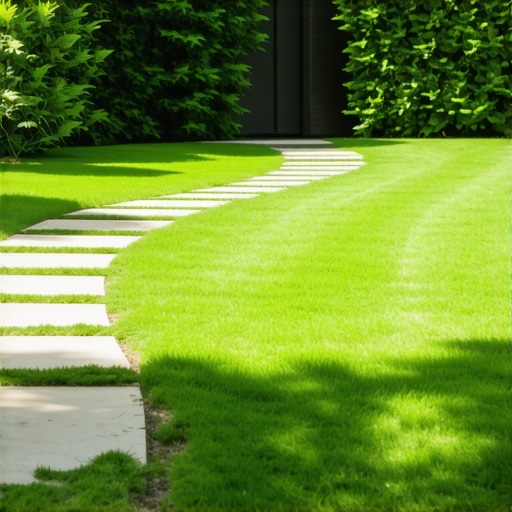
Forced perspective in small yards uses 12×24 or 24×24 pavers in a linear pattern to draw the eye toward a distant focal point, creating the illusion of depth. By manipulating the vanishing point and using light-colored natural stone, you reflect more light and expand the visual footprint of the site. It works. Most hacks just throw down some 12-inch bricks and wonder why the yard feels like a cage. You need large-format pavers. Lay them in a running bond pattern perpendicular to the house. This forces the eye to travel the length of the joint lines. It creates a vector. If you use dark slate, the space shrinks. If you use a light-colored travertine or thermal-finish bluestone, the ambient light bounces. This is basic physics. We focus on the Albedo effect. Higher reflectivity means the space feels open. Don’t skip the base. I see guys skip the compaction. You need 4 to 6 inches of 21A modified stone, compacted in 2-inch lifts using a plate compactor with at least 3,000 lbs of centrifugal force. If that base is not 95 percent Proctor density, your ‘huge’ feeling yard will be a trip hazard in two seasons. It will settle.
How much modified gravel do I need for a patio base?
To calculate gravel needs, multiply the total square footage by the desired depth in feet, then divide by 27 to get cubic yards. For a 200-square-foot patio with a 6-inch base, you need approximately 3.7 cubic yards of CR6 or 21A stone. Always add 10 percent for compaction loss.
| Material Type | Compaction Rating | Drainage Capability | Best Use Case |
|---|---|---|---|
| 21A Modified | High | Low | Structural base for pavers |
| #57 Clean Stone | Medium | Very High | French drains and wall backfill |
| Stone Dust | Low | None | Avoid; traps moisture and heaves |
| Polymeric Sand | N/A | Medium | Joint stabilization and weed tech |
Vertical Horticulture and the 3D Layering Strategy
Vertical landscaping utilizes wall-mounted planters, espaliered fruit trees, and narrow-profile cultivars like Carpinus betulus ‘Columnaris’ to regain floor space. By shifting the biomass from the horizontal plane to the vertical, you maximize photosynthetic surface area without encroaching on usable hardscape. People forget that a yard has three dimensions. If you plant a wide-spreading burning bush in a 10-foot wide yard, you just lost your yard. You need ‘Fastigiate’ plants. These are cultivars bred to grow tall and skinny. Think about the root flare. Even in a small space, you cannot bury the trunk. If I see a mulch volcano on a Japanese Maple, I know the contractor is a hack. You expose the flare to prevent stem-girdling roots. In a tiny yard, you also have to manage the hydrostatic pressure of the boundary walls. If you are planting behind a 3-foot retaining wall, you need a 1-foot chimney of #57 stone behind that wall or the weight of the wet soil will blow the stones out. Do not use topsoil as backfill.
“A retaining wall doesn’t fail because of the stone; it fails because of the water trapped behind it.” – Hardscape Engineering Axiom
What are the best trees for a small yard?
The best trees for tight spaces include Skyrocket Junipers, Emerald Green Arborvitae, and Slender Silhouette Sweetgum. These species provide height for privacy while maintaining a narrow 2 to 3 foot spread, ensuring they do not invade the active living space of the garden.
- Check USDA Hardiness Zones before buying.
- Verify the 10-year mature width, not the size at the nursery.
- Install a drip irrigation system to the root ball.
- Avoid invasive species that will take over the soil volume.
- Use structural soil if planting near a patio base.
Visual Continuity and the Low-Profile Edge
Visual continuity is achieved by keeping the eye moving across a single, uninterrupted material plane or by using flush-mounted steel edging. Removing visual barriers like chunky boxwood hedges allows the eye to travel to the property line, making a small lot feel significantly larger than its measured square footage. This is where lawn care comes in. If you have a tiny patch of grass, it has to be perfect. You need a mowing height of 3 to 4 inches for Tall Fescue to encourage deep roots. Deep roots mean the grass survives the heat reflected off the nearby hardscape. In a small yard, the concrete acts as a heat sink. It cooks the soil. You need to monitor the pH levels. If your soil is at 5.5, your grass can’t eat the nitrogen you give it. Get it to 6.5 with pelletized lime. Don’t use a cheap spreader. Use a professional rotary spreader to avoid ‘striping’ the lawn with fertilizer burns. Use a slow-release nitrogen source. Fast-release urea will torch a small lawn in 24 hours if you miss a spot. It will die. Keep your edges crisp. A 14-gauge steel edge set flush with the grass creates a razor-sharp line that defines the space without blocking the view. It is clean. It is professional.