Build a $200 Solar Pond Fountain for Your 2026 Backyard
Designing the High-Performance Backyard Pond for 2026
A $200 solar pond fountain requires a high-efficiency brushless DC pump, a 20-watt monocrystalline solar panel, and a 45-mil EPDM liner to ensure structural integrity and consistent water flow without the need for trenching electrical lines across your backyard. Most homeowners fail because they treat a pond like a bathtub. It is not. It is a biological reactor and a hydraulic system that must balance evaporation, filtration, and pressure. If you do not account for the hydrostatic pressure of the surrounding soil, your pond will fail. It is that simple.
The Apprentice Lesson: Why Grading is Everything
I always drill into my new crew members: if you don’t fix the soil grading first, every plant you put in the ground is just expensive compost. I remember an apprentice, eager but green, who installed a beautiful stone rim around a feature pond on a slight 3-degree slope. Within three weeks, the uphill runoff silted the water, clogged the impeller, and turned the feature into a mosquito-breeding swamp. We had to rip the whole thing out. The water level is the only true level. If your basin isn’t perfectly graded, the liner will show on the high side, and the low side will overflow, eroding your hardscape base. Dig it right the first time. Use a 4-foot level. No excuses.
“Maintaining a healthy nitrogen cycle in small water features requires a minimum surface-to-depth ratio to facilitate gas exchange.” – University of Maryland Extension Service
Materials and Physics: The $200 Budget Breakdown
Building a sustainable water feature on a budget means you cannot afford to buy things twice. You must prioritize the liner and the pump over decorative stone. In 2026, solar technology has advanced to the point where lithium-iron-phosphate (LiFePO4) battery buffers are standard even in entry-level kits, allowing your fountain to run during cloud cover or for four hours after sunset. Do not buy a pump without a dry-run protection sensor. It will burn out in a week if the water level drops.
| Component | Recommended Material | Estimated Cost | Primary Function |
|---|---|---|---|
| Basin Liner | 45-mil EPDM or 20-mil RPE | $75 | Watertight containment |
| Solar Pump Kit | 20W Panel w/ Battery Backup | $65 | Circulation and aeration |
| Underlayment | Non-woven Geotextile Fabric | $25 | Puncture prevention |
| Mechanical Filter | Coarse Bio-Sponge Box | $15 | Debris management |
| Edging Stone | Local Sourced River Rock | $20 | UV protection for liner |
The Engineering Logic of Excavation
To prevent the basin walls from collapsing, you must excavate with a 45-degree slope. Do not dig vertical walls. Soil shear strength is not high enough to hold a 90-degree cut once the soil becomes saturated by rain. Dig a ‘shelf’ 8 inches deep for your marginal plants. This acts as a biological filter. The main basin should reach 18 to 24 inches to prevent the water from overheating, which drops the dissolved oxygen levels and kills beneficial bacteria.
How deep should a small pond be?
A backyard pond should be at least 18 inches deep to maintain thermal stability and prevent total freezing in moderate climates, while also providing enough volume to prevent rapid ammonia spikes. Shallow water heats up too fast, accelerating algae growth and stressing the biological load of the system.
Can a solar pump run at night?
A solar pump can run at night only if it is paired with a solar charge controller and a battery storage unit, which stores excess energy during the day to power the fountain during low-light hours. Modern 2026 kits often include integrated 10Ah batteries that provide 4-6 hours of runtime after dark.
“Hydrostatic pressure from groundwater can lift a flexible liner out of the ground if the basin is not properly drained.” – Agricultural Engineering Handbook
[image_placeholder_1]
Installation Protocol: Step-by-Step
- Identify Utilities: Call 811 before you sink a shovel. Even a shallow pond can hit a secondary gas line or irrigation main.
- Excavate and Level: Remove all sharp rocks and roots. If you leave a root, it will grow and pierce your liner. Use a sand base.
- Install Underlayment: Do not skip this. Even old carpet is better than nothing, but geotextile is best.
- Lay the Liner: Drape it loosely. Let the weight of the water pull it into the contours. Do not stretch it.
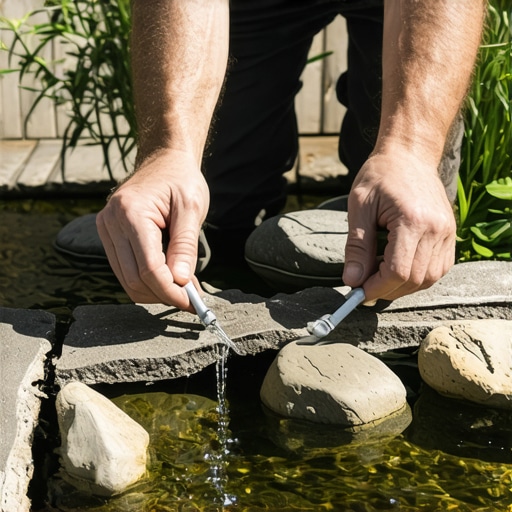
- Position the Pump: Place the pump on a flat brick, not the bottom. This prevents it from sucking up the fine silt that inevitably settles.
- Edge with Stone: Cover every inch of exposed liner. UV rays are the enemy of EPDM. They will make it brittle in three seasons.
Maintenance and Biological Balance
You aren’t just a landscaper; you are a microbial manager. In the first year, your pond will turn green. This is normal. It is the nitrogen cycle finding equilibrium. Do not pour chemicals into it. Add floating plants like water lettuce to compete for nutrients. Check your pump intake every week. A single oak leaf can drop your GPH (gallons per hour) by half. Test your water pH monthly; you want to stay between 6.5 and 8.5. Anything outside that range indicates a failure in your biological filtration. Keep it clean. Keep it moving. Don’t be a hack.