![Build a $250 Flagstone Fire Pit Circle [Weekend Fix]](https://lawnmajesty.com/wp-content/uploads/2026/06/Build-a-250-Flagstone-Fire-Pit-Circle-Weekend-Fix.jpeg)
Build a $250 Flagstone Fire Pit Circle [Weekend Fix]
The Hardscape Autopsy: Why Most Weekend Projects Fail
I recently got called out to tear up a $30,000 patio that was sinking because the previous contractor thought he could skip the sub-base compaction and rely on the weight of the flagstone to stabilize the soil. Within two seasons, the frost-heave cycle turned that high-end installation into a dangerous, uneven mess of stone and mud. This is the reality of hardscaping: if the engineering beneath the surface is flawed, the aesthetics on top are irrelevant. When building a $250 flagstone fire pit circle, you aren’t just laying rocks in a circle; you are managing soil density, moisture migration, and thermal expansion. Most DIYers fail because they treat the ground like a static floor rather than a living, shifting geological layer. I’ve spent two decades fixing these mistakes, and the secret isn’t more expensive stone—it’s better physics.
The Ground-Up Build: Site Selection and Planning
To build a flagstone fire pit circle for under $250, you must prioritize site excavation, soil compaction, and base aggregate selection to prevent settling and stone shifting. Start by identifying a location at least 15 feet from any structures or low-hanging canopies to mitigate fire risk and smoke intrusion.
Before you even touch a shovel, you need to understand the substrate. In my region, we deal with heavy clay that holds water like a sponge. If you place stone directly on clay, the first freeze will pop those stones right out of the ground. You must call 811 to mark utility lines—hitting a gas line while digging a 6-inch pit is a mistake you only make once. For a $250 budget, you are looking at a 10-foot diameter circle. This provides enough room for a 36-inch fire ring and 3.5 feet of seating area. We are using Blueprint B: The Ground-Up Build. We focus on the prep work because 80% of the labor happens before the first flagstone is set. If the base is not dead-level and rock-hard, your project is just expensive gravel.
“A retaining wall doesn’t fail because of the stone; it fails because of the water trapped behind it.” – Hardscape Engineering Axiom
How much modified gravel do I need for a fire pit base?
To calculate your modified gravel needs, multiply the square footage of your 10-foot circle (approx 78 sq ft) by your desired depth (4 inches), which equals roughly 1.2 tons of 2A modified crushed stone. At most local quarries, this should cost you between $40 and $60, leaving plenty of budget for the stone.
The Material Breakdown: Sourcing Quality on a Budget
The key to staying under $250 is sourcing. Do not go to a big-box retailer and buy individual stones at $10 a piece. Go to a local stone yard or quarry and ask for “pallet seconds” or “natural fieldstone.” You need roughly 500-600 pounds of stone for a standard circle. Focus on stones with a thickness of at least 2 inches. Thinner slabs, often called “veneer,” will crack under the heat of a fire or the weight of a heavy Adirondack chair. Real stone has structural integrity that manufactured concrete pavers lack. It handles the thermal shock of a fire much better. Here is how the budget breaks down:
| Material Item | Estimated Quantity | Projected Cost |
|---|---|---|
| 2A Modified Gravel (Base) | 1.2 Tons | $55.00 |
| Natural Flagstone (Seconds) | 600 lbs | $120.00 |
| Stone Dust / Polymeric Sand | 4 Bags | $45.00 |
| Steel Fire Ring (36-inch) | 1 unit | $30.00 |
Notice we aren’t using mortar. Mortar is brittle. In an outdoor fire pit environment, the constant expansion and contraction of the earth and the heat of the fire will snap mortar joints in months. We use a dry-laid system. It’s flexible. It’s durable. It breathes.
Step-by-Step Installation: The Physics of Compaction
Excavate the entire 10-foot circle to a depth of 6 inches. This isn’t a suggestion; it’s a requirement. You need 4 inches of compacted gravel and 2 inches of stone to sit flush with the grade. Once excavated, use a hand tamper or rent a plate compactor if your soil is particularly soft. The tamper should literally bounce off the ground when you’re done. If the soil feels soft, keep tamping. If you skip this, the pit will sink.
- Mark the center point with a stake and use a string line to scribe a perfect 10-foot circle.
- Remove all turf and organic material; grass trapped under gravel will rot and create voids.
- Level the sub-grade. Use a 2×4 with a level on top to ensure the dirt is flat.
- Add gravel in 2-inch “lifts.” Tamp after every lift. If you dump 4 inches at once, you won’t get deep compaction.
- Use a screed pipe to level the final layer of stone dust or sand. This is your bedding layer.
“Proper sub-grade preparation is the most critical factor in the longevity of any segmental pavement system.” – ICPI Tech Spec No. 2
Can I build a fire pit directly on my lawn?
No. Building a hardscape fire pit directly on turf grass will cause the stones to shift as the organic matter decomposes, and the heat from the fire will scorch the soil microbiology, leading to drainage issues and permanent lawn damage. Always excavate and install an aggregate base.
The Professional Finish: Setting the Flagstone
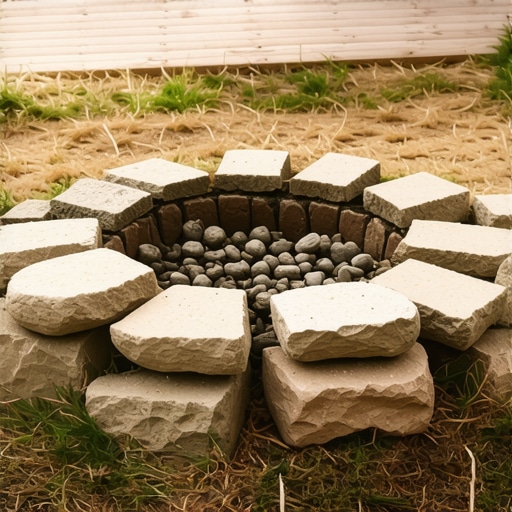
When laying the flagstone, think of it like a giant jig-saw puzzle. You want to keep your joints between 1 and 2 inches wide. If the joints are too wide, the sand will wash out. If they are too tight, you can’t get the sand in to lock the stones together. Use a rubber mallet to set each stone. Do not hit it with a sledgehammer; flagstone is sedimentary or metamorphic and can split along its natural layers if struck with high-velocity steel. Once the stones are set, pour polymeric sand or stone dust into the joints. Sweep it in, then lightly mist it with water. This “locks” the circle into a single, monolithic unit that can still shift slightly with the freeze/thaw cycle without cracking. The fire ring goes in last. Place it in the center and backfill the exterior with leftover stone or decorative river rock. Do not use river rock inside the pit—moisture trapped in river rocks can turn to steam and cause them to explode when heated.
The Year-One Maintenance Schedule
Your fire pit will settle. It’s a physical certainty. In the first year, watch for stones that begin to rock. If a stone becomes unstable, lift it, add a handful of stone dust to the low spot, and reset it. Keep the joints filled. If weeds start to pop through, it means your sand has washed out. Re-fill it. This isn’t a “set it and forget it” project. Hardscaping is a battle against erosion and gravity. You win by staying vigilant. Avoid using harsh chemicals or acids to clean the stone; natural flagstone can react poorly to acidic cleaners, leading to surface spalling. Just use water and a stiff brush. Your $250 investment, if built with these engineering principles, will outlast the house itself.