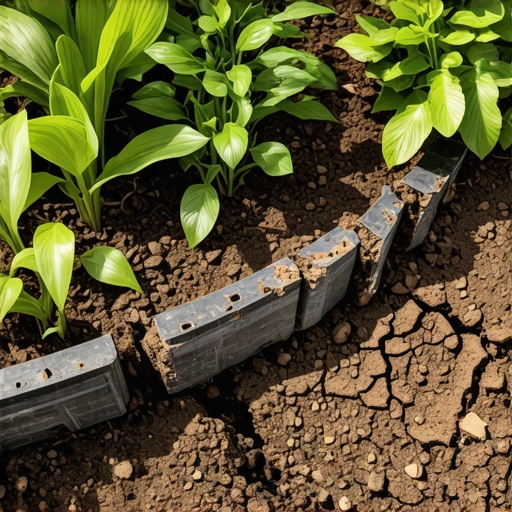
Why You Should Never Use Plastic Edging for Garden Beds
Why Professional Landscapers Never Use Plastic Garden Edging
Planning a landscape is eighty percent engineering and twenty percent aesthetics. If you start with inferior materials, the aesthetics will fail within two seasons. I always drill into my new crew members: if you don’t fix the soil grading first, every plant you put in the ground is just expensive compost. The same logic applies to garden edging. Using plastic “no-dig” or thin-walled polyethylene edging is the hallmark of a contractor who wants to be paid today but won’t answer the phone next spring. It is a fundamental failure of site stabilization.
Why Plastic Edging Fails the Frost Heave Test
Plastic edging fails because it lacks the mass and structural anchoring required to resist the vertical force of frost heaves. When soil moisture freezes, it expands by approximately nine percent, pushing lightweight materials like plastic upward until the stakes lose their friction-based grip in the subgrade.
This isn’t just an eyesore. It is a functional disaster. Once the edge rises, it no longer serves as a barrier for stoloniferous grasses. In the northern states, we deal with the freeze-thaw cycle constantly. A plastic edge might look clean in October. By April, it looks like a black snake crawling out of the mulch.
“A retaining wall doesn’t fail because of the stone; it fails because of the water trapped behind it.” – Hardscape Engineering Axiom
This axiom applies to edging too. Water collects in the gap between the plastic and the soil, freezes, and ejects the barrier. We see it every year. It’s a waste of the homeowner’s money. Don’t skip the prep. It will rot or rise.
The Chemical Degradation of Cheap Polymers
The sun is the primary enemy of plastic landscape materials because ultraviolet (UV) radiation breaks down the molecular bonds in polyethylene, leading to embrittlement and cracking. Within 24 months, most residential-grade plastic edging loses its tensile strength and becomes brittle enough to shatter under minor impact.
Most big-box store edging is made from low-density polyethylene (LDPE). While flexible during installation, this material has poor resistance to thermal expansion. In mid-summer, soil temperatures can reach 120 degrees Fahrenheit. The plastic softens and warps. Then, when the temperature drops, it becomes brittle. Add in a string trimmer spinning at 3,000 RPMs, and that plastic is shredded in seconds. It creates microplastic pollution in your soil. It looks cheap because it is cheap. It creates a maintenance nightmare for lawn care crews. One nick from a mower blade and the entire run is compromised.
Professional Material Comparison Table
We analyze materials based on their lifecycle cost, not their upfront price. Here is how plastic stacks up against professional-grade solutions.
| Material | Lifespan | Durability | Average Cost/Lin. Ft. | Best Use Case |
|---|---|---|---|---|
| Plastic (Retail Grade) | 1-3 Years | Very Low | $0.50 – $1.50 | Temporary rentals only. |
| Professional Steel (1/8 inch) | 25+ Years | Extreme | $4.00 – $7.00 | Modern clean lines, hillsides. |
| Aluminum | 20+ Years | High | $3.50 – $6.00 | Curved paths, rust-free zones. |
| Victorian Trench | Infinite | Natural | $0.00 (Labor) | Traditional estates, low cost. |
| Belgian Block | 50+ Years | Highest | $12.00 – $25.00 | High-end hardscaping. |
How much does professional garden edging cost?
Professional garden edging typically costs between $5 and $20 per linear foot installed, depending on whether you choose 14-gauge powder-coated steel or masonry units like Belgian Block. While the material cost is higher than plastic, the longevity of the installation means the cost-per-year is significantly lower over a ten-year period.
What is the best material for garden edging?
The best material for garden edging is 1/8-inch thick structural steel or a hand-cut Victorian trench. Steel provides a rigid, permanent barrier that prevents rhizomatous grass spread, while a Victorian trench offers the cleanest aesthetic for traditional gardens without introducing synthetic materials into the soil profile.
The Biology of Grass Intrusion
Grass is aggressive. Kentucky Bluegrass (Poa pratensis) and Bermuda grass (Cynodon dactylon) spread via rhizomes and stolons. These are underground and overground stems designed to hunt for nutrients and water.
“Maintaining a clean separation between turfgrass and ornamental beds requires a physical barrier or a mechanical trench that prevents rhizome spread through the upper 4 inches of the soil profile.” – Penn State Extension Horticulture
Plastic edging is usually only 3 to 4 inches deep, with a rounded top that grass easily grows over. Because plastic is non-porous and lacks weight, grass roots often find gaps between the soil and the edging. They dive deep, go under the plastic, and emerge in your mulch bed. Once grass gets into a perennial bed, you are looking at hours of manual weeding or the use of non-selective herbicides that can damage your ornamentals. A proper edge needs to be deep. It needs to be structural. Plastic is neither.
The Ground-Up Build: Professional Installation Steps
If you want a bed edge that lasts for twenty years, you follow a specific engineering process. We don’t use “no-dig” methods because they are a lie. Soil must be managed. Follow this checklist for a permanent edge:
- Excavate a 4-to-6 inch trench: You must get below the primary root zone of the turf.
- Establish a 90-degree cut: The vertical wall of the trench should be on the grass side to prevent root lateral movement.
- Compact the subgrade: Use a hand tamper to ensure the soil base is firm to prevent settling.
- Install heavy-duty restraints: If using steel, use 12-inch serrated stakes driven at an angle for maximum pull-out resistance.
- Backfill with drainage media: Use a small amount of 1/4 inch clean stone if you are in a heavy clay region to prevent hydrostatic pressure build-up.
The Impact on Lawn Care Efficiency
Lawn care is about precision. When we see plastic edging on a property, we have to slow down. You cannot get a crisp line with a string trimmer against plastic without destroying the edge. If the plastic has heaved, it risks catching the mower deck, which can bend a spindle or shatter a blade. This increases your maintenance costs. A natural trench or a recessed steel edge allows the mower wheel to ride right along the border. This results in a cleaner look and faster service times. Cheap materials cost more in labor over time. Always.
The Environmental Reality of Landscape Plastics
We are seeing a shift in the industry away from “disposable” landscaping. Every time a plastic edge breaks, those pieces stay in the soil. They don’t biodegrade. They fragment. For homeowners who care about soil microbiology and the health of their plants, introducing pounds of polyethylene is counterproductive. Natural stone or steel can be recycled or repurposed. Plastic just goes to the landfill. Invest in your soil. It is a living system. Treat it with respect. Stop buying junk.