Fix Sinking Flagstones Without Digging Everything Up
The Anatomy of a Sinking Patio Base
To fix sinking flagstones without digging everything up, you must utilize targeted pressure-grouting or precision-lifting methods like targeted dry-pour polymeric sand packing and individual slab shim adjustments using compacted HPB (High-Performance Bedding). This surgical approach stabilizes localized sub-base failure without destroying the surrounding hardscape design. It is fast, clean, and highly effective when executed correctly.
I recently got called out to tear up a $30,000 patio that was sinking because the previous contractor skipped the compaction phase on a clay subgrade. The homeowner was in tears. The entire surface looked like a rolling wave, and water was pooling directly against their foundation wall. It was a complete hardscape autopsy. I could literally scoop up the wet sand base with my bare hands. It had turned into a soupy muck because there was no drainage layer. You do not always have to go to that extreme of tearing everything out if only a few flags are dipping. If the majority of your patio is stable, you can execute a localized surgical lift.
“A retaining wall or paved surface doesn’t fail because of the stone; it fails because of the water trapped behind or beneath it.” – Hardscape Engineering Axiom
Why Do Flagstones Sink in the First Place?
Understanding the root cause of the settling is crucial. When a flagstone dips, it is almost always a localized drainage or compaction failure. Water finds a low spot, saturates the bedding sand, and washes it into the subgrade. In cold climates, this saturated base undergoes freeze-thaw cycles. The ice expands, lifts the stone, and then drops it back down unevenly when it melts. Clay soils make this worse by holding onto water like a sponge. If you just throw more sand on top, the stone will sink again within a year. You have to address the void underneath.
How to Fix Sinking Flagstones Without Digging Everything Up
You can remediate sinking flagstones surgically by carefully extracting the individual sunken stones, correcting the localized base compaction with angular stone dust or HPB, and reseating them to match the established grade. This targeted method preserves the surrounding patio and restores structural integrity. Do not skip the compaction. It is the most critical step.
Step-by-Step Localized Remediation
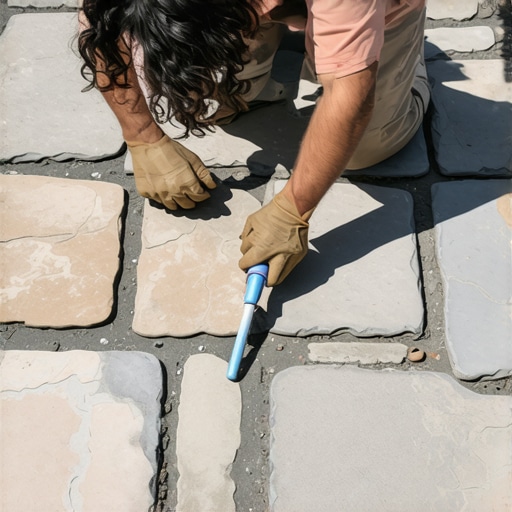
First, clear the jointing material around the offending stones. Use a cold chisel and a hammer, or a oscillating tool with a carbide grout blade. Be careful not to chip the edges of the flagstones. Once the joints are clear, insert two heavy-duty pry bars on opposite sides of the stone. Lift the flagstone straight up. Do not pry against adjacent stones without placing a piece of plywood down to protect them from chipping. Set the stone aside.
Next, inspect the exposed base. Scrap away any organic matter or mushy, wet sand. Dig down about two inches into the sub-base layer. You will likely find wet, uncompacted soil. Fill this void with High-Performance Bedding (HPB) or 1/4-inch clean, angular stone dust. Avoid rounded play sand. Rounded sand acts like tiny ball bearings and will slide around under load. Angular stone chips lock together under pressure.
Pack the new base material down. Use a hand tamper or a short length of a 4×4 post. Hit it hard. The tamper should literally bounce off the compacted base. Add more material until the base is exactly high enough so that when the flagstone is replaced, it sits about 1/4 inch higher than the surrounding stones. This allows for minor settling when you tamp the stone back into place.
Resetting and Joint Stabilization
Lower the flagstone back into its original position. Use a rubber mallet to pack it down. Do not use a metal hammer. Place a straightedge board across the patio to ensure the stone sits perfectly flush with its neighbors. Once level, fill the joints with high-quality polymeric sand. Sweep it into the cracks, vibrating the stone slightly with your mallet to force the sand deep into the joints. Mist the sand with water to activate the polymers. This seals the joint and prevents future water intrusion.
| Material Options | Pros | Cons | Best Use Case |
|---|---|---|---|
| High-Performance Bedding (HPB) | Excellent drainage, self-compacting to 95% | Can be hard to find in small bags | Areas with severe drainage issues |
| Angular Stone Dust | Packs extremely tight, locks stone in place | Holds more moisture than HPB | Standard dry-laid flagstone repair |
| Polymeric Sand | Prevents weed growth, locks joints | Requires dry conditions for application | All joint stabilization projects |
Proactive Maintenance to Prevent Future Settling
To prevent flagstones from sinking again, you must maintain water runoff paths away from the patio and reseal polymeric joints every three to five years. Water is the ultimate enemy of any hardscape. Keep it moving away from your stone surfaces. If water pools, the stone sinks. It is that simple.
How much modified gravel do I need for a patio base?
To calculate your base needs, multiply the patio area by the depth of the base (minimum 4 inches for walkways, 6 inches for patios) in feet, then divide by 27 to get cubic yards. Multiply by 1.5 to account for compaction. Do not skimp on this measurement. A thin base will always fail.
Can you lay flagstone directly on dirt?
No, laying flagstone directly on dirt guarantees failure. The organic matter in soil decays, causing uneven settling, while clay soils swell and shrink with moisture changes. Always use a proper gravel base layer. Dirt is for growing things, not supporting stone.
Keep your gutters clean. Downspout runoff should never dump directly onto or near your flagstone patio. Install French drains or catch basins to route water safely away. Inspect your joints annually. If you see cracks or missing sand, clean them out and reapply polymeric sand immediately. A tiny gap in the joint is all water needs to start eroding your hard-earned base layer. Stay vigilant.
- Inspect joints annually for erosion or cracking.
- Ensure downspouts discharge at least five feet away from hardscape edges.
- Never use de-icing salts on natural flagstone as it accelerates spalling.
- Keep lawn irrigation systems directed away from patio perimeters.