Fix Your 2026 Cloudy Pond Water with Barley Straw
Fix Your 2026 Cloudy Pond Water with Barley Straw
You wake up, walk out to your custom EPDM-lined koi pond, and instead of seeing your expensive Grade-A Show Sanke, you see a thick, green sludge. It looks like pea soup. Your pump is straining, your filters are clogged every six hours, and your wife is asking why you spent five figures on a mud hole. This is the biological reality of a pond that has lost its equilibrium. Cloudy pond water is not just an eyesore; it is a symptom of a system failing to process nitrogen and phosphorus. Most homeowners reach for a bottle of copper sulfate or some high-speed chemical algaecide. That is a rookie mistake. You kill the algae fast, it rots, consumes all the dissolved oxygen, and then your fish turn belly up by dinner time. In 2026, we are going back to basics with a heavy dose of biological engineering using barley straw.
The Forensic Autopsy of Pea Soup Water
Cloudy pond water in 2026 indicates a biological collapse where excess nutrients like phosphorus and nitrogen fuel cyanobacteria and algae blooms. By introducing barley straw, you initiate a oxidative process that suppresses cellular division in algae without harming aquatic plants or beneficial bacteria. Most people think barley straw is a filter. It is not. It is a slow-release chemical reactor. When barley straw sits in oxygenated water and begins to rot, it releases humic acids. These acids, when combined with sunlight and dissolved oxygen, create low levels of hydrogen peroxide. This peroxide acts as a growth inhibitor. It does not kill what is there; it stops what is coming. If you do not understand this distinction, you will fail.
I always drill into my new crew members: if you don’t fix the soil grading first, every plant you put in the ground is just expensive compost. The same goes for ponds. I was on a job last June where a guy had a $50,000 pond install that looked like a swamp. He kept dumping in clarifiers. I took one look at the surrounding hardscaping and saw the problem. His patio was pitched toward the water. Every time it rained, nitrogen-rich lawn fertilizer from his turf grass was washing directly into the pond. You can put all the barley straw in the world in there, but if you’re feeding the beast with runoff, you’re wasting my time and your money. We had to rip out two courses of natural stone and install a French drain to divert that nutrient-heavy water away from the aquatic ecosystem. That is the difference between a landscaper and a guy who just mows lawns.
“Barley straw does not kill existing algae but prevents the growth of new algae cells through the slow release of hydrogen peroxide during decomposition.” – Penn State Agricultural Extension
How much barley straw do I need for a pond?
The standard industry measurement for barley straw application is roughly 2 to 3 bales per acre of surface area, or more practically for homeowners, about 10 to 25 grams of straw per square meter of pond surface. Do not guess these numbers. Over-applying straw in a small, stagnant pond can lead to deoxygenation as the straw rots, which will kill your fish faster than the algae ever would. You need to calculate the surface area (Length x Width) and ignore the depth for this specific calculation because the peroxide reaction occurs primarily where the sunlight hits the upper water column.
| Treatment Method | Action Type | Pros | Cons |
|---|---|---|---|
| Barley Straw | Biological Inhibitor | Safe for fish, long-lasting, cheap | Slow acting (4-6 weeks) |
| UV Clarifier | Mechanical/Light | Instant results, clear water | High electricity cost, bulb replacement |
| Algaecides | Chemical Contact Kill | Immediate kill | Risk of oxygen crash, toxic to some plants |
| Beneficial Bacteria | Nutrient Competition | Natural, improves muck levels | Requires consistent water temps above 50F |
Where do you place barley straw in a pond for best results?
Placement is where most DIYers fail. If you throw a bale of straw into the deep, stagnant corner of your pond, it will turn anaerobic and smell like a sewer. To activate the lignin decomposition, the straw must be in a high-oxygen environment with good water flow. I tell my clients to secure the mesh bags near the waterfall return or right in front of the pond skimmer. The movement of water through the straw ensures that the hydrogen peroxide byproduct is distributed throughout the entire water column. If it sits still, the peroxide stays concentrated in one spot and does nothing for the rest of the pond.
The Engineering of Aquatic Stability
Landscaping is not just about aesthetics; it is about managing hydrostatic pressure and nutrient cycles. When we design a pond, we look at the entire watershed of the property. If your pond is at the low point of the yard, it is a collection basin for every chemical you put on your lawn. You need to check your soil pH. High alkalinity in the water (above 8.5 pH) often locks out other biological processes, making algae blooms more aggressive. Barley straw helps buffer this, but it is not a magic wand. You must combine it with mechanical filtration and proper plant density. We recommend at least 50% surface coverage with floating plants like lilies to block the UV rays that the algae need to photosynthesize. This is the 2026 standard: multi-layer defense.
“A retaining wall doesn’t fail because of the stone; it fails because of the water trapped behind it.” – Hardscape Engineering Axiom
The same logic applies to pond water. It doesn’t get cloudy because of the water; it gets cloudy because of what the water is carrying. If you have a high fish load (too many koi), the ammonia levels will spike. Your bio-filter (the rocks and beads where bacteria live) has to convert that ammonia to nitrites and then nitrates. Algae loves nitrates. If your barley straw isn’t keeping up, it’s because your bio-load is too high. Stop overfeeding your fish. Anything they don’t eat in three minutes is just fuel for the green monster. I’ve seen guys dump whole handfuls of pellets into a pond and then wonder why they can’t see the bottom. It is basic math.
The Barley Straw Installation Checklist
- Calculate surface area: Length x Width = Total Square Footage.
- Purchase certified organic barley straw to avoid pesticide contamination.
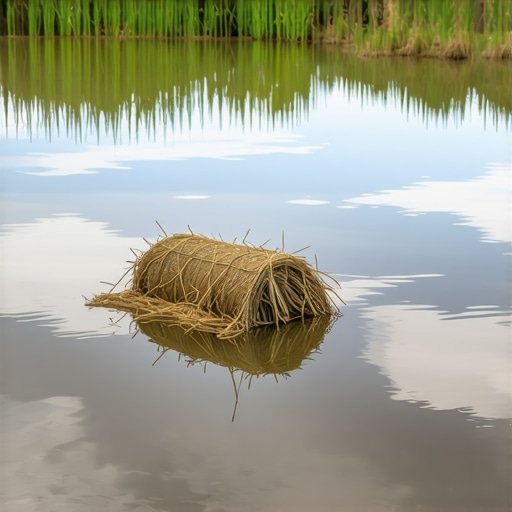
- Stuff straw loosely into mesh pond bags (do not pack tight; water must flow through).
- Add floats (like a small piece of foam) to keep the bag in the top 12 inches of water.
- Anchor the bag near the pump intake or waterfall.
- Wait 4 to 6 weeks for the decomposition cycle to trigger peroxide release.
- Replace every 4 to 6 months to maintain the chemical reaction.
Remember, the straw needs to stay aerobic. If the bag starts to smell like rotten eggs, pull it out. That means it has gone anaerobic and is releasing hydrogen sulfide, which is lethal to your fish. This usually happens because the bag is too dense or it sank to the bottom into the muck. Keep it floating. Keep it moving. In the landscaping world, we say ‘if it doesn’t move, it dies.’ That applies to water, air, and your pond’s biological filter. You need to be checking your dissolved oxygen levels, especially in the heat of July. If your fish are gulping for air at the surface, turn on an aerator immediately. The barley straw reaction consumes a small amount of oxygen, so in a 2026 heatwave, you need that mechanical backup. Do not skip this step. A dead pond is a lot harder to fix than a cloudy one.
2026 Maintenance Protocols
As we move into the 2026 season, expect higher-than-average temperatures. This means the biological clock of your pond will run faster. Barley straw will decompose more quickly in 80-degree water than in 60-degree water. You might need to rotate your straw bags every 3 months instead of 6. Monitor the color of the straw. When it turns dark brown and loses its structure, the lignin is gone. It is no longer producing the peroxide you need. Pull it and replace it. This is not a set-it-and-forget-it deal. It is a biological partnership. Keep your edges clean. Trim back any terrestrial plants that are dropping debris into the water. Every leaf that rots in the pond is more phosphate for the algae. Get a good net and use it. This is how you keep a professional-grade pond looking crisp year-round. It’s about discipline, not chemicals.
![Build a $350 Pondless Waterfall [2026 DIY]](https://lawnmajesty.com/wp-content/uploads/2026/06/Build-a-350-Pondless-Waterfall-2026-DIY.jpeg)