How to Design a Low-Maintenance Rock Garden on a Hill
The Foundation of Hillside Engineering
To design a low-maintenance rock garden on a hill, you must first master slope stabilization and hydrostatic pressure management. Success relies on keying in boulders, using non-woven geotextile fabrics, and selecting native xeriscape plants that anchor the soil through deep root systems rather than surface-level coverage. I always drill into my new crew members: if you don’t fix the soil grading first, every plant you put in the ground is just expensive compost. I have seen too many rookies throw $5,000 worth of nursery stock on a 30-degree slope without checking the angle of repose. Within two rainstorms, those plants and half the topsoil are sitting in the neighbor’s driveway. You cannot fight gravity with aesthetics. You fight gravity with civil engineering principles and soil physics. If the base isn’t compacted and the drainage isn’t diverted, the project is a failure before the first stone is set.
The Physics of Slope Stability
Before you touch a shovel, you need to understand the coefficient of friction between your substrate and your cover. A hill is a dynamic environment where water acts as a lubricant.
“A retaining wall or rock slope doesn’t fail because of the stone; it fails because of the water trapped behind it.” : Hardscape Engineering Axiom
When water saturates uncompacted soil, it increases the weight of the bank while simultaneously reducing the friction holding it together. Your goal is to break the flow. This is why we use angular rip-rap or fractured stone rather than smooth river rock for hillsides. Smooth rocks roll. Jagged rocks lock.
Materials Selection: Beyond the Big-Box Store
Selecting materials for a hillside rock garden requires a focus on bulk density, porosity, and mineral stability. Professionals choose weathered limestone, granite boulders, or basalt because these materials resist freeze-thaw shattering and provide a stable thermal mass for plant roots. Avoid cheap, thin mulch which will simply wash away in a heavy downpour.
Rock Comparison for Sloped Landscapes
| Rock Type | Stability Rating | Drainage Capability | Best Use Case |
|---|---|---|---|
| River Rock (Round) | Low | High | Dry creek bed bottoms |
| Crushed Granite (Angular) | High | Medium | Pathways and slope infill |
| Fieldstone Boulders | Very High | Low | Structural anchoring and focal points |
| Lava Rock (Scoria) | Medium | High | Moisture retention in arid zones |
Step-by-Step Installation: The Ground-Up Build
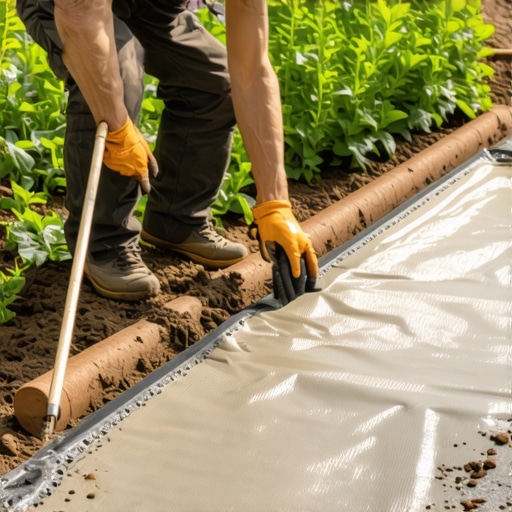
The installation of a permanent rock garden begins with excavation and substrate preparation to ensure long-term stability. This process involves stripping turf grass, correcting the grade to prevent pooling, and installing a heavy-duty weed barrier that allows for gas exchange and water infiltration.
- Site Marking and Utility Check: Call 811 to mark underground lines. Never assume depth.
- Excavation: Remove 4 to 6 inches of topsoil. You need to reach the sub-grade.
- Geotextile Layering: Lay down 4-ounce non-woven fabric. Do not use the plastic-coated junk from hardware stores.
- Boulder Placement: Bury each boulder at least 1/3 into the ground. This is called ‘nesting’.
- Backfilling: Use a mix of 50 percent native soil and 50 percent angular gravel for drainage.
- Planting: Cut ‘X’ shapes in the fabric and install plants into the mineral soil below.
How much modified gravel do I need for a rock garden base?
To calculate the required aggregate volume, multiply the square footage by the desired depth in feet, then divide by 27 to get cubic yards. For a stable hillside base, a 4-inch layer of #57 crushed stone is the industry standard to ensure structural integrity and permeable drainage.
Botanical Selection for High-Stress Slopes
Plants on a hill must be drought-tolerant and possess fibrous root systems to hold the soil together. Focus on USDA Hardiness Zones and native species like Sedum, Creeping Phlox, or Arctostaphylos uva-ursi (Kinnikinnick).
“Native plants with deep taproots or extensive lateral rhizomes are the most effective biological tool for mitigating slope erosion in residential landscapes.” : Penn State Agricultural Extension
Avoid ‘mulch volcanoes’ around your plants. Keep the root flare visible. If you bury the crown, the plant will rot. It is that simple. On a hill, you want plants that ‘crawl’ and ‘knit.’
How do you stop soil erosion on a hill?
Stopping soil erosion on a steep grade requires a combination of mechanical armoring and biological anchoring. Use boulder outcroppings to create mini-terraces that slow water velocity, while planting groundcovers with high root density to knit the remaining soil particles together and prevent sheet erosion.
The Maintenance Reality
A low-maintenance rock garden is not ‘no-maintenance.’ In the first year, you must monitor for weed encroachment and ensure the drip irrigation is functioning. Check the boulders after the first freeze-thaw cycle. If a stone has shifted, it means your compaction was insufficient. Fix it now. Do not wait for the whole slope to migrate. Use a pre-emergent herbicide in early spring to stop weed seeds from germinating in the gaps between rocks. Stick to the plan. Precision matters.