Stop 2026 Lawn Compaction: Why You Need Core Aeration
The Autopsy of a Suffocating Lawn
I walked onto a property last spring where the homeowner was frantic. They had spent thousands on premium Kentucky Bluegrass sod, yet it looked like a moth-eaten rug within six months. The ground was so hard you could have parked a semi-truck on it without leaving a tire mark. When I drove my soil probe in, it hit a wall at two inches. This is the reality of soil compaction. It is a silent killer that turns your expensive landscaping into a wasteland of opportunistic weeds and shallow-rooted, dying grass. Soil compaction occurs when the macropores in the soil—the tiny tunnels that hold air and water—are crushed under the weight of foot traffic, mowers, or heavy clay content. Without these voids, the gas exchange stops. Roots cannot breathe, carbon dioxide builds up to toxic levels, and your turf literally suffocates from the bottom up. Stop thinking of your yard as a flat green carpet; think of it as a living, breathing biological filter that requires physical pore space to survive. If you ignore this in 2026, you are just throwing money into a furnace.
“Soil compaction is the single most neglected problem in turfgrass management. It limits root growth by increasing soil strength and decreasing oxygen diffusion rates.” – Penn State Center for Turfgrass Science
What Is Soil Compaction and Why Does It Kill Turf?
Soil compaction is the physical compression of soil particles that eliminates pore space, leading to increased bulk density and decreased hydraulic conductivity. When bulk density exceeds 1.6 grams per cubic centimeter in clay soils, root elongation ceases entirely because the physical resistance is higher than the root’s turgor pressure. This creates a physiological drought where even if you saturate the surface, the water cannot reach the rhizosphere. Instead, water sits on the surface, causing fungal pathogens like Pythium to thrive, or it simply runs off into the street, wasting every drop. Compaction also creates a physical barrier to nutrient cycling. Soil microbes, which break down organic matter into plant-available nitrogen, are aerobic organisms. When you crush the air out of the soil, these microbes die off, and your soil becomes chemically inert. You can dump all the fertilizer you want, but without those microbes, the plants can’t eat it. It is like trying to eat a steak through a straw.
How much modified gravel do I need for a patio base?
While this article focuses on lawn care, I get asked this frequently during hardscaping projects. For a standard residential patio, you need a minimum of 6 inches of compacted 21A or CR-6 modified gravel. To calculate this, multiply your square footage by 0.5 (for 6 inches depth) and divide by 27 to get cubic yards. Do not skimp on the vibratory plate compactor; if you don’t hit 95% Proctor density, your pavers will settle within two seasons. Drainage starts with the base.
The Core Aeration Solution: Mechanical Engineering for Your Dirt
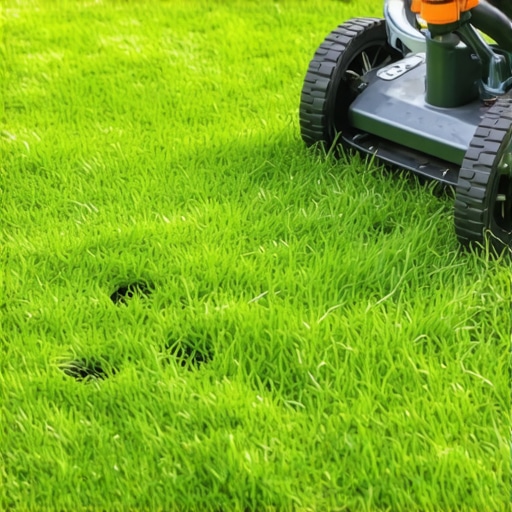
Core aeration is the process of using a mechanical aerator to pull thousands of cylindrical plugs (0.5 to 0.75 inches in diameter and 3-4 inches deep) out of the soil profile. This is not the same as spike aeration. Spike aerators, often sold as shoes or cheap pull-behind tools, actually increase compaction by pushing soil sideways as the spike enters. You must use a hollow-tine aerator that physically removes a core. This creates immediate lateral expansion room for the surrounding soil. Once those cores are pulled, the soil around the hole relaxes, reducing the bulk density of the entire lawn. Oxygen floods back into the root zone, stimulating a hormonal response in the grass to produce new white feeder roots. This is the only way to reset the physical structure of your yard without tilling the whole thing under and starting over.
The Engineering of the Core
| Aeration Method | Resulting Soil Bulk Density | Impact on Water Infiltration | Recommended Frequency |
|---|---|---|---|
| Spike Aeration | Increases Density | Minimal/Negative | Never |
| Liquid “Aeration” | No Change to Physics | Temporary Wetting Agent | Supplementary Only |
| Core Aeration | Decreases Density | 300% Increase | Annual/Bi-Annual |
Do not fall for the liquid aeration scam as a standalone solution. While some surfactants can help water penetrate temporarily, they do nothing to solve the mechanical failure of compacted soil. You cannot dissolve physics with a spray bottle. You need to pull the plugs. It is loud, it is dirty, and it is the most important thing you will do for your garden design and landscaping health this decade.
Can I aerate my lawn myself?
You can, but most rental units are outdated drum-style aerators that are difficult to maneuver and often don’t pull deep enough cores. A professional-grade stand-on piston aerator applies massive downward pressure to ensure 4-inch cores even in sun-baked clay. If you do it yourself, wait for a period of moderate moisture. If the ground is too dry, you won’t get deeper than half an inch. If it is too wet, you will destroy the soil structure and create a muddy mess. You want the soil to have the consistency of damp cake.
“Water movement into the soil is governed by the size and continuity of pores; compaction destroys these pathways, forcing water to move laterally rather than vertically.” – Agronomy Manual Section 4.2
The 2026 Core Aeration Checklist
- Check Soil Moisture: Ensure the ground is moist but not saturated. The “screwdriver test” should allow a 6-inch blade to slide in easily.
- Flag Your Utilities: Call 811. Do not hit your irrigation heads, shallow cable lines, or invisible dog fences. A core aerator will shred them.
- Patterning: Run the machine in a double-pass pattern (North-South, then East-West). You want roughly 20 to 40 holes per square foot.
- Leave the Plugs: Do not rake them up. These cores contain the microbiome of your lawn. As they break down over the next two weeks, they act as a top-dressing, filtering nutrients back into the holes.
- Overseed Immediately: The holes created by aeration are perfect germination chambers. Seed-to-soil contact is 100% in an aeration hole.
Maintenance and the Long Game
Core aeration is not a one-time fix; it is a biological reset. In heavy clay regions, you should be doing this every fall. In sandy soils, every two years is sufficient. If you ignore it, the thatch layer—that spongy mess of dead organic material between the green blades and the soil—will become thick and hydrophobic. Once thatch exceeds half an inch, it acts like a roof, shedding water away from the roots. Aeration punches through that roof. It forces the lawn to integrate that organic matter back into the soil profile. It is the difference between a lawn that survives and a lawn that thrives. I have seen 20-year-old lawns rejuvenated in a single season just by fixing the oxygen deficit. Don’t be the homeowner who keeps buying more fertilizer to fix a structural problem. Fix the dirt first. The grass will follow. It will thrive. It will last. Keep your hands on the equipment and your eyes on the soil physics. That is how you win in 2026.
![Fixing 2026 Yellow Lawn Patches [Pet Waste Fix]](https://lawnmajesty.com/wp-content/uploads/2026/07/Fixing-2026-Yellow-Lawn-Patches-Pet-Waste-Fix.jpeg)