Stop 2026 Leaf Spot on Roses with This Spray
Identifying the 2026 Black Spot Surge in Modern Rose Cultivars
Black spot on roses is a fungal infection caused by the pathogen Diplocarpon rosae, which requires a minimum of seven hours of continuous moisture on the leaf surface to germinate and penetrate the plant tissue. To stop its spread in 2026, a preventative fungicide spray combined with strict sanitation protocols and airflow management is essential for maintaining plant health.
I have spent two decades looking at soil samples and necrotic plant tissue under a 40x lens. I have seen every mistake in the book, but one recent case stands out as a warning for anyone looking for a quick fix. A homeowner called me in a panic after they completely torched their front lawn and a collection of $150 David Austin roses by applying a triple-strength dose of a concentrated copper fungicide during a 95-degree heatwave. They didn’t read the label; they thought ‘more is better.’ Instead of killing the fungus, they acidified the leaf surface to the point of chemical desiccation. The roses didn’t just lose their leaves; the cambium layer on the canes was literally cooked. It was a $4,000 mistake that could have been avoided with 15 minutes of research and a calibrated sprayer. Don’t be that person. If you want results, you have to respect the chemistry and the biology of the plant. A rose is a living system, not a plastic decoration.
“Black spot is the most important disease of roses worldwide. The fungus survives the winter in infected canes and fallen leaves. In the spring, spores are splashed by rain or irrigation water onto the new foliage.” – Texas A&M AgriLife Extension
The Molecular Mechanics of Diplocarpon rosae
To kill the enemy, you have to understand its lifecycle. Black spot isn’t just a surface blemish. Once that spore lands on a wet leaf, it sends out a germ tube that pierces the cuticle. It then develops haustoria—microscopic roots—that suck the nutrients directly out of the rose’s cells. By the time you see that black circle with the fringed edges, the damage is done. The leaf is already signaling its own death, producing ethylene gas that causes it to turn yellow and drop. This is a survival mechanism for the plant, but if it happens too often, the rose loses its ability to photosynthesize, weakens, and eventually dies over the winter because it couldn’t store enough starch in its roots.
The 2026 ‘Master Mix’ Spray Formula
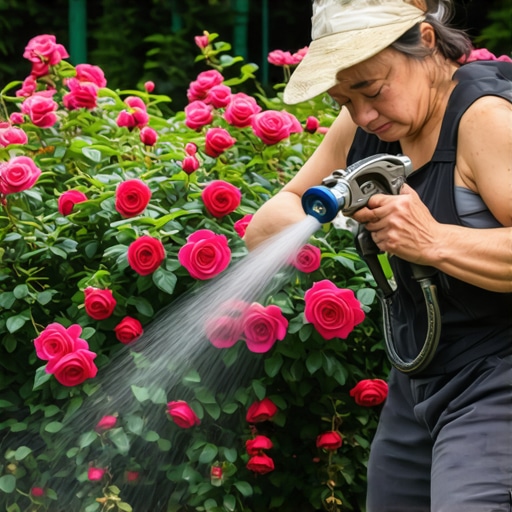
For the 2026 season, we are seeing increased resistance to standard myclobutanil-based sprays. I recommend a rotation of two specific types of fungicides to prevent the pathogen from adapting. You need a Systemic Fungicide (like Tebuconazole) which stays inside the plant tissue for 14 days, and a Contact Protectant (like Chlorothalonil or a high-grade Sulfur) that creates a hostile barrier on the leaf surface. Mix these at the exact manufacturer’s rate—usually 1 tablespoon per gallon, but check your label. I also add a ‘spreader-sticker’—a non-ionic surfactant that ensures the spray doesn’t just bead up and roll off the waxy rose leaf. It needs to coat the underside of the leaf too. That is where the stomata are, and that is where the fungus often gains entry.
| Fungicide Type | Active Ingredient | Application Frequency | Primary Benefit |
|---|---|---|---|
| Systemic | Tebuconazole / Propiconazole | Every 14 Days | Protects new growth from the inside. |
| Contact | Chlorothalonil | Every 7-10 Days | Prevents spore germination on contact. |
| Organic | Sulfur / Potassium Bicarbonate | Every 5-7 Days | Disrupts pH of leaf surface; safe for bees. |
| Bio-Fungicide | Bacillus amyloliquefaciens | Weekly | Uses beneficial bacteria to outcompete fungus. |
How much modified gravel do I need for a patio base?
While this seems unrelated to roses, drainage is the foundation of all landscaping. For a standard patio base, you need 6 inches of 2A modified gravel compacted in 2-inch lifts. If your rose garden borders a hardscape feature, ensure the patio is pitched at 2% (1/4 inch per foot) away from the rose beds. Excess runoff from a poorly graded patio will keep your rose roots saturated, leading to Phytophthora root rot and making the plant more susceptible to leaf spot. I have seen million-dollar landscapes fail because the contractor didn’t understand hydrostatic pressure and drainage. If your soil is heavy clay, you must install a French drain or use perforated PVC to move water out of the root zone.
“A retaining wall doesn’t fail because of the stone; it fails because of the water trapped behind it. The same logic applies to your garden beds—saturated soil is the precursor to pathogen outbreaks.” – Hardscape Engineering Axiom
The Information Gain: Why ‘Old Growth’ Mulch is Killing Your Roses
Most gardeners think any mulch is good mulch. They are wrong. If you are using cheap, dyed mulch from a big-box store, you are likely introducing artillery fungus and slime molds into your garden. More importantly, these mulches are often made from ground-up pallets and construction waste. They have zero nutritional value and can actually tie up nitrogen in the soil as they break down. For roses, you need aged arborist wood chips or composted leaf mold. This provides a home for mycorrhizal fungi which form a symbiotic relationship with rose roots, effectively increasing their surface area for water and nutrient uptake by up to 100 times. A rose with a strong root system can often outpace a fungal infection that would kill a weaker plant.
Why you should never water roses in the evening
If you water your roses at 6:00 PM, you are essentially inviting leaf spot to dinner. The water sits on the leaves all night long, providing the exact 7-hour window Diplocarpon rosae needs to germinate. You must water between 5:00 AM and 8:00 AM. This allows the morning sun to dry the foliage quickly. If you are still using overhead sprinklers, stop. You need a drip irrigation system with emitters spaced 12 inches apart. This keeps the water at the roots and the leaves dry. It also saves about 30% on your water bill because you aren’t losing moisture to evaporation.
Rose Maintenance Checklist for 2026
- Soil Test: Ensure your pH is between 6.0 and 6.5. High pH locks out iron and manganese.
- Dormant Spray: Apply Lime Sulfur in late winter before buds break to kill overwintering spores on the canes.
- Airflow Pruning: Remove any crossing branches in the center of the bush. You should be able to throw a bird through a rose bush without it hitting a branch.
- Sanitation: If a leaf falls, pick it up. Do not compost infected leaves; the heat of a standard home pile isn’t enough to kill the spores. Bag them and trash them.
- Mulch Depth: Maintain exactly 2-3 inches of organic mulch. Any more and you risk root suffocation.
Can I use baking soda to treat rose black spot?
A common DIY tip is using baking soda (sodium bicarbonate). While it can work by changing the pH of the leaf, it is a salt. Repeated applications will build up in your soil, lead to sodium toxicity, and eventually kill the plant. If you want an organic option, use Potassium Bicarbonate. It provides the same pH shift without the harmful salt buildup and actually provides a small boost of potassium, which strengthens the plant’s cell walls. This makes it harder for the fungus to penetrate the leaf in the first place.
Closing the Loop on Rose Health
Don’t expect a single spray to fix a year of neglect. Landscaping is a game of inches and consistency. You have to be out there, checking the undersides of the leaves, monitoring the soil moisture, and pruning with intent. If you follow the protocol—calibrate your sprayer, water the roots, and use the right chemistry—you won’t just stop leaf spot in 2026; you will have a garden that is structurally and biologically superior to anything your neighbors are doing. It takes work. It takes dirt under your fingernails. But that is the difference between a landscaper and a guy with a lawnmower.