Stop 2026 Tree Root Damage with Proper Care
The Structural Autopsy: Why Trees Fail Years After the Excavator Leaves
Root damage in landscaping often stays hidden for three to five years, meaning the mistakes you make today will manifest as a dead canopy in 2026. By understanding soil compaction, pore space, and the critical root zone (CRZ), you can prevent structural failure and costly hardscaping repairs. It is a slow death. Most homeowners don’t see it coming until the tree is a liability.
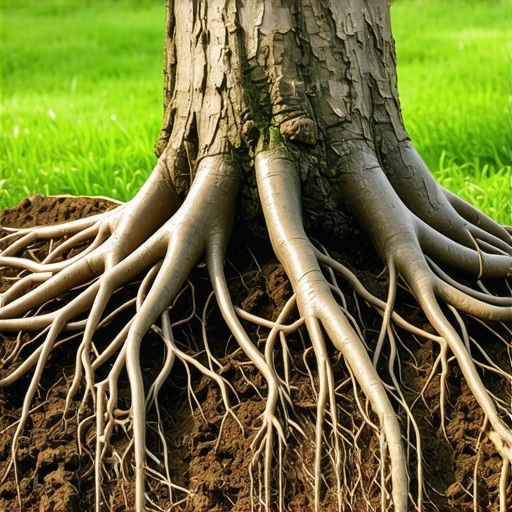
I always drill into my new crew members: if you don’t fix the soil grading first, every plant you put in the ground is just expensive compost. I’ve watched guys with shiny trucks and new shovels drop a $2,000 specimen tree into a hole that was essentially a clay bowl with no drainage. That tree didn’t die that week. It took three years for the roots to drown in the bathtub they’d built. When we finally got called to look at it in the third season, the root flare was buried six inches deep, and the tree was literally strangling itself. We call it a ‘slow-motion execution.’ If you aren’t looking at the trunk-to-root transition—the flare—you are failing the plant and the client. Period.
“The critical root zone is generally defined as a circular area around a tree with a radius equal to one foot for every inch of tree diameter at breast height (DBH).” – Penn State Extension
The Mechanics of Root Girdling and Foundation Pressure
Girdling roots act as a biological garrote, slowly cutting off the flow of nutrients through the xylem and phloem as the tree grows. This often happens because the tree was grown in a container too long or planted too deep in the garden design. When roots hit the edge of a planting hole that hasn’t been properly scarified, they turn and circle. As those roots thicken, they press against the trunk. This restricts the tree’s vascular system. It is like trying to breathe with a belt tightened around your neck. By the time you see the canopy thinning in 2026, the damage is often irreversible. You have to intervene now by exposing the root flare and pruning circling roots before they become structural anchors.
How do I stop tree roots from lifting my driveway?
To prevent roots from lifting hardscaping, you must install physical root barriers made of high-density polyethylene (HDPE) to a depth of at least 18 inches. These barriers force the roots downward, away from the modified gravel base of your driveway or patio, preventing hydrostatic pressure and soil heave. Most people think roots grow deep. They don’t. They stay in the top 12 to 18 inches of soil because that is where the oxygen is. If you provide a compacted gravel path, they will find the moisture underneath it and lift your pavers. Use a barrier. Don’t skip this.
| Material Type | Effective Depth | Best Use Case | Durability Rating |
|---|---|---|---|
| HDPE Plastic Panels | 18-24 inches | Driveways and Sidewalks | High |
| Bio-Barriers (Herbicidal) | 12-18 inches | Retaining Wall Protection | Medium |
| Copper-Coated Fabric | 12 inches | Flower Bed Borders | Low |
The 2026 Soil Health Protocol: Compaction is the Silent Killer
Soil compaction is the primary reason for lawn care failure and tree decline in urban environments. When we bring heavy equipment in for landscaping, we crush the macropores and micropores in the soil. This eliminates the space for air and water. Roots cannot penetrate soil that has a Proctor density higher than 80%. They starve. If you are planning a project now, you must protect the CRZ with wood chips or temporary fencing. If the soil is already compacted, you need to look at supersonic air-spade services to loosen the soil without damaging the delicate feeder roots. It is specialized work. It is not cheap. But it is cheaper than removing a 50-foot oak that fell on your house because its roots rotted in compacted dirt.
“Root systems are not typically deep; 90% of a tree’s active roots are found in the top 18 inches of soil.” – ISA (International Society of Arboriculture)
What is the best way to protect tree roots during construction?
Protect tree roots during hardscaping construction by establishing a Tree Protection Zone (TPZ) that is off-limits to all heavy machinery and material storage. Use a layer of 6 inches of wood mulch over the root zone if temporary access is required to distribute the weight and prevent pore space collapse. One pass with a skid-steer on wet soil can do enough damage to kill a tree by 2026. You won’t see the yellowing leaves today. You will see them in three years. Respect the TPZ. It is the only way to ensure the long-term viability of the site.
The Master Landscaper’s Tree Audit Checklist
- Expose the Root Flare: Ensure the transition between the trunk and roots is visible above the soil line.
- Check Soil pH: Trees near concrete hardscaping often suffer from high alkalinity; adjust with elemental sulfur if needed.
- Inspect for Girdling: Use a hand trowel to find roots crossing the main trunk and prune them cleanly.
- Monitor Moisture: Use a soil probe to check moisture levels 6 inches down; aim for deep, infrequent saturation.
- Mulch Correctly: Apply a 2-3 inch layer of organic mulch, keeping it 3 inches away from the trunk—no ‘mulch volcanoes.’
Proper lawn care and tree maintenance require a long-term view. Most contractors want to get paid and get out. They don’t care what happens in 2026. I do. If you want a landscape that lasts a generation, you have to respect the biology of the ground. Stop treating your yard like a static object and start treating it like a living system. Get the soil right. Get the planting depth right. The rest is just window dressing.