The Best Drought-Tolerant Plants for Full Sun Borders
The Engineering Behind Drought-Resistant Garden Design
To build a successful drought-tolerant border, you must prioritize soil structure and drainage capacity over aesthetics. High-performance xeric gardens rely on deep-reaching root systems and mulch layers that regulate soil temperature, preventing the thermal shock common in full-sun exposures.
I always drill into my new crew members: if you don’t fix the soil grading first, every plant you put in the ground is just expensive compost. Most homeowners see a dry patch of dirt and think a few bags of big-box store mulch will save them. It won’t. I have spent two decades remediating sites where ‘landscapers’ ignored the compaction layers and the Cation Exchange Capacity (CEC) of the soil. When you are dealing with full sun borders, you are dealing with a high-transpiration environment. If the roots cannot find water six to twelve inches down because the soil is a compacted brick of clay or a nutrient-devoid pile of sand, the plant will fail. Period. It is not about the water you put on top; it is about the reservoir you build underneath.
The Science of Soil Porosity and Hydraulic Conductivity
In a full-sun exposure, the top two inches of soil can reach temperatures exceeding 120 degrees Fahrenheit. This heat literally cooks the mycorrhizal fungi and beneficial bacteria necessary for plant health. Professional garden design starts with a soil test. We are looking for a pH between 6.2 and 7.0 for most drought-tolerant perennials. If your pH is off, the plant cannot uptake nutrients regardless of how much fertilizer you dump on it. We focus on ‘macropores’ and ‘micropores.’ Macropores allow for the rapid infiltration of water and air, while micropores hold onto moisture for the plant to use during dry spells. Achieving this balance requires the mechanical incorporation of high-quality organic matter—not the bagged woodchips from the hardware store, but composted leaf mold or aged manure.
“Soil health is the primary determinant of plant survival in water-limited environments; without adequate organic matter, the soil’s water-holding capacity drops by 50% for every 1% loss in organic carbon.” – Agricultural Extension Agronomy Manual
Strategic Plant Selection for Full Sun Borders
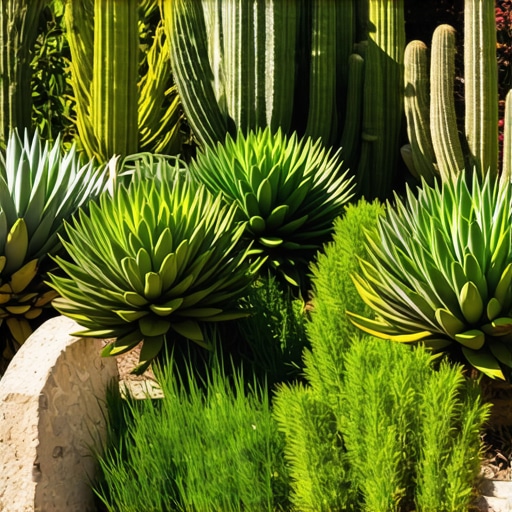
When selecting plants, we categorize them by their adaptive strategies: sclerophyllous (leathery leaves), tomentose (hairy leaves), or succulent. These are not aesthetic choices; they are survival mechanisms. A hairy leaf, like that of Stachys byzantina, creates a micro-layer of still air that reduces moisture loss from the leaf surface. [image_placeholder] This is the engineering of nature at work.
| Plant Species | Root Structure | Drought Index | Preferred pH Range |
|---|---|---|---|
| Perovskia atriplicifolia | Taproot/Woody | High | 6.5 – 7.5 |
| Agastache ‘Blue Fortune’ | Fibrous | Moderate | 6.0 – 7.0 |
| Echinacea purpurea | Deep Fibrous | High | 6.0 – 8.0 |
| Lavandula angustifolia | Woody/Spreading | Very High | 6.7 – 7.3 |
| Sedum ‘Autumn Joy’ | Fleshy/Rhizomatous | Extreme | 6.0 – 7.5 |
Which plants survive 10 hours of direct sun?
Plants with deep taproots or waxy leaf coatings, such as Russian Sage, Lavender, and certain species of Sedum, are best suited for 10+ hours of direct sun. These species have evolved to minimize water loss through their stomata while maximizing soil moisture extraction through specialized root architectures.
Russian Sage (Perovskia atriplicifolia) is a staple for a reason. It is a workhorse. It demands a well-drained site. If you plant this in heavy clay that holds water during the winter, the roots will rot by March. We install these on a slight mound if the site has poor drainage. Then there is Agastache. Not only is it drought-tolerant, but it provides high-calorie forage for pollinators. However, Agastache is sensitive to planting depth. If you bury the crown even half an inch too deep, you’ve signed its death warrant. The crown must sit exactly at the soil line.
How do I prep soil for a drought-tolerant garden?
Soil preparation for drought tolerance requires deep tilling to 12 inches, the incorporation of 3 inches of high-quality organic compost, and the application of a 2-3 inch layer of coarse-textured mulch to prevent surface evaporation and suppress weed competition.
The installation process is where the hacks separate from the pros. We use a ‘specimen-specific’ digging protocol. The hole should be twice as wide as the root ball but no deeper. We never use ‘potting soil’ in the hole. We use the native soil, amended with no more than 20% compost. If you fill a hole with rich potting soil in a field of heavy clay, you have effectively created a bathtub. The water will fill the hole and stay there, drowning the roots. We call this the ‘container effect.’ It is the most common cause of plant death in residential landscaping.
- Test soil pH and adjust with lime or sulfur 3 weeks prior to planting.
- Excavate planting holes to 2x root ball width to allow for lateral root expansion.
- Remove any girdling roots from nursery-grown stock to prevent future choking.
- Install plants at a depth where the root flare is visible at the soil surface.
- Apply 20 gallons of water per 10 square feet immediately after planting to eliminate air pockets.
- Top-dress with a coarse cedar or hemlock mulch—avoid ‘mulch volcanoes’ around stems.
“Hydraulic lift, the movement of water from moist deep soil layers to dry shallow layers via plant roots, is a critical survival mechanism for deep-rooted perennials in sun-baked borders.” – USDA Plant Physiology Research
The Myth of Low Maintenance
There is no such thing as a ‘no-maintenance’ garden. Even the most drought-tolerant border requires a ‘settling in’ period of 12 to 24 months. During this time, the goal is to force the roots down. If you water for ten minutes every day, the roots will stay in the top two inches of soil. When the first real heat wave hits, they will bake. You must water deeply and infrequently. We recommend 1 inch of water once a week, delivered via drip irrigation at a low GPH (Gallons Per Hour) rate. This mimics a deep rain and encourages the roots to chase the moisture deep into the subsoil. Once established, these plants should only need supplemental water during extreme droughts (3+ weeks without rain).
Hardscape Integration and Drainage
A border is only as good as the hardscaping that surrounds it. If you have a concrete patio adjacent to your border, that concrete acts as a heat sink. It will radiate heat into the soil long after the sun goes down. This increases the ‘micro-climate’ temperature. We often install a ‘buffer zone’ of 4-6 inches of clean 57 stone between the hardscape edge and the first plant. This provides a thermal break and ensures that runoff from the patio doesn’t overwhelm the root zones of the xeric plants. We also look at hydrostatic pressure. If the border is at the bottom of a slope, we install a French drain behind a low fieldstone wall to divert excess groundwater. Drought-tolerant doesn’t mean they can handle standing water; in fact, most ‘desert’ plants are more sensitive to over-watering than under-watering.