The Best Methods for Removing Tree Stumps from Your Yard
Why Stump Removal is the Foundation of Professional Landscaping
To ensure successful lawn care or hardscaping, removing tree stumps is essential to prevent soil subsidence, fungal pathogens, and pest infestations like termites. Professional removal involves more than just surface grinding; it requires addressing the root flare and secondary lateral roots to stabilize the ground for future construction. I always drill into my new crew members: if you don’t fix the soil grading first, every plant you put in the ground is just expensive compost. Stumps are the enemy of grading. They create air pockets as they rot. They invite Armillaria mellea, or honey fungus, which can spread underground to kill your healthy $5,000 specimen trees. If you’re planning a patio, a stump left in the ground is a ticking time bomb for your hardscaping. It will rot. The ground will sink. Your pavers will crack. No exceptions.
Mechanical Stump Grinding: The Industrial Standard
Mechanical stump grinding uses a high-speed carbide-tipped wheel to pulverize wood into mulch, typically reaching depths of 6 to 18 inches below the soil grade. This method is the most efficient for garden design projects where immediate replanting or turf installation is required to maintain aesthetics. Do not hire a guy with a 25HP rental unit for a 40-inch oak stump. You need a 75HP track-mounted grinder. We chase the lateral roots until the machine hits mineral soil. This ensures the lawn care routine isn’t interrupted by ‘mushrooms circles’ or sinking turf five years down the line. We don’t just grind; we excavate the ‘grindings.’ Wood chips are high in carbon. As they decompose, they rob the soil of nitrogen. This is called nitrogen tie-up. If you leave those chips and throw seed over them, your grass will be yellow and stunted. It’s basic soil chemistry.
How much does stump grinding cost per inch?
Professional rates for stump grinding typically range from $3 to $5 per inch of the stump’s diameter measured at its widest point near the ground. Factors such as root spread, soil rockiness, and machine accessibility can increase the total cost of the landscaping project.
“A retaining wall doesn’t fail because of the stone; it fails because of the water trapped behind it, or the unstable organic matter rotting beneath its base.” – Hardscape Engineering Axiom
The Biology of Decay: Chemical Stump Removal Methods
Chemical stump removal relies on high-nitrogen fertilizers or potassium nitrate to accelerate the natural decomposition process of the lignin and cellulose within the wood. This method is cost-effective for long-term landscaping plans but requires 12 to 24 months of wait time before the soil is stable enough for heavy hardscaping. You drill 1-inch holes, 12 inches deep, every 3 inches around the perimeter. Fill them with the accelerant and keep it moist. This isn’t a quick fix. It is a biological process. The nitrogen feeds the bacteria that eat the wood. If you’re in a hurry, skip this. If you have a back-40 area where aesthetics don’t matter, it’s a viable engineering choice. But remember: a rotting stump is a beacon for carpenter ants. Keep it far from your house foundation.
Manual Excavation and High-Pressure Hydraulics
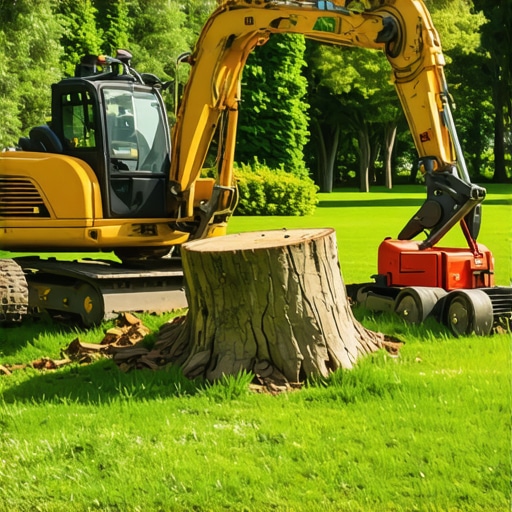
Manual stump excavation involves using backhoes or compact excavators to physically rip the root ball out of the earth, providing the cleanest slate for garden design and utility installation. This is the only way to go if you’re installing a pool or a structural wall. You have to break the taproot. We use a 5-ton excavator for anything over 20 inches. The leverage required is immense. Once the stump is out, you’re left with a massive void. You cannot just fill this with topsoil. You must backfill in 6-inch ‘lifts’ and use a vibratory plate compactor. If you don’t reach 95% Proctor density, your new lawn will have a bowl in it by next spring. Soil physics doesn’t care about your weekend schedule.
“Complete removal of the root system is the only way to guarantee that fungal pathogens do not migrate to new plantings in the same vicinity.” – USDA Forest Service Management Guide
What is the easiest way to remove a large tree stump?
The easiest and most effective way to remove a large stump is via a high-horsepower stump grinder operated by a professional who understands soil compaction and nitrogen management. Attempting to pull a stump with a pickup truck is a recipe for a snapped frame or a shattered window. Physics wins every time.
| Method | Timeframe | Cost Factor | Best Use Case |
|---|---|---|---|
| Mechanical Grinding | 1-4 Hours | Medium | Lawn renovation & Garden design |
| Chemical Rotting | 12-24 Months | Low | Low-traffic areas/Budgeting |
| Full Excavation | 2-6 Hours | High | Hardscaping & Construction |
| Manual Digging | Days/Weeks | Labor Only | Small stumps (< 6 inches) |
- Step 1: Locate all underground utilities by calling 811. Don’t hit a gas line for a $200 stump.
- Step 2: Clear rocks and debris from a 5-foot radius around the stump flare.
- Step 3: Grind or excavate to at least 12 inches below grade.
- Step 4: Remove 90% of the wood chips to prevent nitrogen deficiency.
- Step 5: Backfill with a 70/30 mix of screened topsoil and compost, compacting every 6 inches.
Remediation: Restoring the Nitrogen Cycle
After a stump is gone, the soil is often dead. The pH might be acidic from the decomposing wood. We test the soil. Usually, we need to add lime to bring the pH back to the 6.5 range for lawn care success. We also double the nitrogen application for the first two cycles. Use a slow-release 24-0-4 fertilizer. Don’t use big-box weed-and-feed. It’s garbage. You need raw nutrients to offset the carbon load. Landscaping isn’t just about what you see; it’s about the microscopic reality of the soil. Do it right, or don’t do it at all.”
![Stop 2026 Leaf Rust on Hydrangea Shrubs [Fix]](https://lawnmajesty.com/wp-content/uploads/2026/07/Stop-2026-Leaf-Rust-on-Hydrangea-Shrubs-Fix.jpeg)
![Stop 2026 Pine Needle Drop [Soil Nutrition Fix]](https://lawnmajesty.com/wp-content/uploads/2026/07/Stop-2026-Pine-Needle-Drop-Soil-Nutrition-Fix.jpeg)