The Best Trees to Plant Near a Pool for Privacy and No Mess
The Engineering of Poolside Planting and Privacy
Most pool projects fail before the first shovel hits the dirt because homeowners focus on aesthetics while ignoring the literal tons of hydrostatic pressure and chemical spray. To select the best trees for pool privacy, you must prioritize evergreen conifers or broadleaf evergreens with low litter rates and non-invasive taproots. Species like Thuja Occidentalis ‘Emerald Green’ or Trachelospermum jasminoides prevent pool filter clogging while providing a visual barrier against neighbors. I always drill into my new crew members: if you don’t fix the soil grading first, every plant you put in the ground is just expensive compost. I have seen $50,000 gunite pools cracked by the lateral root pressure of a misplaced Silver Maple. It is a disaster that could have been avoided with 20 minutes of horticultural planning. Landscaping near a pool requires a deep understanding of soil pH and the chemical reality of chlorine or salt-water splash-back. You are not just gardening; you are managing a micro-ecosystem that interacts with 20,000 gallons of treated water.
“A retaining wall doesn’t fail because of the stone; it fails because of the water trapped behind it.” – Hardscape Engineering Axiom
The Physics of Root Systems and Pool Liners
Root systems are opportunistic. They hunt for water, and a pool deck that traps moisture underneath is a prime target. When you choose a tree, you are looking for species with a deep taproot or a non-aggressive fibrous system. Avoid Salix (Willows) or Populus (Poplars) at all costs. Their roots can travel three times the height of the tree. If they find a hairline crack in your plumbing or your vinyl liner, they will exploit it. You need a root barrier. We install 60-mil high-density polyethylene (HDPE) root barriers at a 24-inch depth for any tree planted within 10 feet of the pool coping. This is not optional if you want the pool to last 30 years.
Top Trees for Privacy and Low Maintenance
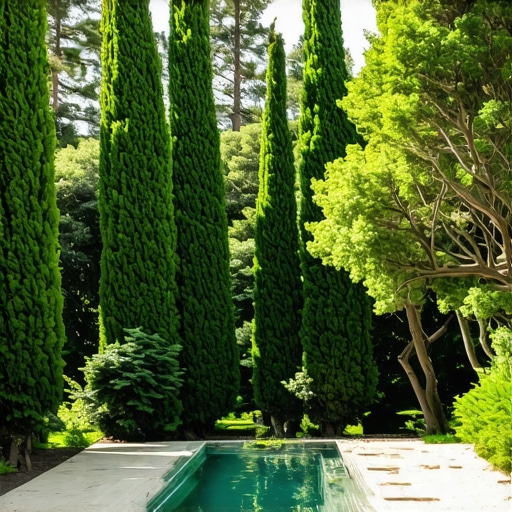
Choosing the best trees for privacy involves balancing growth rate, foliage density, and deciduous shedding to minimize pool maintenance. Professional landscaping requires selecting columnar evergreens like Skyrocket Junipers or Spartan Junipers which offer narrow footprints and high UV resistance. These trees do not drop large leaves that stain plaster or clog skimmer baskets. Here is a technical breakdown of the top performers for pool-side utility.
| Tree Species | Growth Rate | Root Aggression | Debris Level | Min. Distance from Pool |
|---|---|---|---|---|
| Thuja ‘Emerald Green’ | Moderate | Low | Very Low | 6 Feet |
| Spartan Juniper | Fast | Low | Low | 5 Feet |
| Japanese Blueberry Tree | Moderate | Low | Low (Evergreen) | 8 Feet |
| Clumping Bamboo (Gracilis) | Extremely Fast | High (Surface) | Moderate | 10 Feet (with barrier) |
How far should I plant a tree from a pool deck?
The distance depends entirely on the tree’s mature canopy width and root architecture. As a hard rule, plant any tree at least 6 to 10 feet away from the outer edge of the pool coping. This provides a buffer for the hardscaping base, which usually consists of 4 to 6 inches of compacted modified gravel. If you plant too close, the expanding root flare will heave the pavers or crack the concrete. We use a 95 percent Proctor density compaction for the sub-base, and any root growth that disrupts this compaction will cause the pool deck to sink. It will fail. Don’t skip the spacing requirements just for a bit more shade.
Which trees have the least invasive root systems?
Evergreens like the Hicks Yew or the Skyrocket Juniper are the gold standard for non-invasive roots near a pool. These species have concentrated root balls that do not seek out moisture with the same intensity as hardwoods. When performing lawn care or garden design near a pool, you must also account for the Cation Exchange Capacity (CEC) of your soil. Heavy clay soils will hold onto pool chemicals, effectively poisoning the roots of sensitive species. Sandy loam is preferred for drainage. We often excavate the native clay and replace it with a structured soil mix of 70 percent sand and 30 percent organic compost to ensure the roots grow downward rather than outward toward the pool structure.
“Plants in proximity to chlorinated water must exhibit high tolerances for salt and aerosolized chemicals to prevent foliar burn.” – Texas A&M AgriLife Extension
The Soil Grading and Drainage Protocol
The biggest mistake in landscaping is ignoring the grade. The ground must slope away from the pool at a minimum of 2 percent. If your garden design creates a basin where water collects, the hydrostatic pressure will eventually pop the pool out of the ground or collapse the walls during a heavy rain. We install French drains behind any planting beds that are uphill from the pool. This 4-inch perforated pipe, wrapped in geotextile fabric and buried in 3/4-inch clean stone, diverts runoff before it can saturate the pool’s backfill. This is engineering, not just planting. Every hole you dig should be twice as wide as the root ball but no deeper than the root flare. Planting too deep is a death sentence; it causes stem-girdling roots that will kill the tree in five years.
The Poolside Planting Checklist
- Verify 811 utility markings before excavating any planting beds.
- Test soil pH; most pool-side trees prefer a range of 6.0 to 7.0.
- Install a 60-mil HDPE root barrier if planting within 8 feet of the deck.
- Set up a dedicated drip irrigation zone to keep moisture consistent and deep.
- Use 2 to 3 inches of wood mulch, but keep it 4 inches away from the tree trunk.
- Check the drainage; pour 5 gallons of water into the hole and ensure it drains within 2 hours.
Mitigating Chemical and Salt Exposure
If you have a saltwater pool, you are essentially creating a coastal environment. You need trees that are salt-tolerant. The Japanese Black Pine or certain species of Holly can handle the salt spray without developing chlorosis or tip-burn. For chlorine pools, the risk is less about the air and more about the splash. Ensure your lawn care regimen does not include high-nitrogen fertilizers right at the pool’s edge, as these can leach into the water and cause massive algae blooms. Use slow-release organic granules. Keep it simple. Keep it professional. Your tree choice determines whether your backyard is a maintenance nightmare or a clean, private space. Stick to the species with tight growth habits and low litter. If it produces a fruit, a nut, or a large leaf, it does not belong near the water.
![3 Reasons Your 2026 Hydrangeas Aren't Blooming [Fix]](https://lawnmajesty.com/wp-content/uploads/2026/05/3-Reasons-Your-2026-Hydrangeas-Arent-Blooming-Fix.jpeg)