
Why We Stopped Bagging Grass Clippings Every Summer
The Biology of Grass Recycling: Why Bagging is Starving Your Turf
Leaving grass clippings on your lawn, a practice known as grasscycling, serves as a natural fertilizer injection that returns approximately 25% of the nitrogen back into the soil ecosystem. By allowing these nitrogen-rich blades to decompose in the rhizosphere, you stimulate microbial activity and reduce the need for synthetic chemical inputs. It is a biological closed-loop system. Most homeowners think they are cleaning their yard; in reality, they are hauling away free nutrients and paying for the privilege.
The Chemical Nightmare: A Cautionary Tale of Synthetic Overload
I remember a homeowner in late July who called me out to look at a front lawn that looked like it had been hit by a flamethrower. They were bagging every single clipping twice a week and then, fearing the lawn was thinning, they dumped a heavy 32-0-4 synthetic fertilizer during a 95-degree heatwave. Without the organic moisture buffer of decomposing clippings, the high salts in the fertilizer literally sucked the moisture out of the grass crowns. We call this osmotic stress, but to the homeowner, it just looked like $5,000 in sod turning into brown straw. We had to core aerate and apply a heavy layer of liquid humic acid just to get the soil biology to wake up again. Stop the madness. If they had just let the clippings fall, the natural nitrogen release would have kept that lawn resilient without the chemical burn.
“Grass clippings contain approximately 4 percent nitrogen, 0.5 percent phosphorus, and 2 percent potassium. When left to decompose, they provide the equivalent of one full fertilizer application per season.” – Penn State Center for Turfgrass Science
The Engineering of a Mulching Deck
A standard side-discharge mower is a crude tool compared to a high-vacuum mulching deck designed to circulate grass blades until they are pulverized into microscopic fragments. These fragments are small enough to bypass the canopy and settle directly on the soil surface where actinomycetes and other soil bacteria can begin the decomposition process. If your clippings are longer than one inch, they won’t settle; they’ll mat. This leads to anaerobic conditions. You must maintain sharp blades. Dull blades tear the tissue, leading to increased evapotranspiration and disease susceptibility.
Does leaving grass clippings cause thatch?
No, grass clippings do not cause thatch because they are composed of 85-90% water and contain very little lignin, meaning they decompose rapidly within weeks. Thatch is actually a buildup of woody roots, rhizomes, and stolons that haven’t broken down because the soil is too compacted or acidic for microbes to thrive. In fact, the microbes that come to eat your clippings often stick around to help break down the real thatch layer. It’s a symbiotic cleanup crew.
| Nutrient/Component | Grass Clippings (Recycled) | Commercial Synthetic Fert |
|---|---|---|
| Nitrogen (N) | Slow-release Organic | Fast-release Salt-based |
| Water Content | 85-90% | 0% |
| Microbial Support | High (Prebiotic) | Low (Can inhibit fungi) |
| Cost per Acre | $0.00 | $150 – $300 |
How much nitrogen do recycled clippings actually provide?
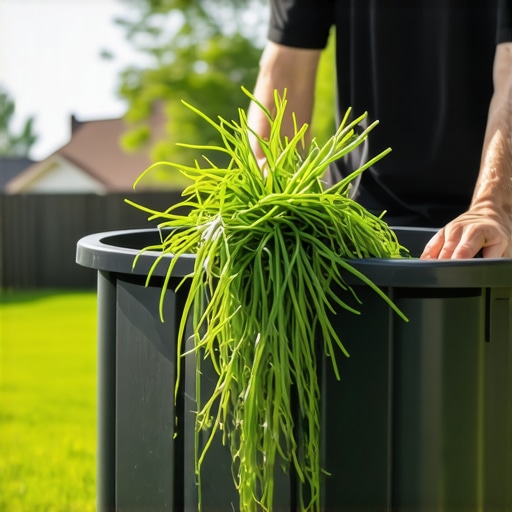
Recycled grass clippings provide roughly 1 pound of nitrogen per 1,000 square feet over the course of a growing season, which satisfies nearly one-third of the total nutrient requirement for cool-season grasses. This isn’t just a guess; it’s a measurement of dry matter yield. If you are bagging, you are essentially throwing away a bag of 10-2-6 fertilizer every three mows. [image_placeholder_1]
“The accumulation of organic matter from grass clippings improves soil structure, increases water infiltration, and enhances the CEC (Cation Exchange Capacity) of the soil profile.” – Texas A&M Agrilife Extension
The 1/3 Rule: Engineering the Perfect Cut
You must never remove more than one-third of the leaf blade in a single mowing event to prevent physiological shock to the plant. When you cut too deep, you limit the plant’s ability to photosynthesize, forcing it to draw on stored carbohydrate reserves in the roots. This weakens the structural integrity of the turf. For summer maintenance, keep your deck height at 3.5 to 4 inches. This shades the soil, reduces weed germination (specifically crabgrass), and ensures the clippings are small enough to disappear into the canopy.
- Check Blade Sharpness: A clean cut prevents jagged edges that invite Pythium blight.
- Mow When Dry: Wet clippings clump and create anaerobic mats that kill the grass underneath.
- Vary Your Pattern: Prevents soil compaction and grain development in the turf.
- Check Soil pH: Microbes need a pH between 6.0 and 7.0 to efficiently break down clippings.
When should you actually bag grass clippings?
You should only bag clippings if the lawn is suffering from a documented fungal outbreak like Dollar Spot or Brown Patch to prevent the spread of spores, or if the grass has grown so long that the 1/3 rule cannot be followed. If you’ve been on vacation and the grass is 8 inches tall, bagging is a necessary evil to prevent smothering the turf. Otherwise, let it ride. The soil is a living organism; feed it.
![Why Your 2026 Grass Seed is Failure [Clay Fixes]](https://lawnmajesty.com/wp-content/uploads/2026/06/Why-Your-2026-Grass-Seed-is-Failure-Clay-Fixes.jpeg)