How to Build a Natural Privacy Screen with Cedar and Lattice
The Engineering and Biology of a Permanent Privacy Screen
A natural privacy screen utilizing Western Red Cedar and lattice requires precise engineering of wind loads and soil mechanics to prevent structural failure. Unlike a simple fence, a screen integrated with plants must manage hydrostatic pressure and biological competition for nutrients within the rhizosphere. I always drill into my new crew members: if you do not fix the soil grading first, every plant you put in the ground is just expensive compost. I have seen too many rookies install beautiful cedar structures directly over drainage swales, leading to post rot in under three years. Understanding the compressive strength of your footings and the soil pH for your climbing vines is the difference between a legacy project and a warranty nightmare.
“A retaining wall doesn’t fail because of the stone; it fails because of the water trapped behind it.” – Hardscape Engineering Axiom
The Forensic Analysis of Material Longevity
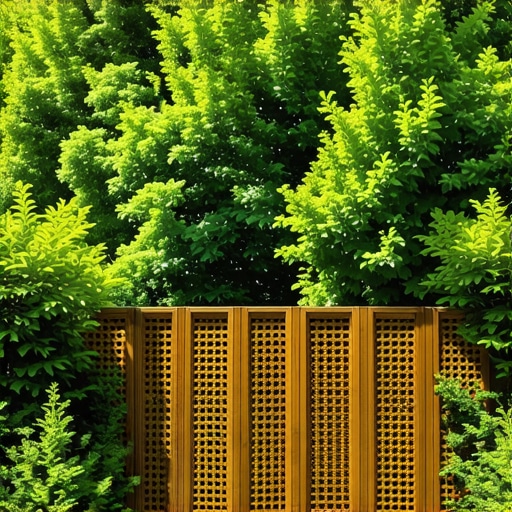
Cedar is the industry standard due to its natural thujaplicins, which are chemical compounds that act as organic fungicides. These tannins prevent rot and repel wood-boring insects. However, grade A clear cedar is a significant investment. Many homeowners settle for pressure-treated pine, which contains copper-based chemicals that can leach into the soil, negatively impacting the mycorrhizal fungi essential for the plants you intend to grow on the lattice. When building a screen, you must consider the porosity of the lattice. A tighter 2 inch diamond pattern provides more privacy but acts as a sail during high-wind events. You need to calculate the wind load capacity based on your local frost line and soil density. For most residential installs, a post depth of 36 inches is the absolute minimum to resist frost heave. [IMAGE_PLACEHOLDER]
| Material | Durability (Years) | Resistance to Fungi | Maintenance Level |
|---|---|---|---|
| Western Red Cedar | 20-25 | High (Natural) | Moderate (Staining) |
| Pressure Treated Pine | 15-20 | Moderate (Chemical) | High (Warps) |
| Vinyl Lattice | 30+ | Extreme | Low |
| Ipe (Brazilian Walnut) | 40+ | Extreme | Very Low |
How deep should fence posts be for a privacy screen?
To ensure structural stability, fence posts for a privacy screen should be buried to a depth of at least one-third of the post’s total height, or below the local frost line, whichever is deeper. In most temperate climates, this is 36 to 48 inches to prevent heaving. If you are in a high-wind area, the footer diameter should be at least three times the width of the post. I use 4,000 PSI concrete for the footers, but I never pour it directly against the wood. I use a 2-inch gravel bed at the bottom of the hole for drainage. This prevents the end-grain of the cedar from sitting in a pool of water inside the concrete sleeve. It will rot. Don’t skip this.
The Horticultural Integration: Selecting the Right Biomass
Integrating living elements with hardscaping requires knowledge of USDA Hardiness Zones and root architecture. If you are planting at the base of your cedar screen, you must avoid root girdling. Choose species like Clematis or Lonicera sempervirens. These vines utilize tendrils or twining stems that will not compromise the structural integrity of the cedar lattice like invasive English Ivy would. The soil microbiology must be prioritized. If your soil is heavy clay, you must amend the entire planting strip with expanded shale or compost to improve pore space for oxygen. Roots need to breathe. If you plant too deep, you will suffocate the root flare. This is a death sentence for the plant.
“Soil compaction is the single greatest cause of plant failure in the urban landscape.” – Penn State Agricultural Extension
How to Build a Natural Privacy Screen with Cedar and Lattice: The Installation Protocol
- Utility Marking: Call 811 before you even think about grabbing a shovel. Severing a gas line will end your day very quickly.
- Post Hole Excavation: Use a power auger to reach the required depth. Hand digging is for people who do not value their time.
- Post Setting: Use a 4-foot level on two adjacent sides of the post. Use temporary bracing.
- Concrete Pouring: Slope the top of the concrete away from the post to shed water.
- Lattice Attachment: Use 3-inch stainless steel screws. Zinc-plated fasteners will react with cedar tannins and leave black streaks.
- Planting: Dig holes twice as wide as the root ball. Keep the root flare 1 inch above the soil line.
How much modified gravel do I need for a patio base?
While this project focuses on vertical screens, any surrounding hardscape requires a base layer of modified gravel (2A or 21A). For a standard 4-inch base, you need roughly 1 ton of gravel per 100 square feet. This gravel must be compacted in 2-inch lifts using a plate compactor to reach 95% Proctor density. If you do not compact it, the screen footers and the surrounding ground will settle unevenly, leading to structural torsion and cracked lattice panels.
The Long-Term Maintenance and Biome Logic
Cedar will naturally weather to a silvery-gray. This is the wood’s way of protecting itself from UV degradation. If you want to keep the warm color, you must apply a penetrating oil stain every 2 to 3 years. Check the lattice caps for moisture retention. If water sits on top of the lattice, it will wick into the end-grain. I recommend a slight 15-degree bevel cut on all horizontal surfaces to encourage hydrostatic runoff. In year one, your plants will focus on root establishment. Do not over-fertilize with high-nitrogen chemicals. Use a slow-release organic fertilizer to support the rhizosphere without burning the delicate new root hairs. Deep, infrequent watering is the rule. Force the roots to chase the moisture down 12 inches into the soil. This creates a drought-resistant screen that can survive a dry August without constant monitoring.
![Building a Hidden Trash Can Screen [DIY 2026]](https://lawnmajesty.com/wp-content/uploads/2026/09/Building-a-Hidden-Trash-Can-Screen-DIY-2026.jpeg)