![Why Your 2026 Grass Seed is Failure [Clay Fixes]](https://lawnmajesty.com/wp-content/uploads/2026/06/Why-Your-2026-Grass-Seed-is-Failure-Clay-Fixes.jpeg)
Why Your 2026 Grass Seed is Failure [Clay Fixes]
Why Your 2026 Grass Seed is Failure [Clay Fixes]
You walk across your yard and it feels like a sponge in April and a parking lot in August. That is the hallmark of high-density clay soil, and it is the primary reason your expensive 2026 grass seed is destined to fail before it even germinates. Most homeowners think the problem is the seed brand; the reality is a structural and chemical blockade happening six inches underground. If you do not address the bulk density and the anaerobic state of your soil, you are just throwing money into a decorative compost bin. Stop. Before you buy another bag of Kentucky Bluegrass or Tall Fescue, you need to understand the physics of the ground beneath your boots.
The Forensic Autopsy of a Failed Clay Lawn
Grass seed failure in clay occurs because heavy soil particles lack pore space, leading to root suffocation, poor drainage, and physical resistance that prevents seedling emergence. To fix this, you must mechanically alter the soil structure and chemically balance the cation exchange capacity to allow for oxygen infiltration and nutrient mobility within the root zone.
I recently got called out to a property where the homeowner had spent $4,500 on ‘premium’ aeration and overseeding the previous fall. By spring, the yard was 70% bare dirt and 30% moss. I took a penetrometer reading and the soil resistance was over 300 PSI at just two inches deep. The grass didn’t die from lack of water; it died because the roots couldn’t punch through the ‘brick’ the soil had become. They had essentially planted their lawn in a giant ceramic bowl. When we pulled a core, the roots were sideways. Literally sideways. If the root can’t go down, the plant can’t survive the first heat wave. This is what happens when you ignore soil physics.
“Soil compaction is the single most difficult challenge for home lawns. When bulk density exceeds 1.6 g/cm³, root growth is severely restricted regardless of nutrient availability.” – Penn State Center for Turfgrass Science
Why clay particles act like a waterproof shield
Clay is comprised of flat, plate-like microscopic particles. When these plates are compressed by foot traffic or heavy machinery, they stack together like a deck of cards. This eliminates the ‘macropores’ where air and water reside. Without air, your soil becomes anaerobic. In an anaerobic environment, beneficial microbes die off and pathogens like Pythium root rot thrive. Your 2026 seed cultivars are bred for drought resistance and color, but none of them are bred to grow in an oxygen-deprived vacuum. You are asking a biological organism to live in a vacuum. It won’t work.
| Soil Property | Heavy Clay (The Problem) | Sandy Loam (The Goal) |
|---|---|---|
| Bulk Density | 1.7 – 2.0 g/cm³ | 1.1 – 1.4 g/cm³ |
| Drainage Rate | < 0.05 inches/hour | 0.5 – 2.0 inches/hour |
| Pore Space | < 10% Macropores | 25-35% Macropores |
| Root Depth | 1-2 inches | 6-10 inches |
The ‘Amending’ Myth vs. The Mechanical Reality
Amending clay soil by simply adding sand is a recipe for disaster that creates a substance similar to low-grade concrete. Effective remediation requires the introduction of screened organic compost, liquid carbon, and gypsum (if sodium levels are high) to encourage flocculation, which aggregates small clay particles into larger, breathable clumps.
How much modified gravel do I need for a patio base?
While often asked in the context of hardscaping, this engineering principle applies to lawn drainage too. For a standard patio, you need 6 inches of compacted 21A or 57 stone, but for a lawn ‘base’ that actually drains, you need to break the surface tension of the clay. If you are installing a French drain to save your grass, you need roughly 1 ton of gravel for every 20 linear feet of trench. Do not skimp on the aggregate. If the water has nowhere to go, your seed will rot in the furrow.
“Chemical amendments like gypsum only improve soil structure if the clay is sodic. In most regions, mechanical aeration and organic matter incorporation are the only ways to break the clay bond.” – Texas A&M Agrilife Extension
The 2026 Clay Remediation Checklist
- Test soil pH and CEC (Cation Exchange Capacity) to determine if you need lime or sulfur.
- Perform a ‘Double-Pass’ Core Aeration, pulling at least 20-30 plugs per square foot.
- Top-dress with 1/4 inch of leaf mulch or compost; do not use playground sand.
- Apply a liquid humic acid to stimulate deep-root microbial activity.
- Switch to a ‘Deep and Infrequent’ watering cycle (1 inch per week in one session).
Will aeration fix clay soil forever?
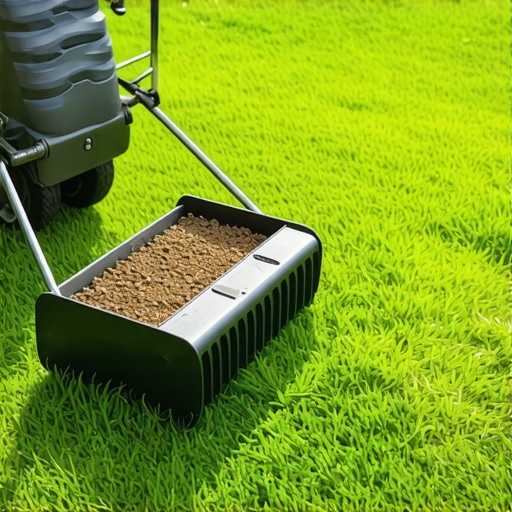
Aeration is a temporary mechanical fix that must be performed annually on clay soils to combat the natural return to a compacted state. To make the change permanent, you must follow aeration with overseeding and organic top-dressing to ensure that organic matter fills the holes, preventing them from collapsing back into solid clay.
You have to be aggressive. A single pass with a rental aerator isn’t enough for heavy clay. You need to pull 3-inch plugs and leave them on the surface to break down. This introduces oxygen directly to the root zone. If you do this every September, within three years, you will have changed the top two inches of your soil profile from ‘brick’ to ‘sponge.’ That is the only way your 2026 seed survives the transition into 2027. It is about the long game. Don’t be the guy who buys the most expensive seed and the cheapest soil. It is a losing bet every time.