![Fix Patchy Fescue: 3 Spring Seeding Rules [2026 Fix]](https://lawnmajesty.com/wp-content/uploads/2026/06/Fix-Patchy-Fescue-3-Spring-Seeding-Rules-2026-Fix.jpeg)
Fix Patchy Fescue: 3 Spring Seeding Rules [2026 Fix]
Fix Patchy Fescue: 3 Spring Seeding Rules [2026 Fix]
Most homeowners view a patchy lawn as an aesthetic failure, but to a veteran horticulturist, it is a forensic crime scene. By April, the typical fescue lawn in the transition zone often looks thin, yellowing, and structurally weak. This is not bad luck; it is a breakdown in soil biology and mechanical execution. Fescue is a bunch-type grass, meaning it does not have the lateral rhizomes of Bermuda or Zoysia to ‘self-heal’ bare spots. If you have a hole in your turf, it stays a hole until you intervene. In this 2026 guide, we are moving past the outdated ‘toss-and-wash’ methods and looking at the civil engineering of the root zone.
The Core Reason Your Spring Seeding Usually Fails
To fix patchy fescue in the spring, you must achieve precise soil-to-seed contact while managing soil temperatures between 50 and 65 degrees Fahrenheit and suppressing weed competition without using pre-emergent herbicides that kill grass seedlings. Failure usually occurs because of ‘mow-and-blow’ shortcuts or poor timing.
A homeowner called me in a panic after they completely torched their front lawn by applying a heavy-duty ‘Triple Action’ weed-and-feed on the same day they put down $400 worth of elite Turf-Type Tall Fescue (TTTF) seed. They did not read the label. The pre-emergent in the fertilizer created a chemical vapor barrier that prevented the grass embryos from ever reaching the soil. Within three weeks, the only thing growing was crabgrass and white clover, while the expensive seed sat on the surface like bird feed. They turned their yard into a sterile chemical wasteland because they prioritized ‘convenience’ over basic plant physiology. I had to scrape the top two inches of soil and start over with a compost top-dressing just to reset the microbial life. Don’t be that person. Understanding the chemistry of the soil is the difference between a resilient lawn and expensive compost.
“Tall fescue is a bunch-type grass, meaning it lacks the rhizomes or stolons to spread laterally and fill in bare spots on its own.” – Penn State Center for Turfgrass Science
Rule 1: Optimize the Cation Exchange Capacity and pH
Before you touch a spreader, you must understand what is happening at the molecular level in your dirt. Soil is not just ‘dirt’; it is a medium for nutrient exchange. If your soil pH is below 6.0, your fescue is starving regardless of how much fertilizer you dump on it. In acidic soil, the nutrients like nitrogen, phosphorus, and potassium become chemically ‘locked’ to the soil particles and are unavailable to the plant roots. You are essentially throwing money into a vault you don’t have the key for. For 2026, we are seeing more acidic rain patterns affecting the transition zone, making lime application more critical than ever.
How much modified gravel do I need for a patio base?
While the answer depends on square footage, a standard 10×10 patio requires approximately 2.5 tons of modified gravel to create a 4-inch compacted base that prevents the shifting that often causes turf-edge drainage issues. Proper hardscape drainage is the silent partner of lawn health. If your patio doesn’t drain properly, the hydrostatic pressure will push water under your fescue, causing root rot and fungal pathogens that create the very patches you are trying to fix.
| Condition | Target Value | Impact on Fescue Seedling |
|---|---|---|
| Soil pH | 6.2 to 6.8 | Maximum nutrient bioavailability |
| Soil Temperature | 55 Degrees F | Optimal germination trigger |
| Nitrogen (N) | Low-Slow Release | Prevents seedling burn |
| Phosphorus (P) | Moderate | Essential for initial root branching |
Rule 2: Mechanical Disturbance and Thatch Debridement
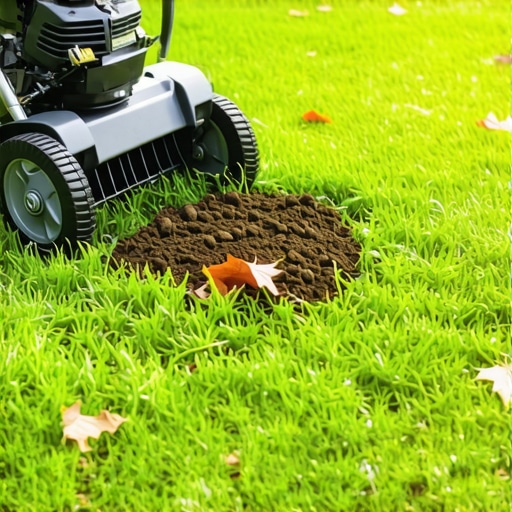
You cannot grow grass on top of dead grass. Thatch is a layer of organic debris that sits between the green vegetation and the soil surface. If your thatch layer is thicker than half an inch, your new seed will germinate in the thatch, dry out in three hours, and die. This is the ‘death by desiccation’ phase. You must use a power rake or a heavy-duty verticutter to slice through that layer and expose the mineral soil. I tell my crew: if you don’t see bare earth, you aren’t ready to seed. The physics of the ‘tamper’ effect applies here too; the seed needs to be pressed into the soil at a depth of exactly 0.25 inches. Any deeper and the sprout runs out of energy before it hits sunlight; any shallower and the sun cooks it.
“A retaining wall doesn’t fail because of the stone; it fails because of the water trapped behind it.” – Hardscape Engineering Axiom
Rule 3: The Deep-Cycle Irrigation Mandate
The internet will tell you to ‘mist’ your lawn three times a day. The internet is wrong. While seedlings need moisture to crack the hull, once they are an inch tall, you must transition to deep, infrequent watering. You want to force those roots to chase the water down into the soil profile. If you keep the surface perpetually wet, the roots stay in the top half-inch of soil. When the first heat wave of June hits, those shallow-rooted plants will shrivel and die. You need 1 inch of water per week, delivered in two heavy sessions. This builds a deep, resilient root architecture that can survive the summer heat. It is about biology, not just hydration.
When is it too late to seed fescue in the spring?
Once soil temperatures consistently hit 70 degrees Fahrenheit, usually by mid-May in most regions, it is too late for fescue. The young plants will not have enough time to develop a mature root flare before the summer heat dormancy kicks in. If you miss this window, wait for the fall. Forcing a late spring seeding is a waste of capital and labor.
2026 Spring Seeding Checklist
- Conduct a soil test to verify pH and Phosphorus levels.
- Mow the existing grass down to 2 inches to allow sunlight to hit the soil.
- Core aerate the patches: aim for 20 to 40 holes per square foot.
- Apply a high-quality TTTF (Turf-Type Tall Fescue) blend at 5lbs per 1000 sq ft.
- Top-dress with 1/8 inch of leaf compost or peat moss for moisture retention.
- Irrigate for 10 minutes, twice daily, until germination (approx. 14 days).
- Switch to deep watering (0.5 inch per session) twice weekly after the first mow.
The Biological Reality of 2026 Turf Management
We are seeing a shift in cultivar resilience. When selecting seed, look for ‘A-List’ certified varieties. These have been tested for drought tolerance and brown patch resistance. If you are buying a bag of ‘Sun and Shade’ mix from a big-box store, you are likely buying 20% weed seed and 30% filler. It is a scam. Go to a professional turf house and buy seed that has a 0.0% weed seed rating. It costs double, but it saves you triple in herbicide costs later. Landscaping is an investment in civil engineering and biology. If you treat it like a chore, it will fail. If you treat it like a system, it will thrive. Stop looking for shortcuts. Do the work. Respect the soil.