Stop Tree Root Damage: 4 Rules for 2026 Sidewalks
Stop Tree Root Damage: 4 Rules for 2026 Sidewalks
Concrete and biology are natural enemies in the urban landscape. To stop tree root damage in 2026, you must pivot from reactive cutting to proactive engineering using structural soils, bio-barriers, and species-specific site planning. Modern hardscaping requires understanding that roots follow the path of least resistance, usually into the moist, oxygen-rich gravel under your slabs. I always drill into my new crew members: if you don’t fix the soil grading and root pathing first, every plant you put in the ground is just expensive compost. I’ve seen $50,000 driveways shattered by a single $100 maple tree because the installer didn’t understand the radial growth of secondary xylem. We don’t just pour concrete; we manage a living ecosystem that exerts thousands of pounds of pressure per square inch. When a root hits that pocket of condensation under a sidewalk, it’s like a straw hitting a milkshake. It stays there, thickens, and eventually, physics wins. The sidewalk lifts. The homeowner trips. The lawsuits start.
Rule 1: Select Species Based on Root Morphology
Selecting the right species for garden design near hardscapes involves analyzing the mature root spread and growth habit of the tree rather than its canopy alone. Avoid high-surface-root species like Silver Maples or Willows, focusing instead on columnar varieties with predictable, non-aggressive root systems designed for urban environments.
“Trees require a minimum volume of uncompacted soil to thrive without encroaching on surrounding infrastructure.” – University of Florida IFAS Extension
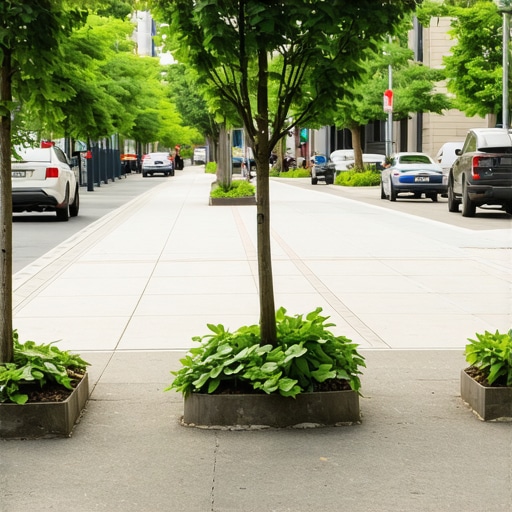
In my 20 years, the biggest mistake I see is planting a tree with a 40-foot mature spread in a 3-foot wide parkway. The biology is simple: roots need oxygen. If the surrounding soil is compacted red clay, the roots will crawl right under the sidewalk where the air is. [IMAGE_PLACEHOLDER_1] We look for trees with a taproot tendency or those bred for narrow urban corridors. It’s about matching the biological potential to the physical constraints of the site.
What are the best tree species for narrow parkways?
For narrow strips, look for Ginkgo Biloba (male clones), Zelkova serrata, or certain Oak cultivars that have been selected for deep-rooting characteristics. These species are less likely to cause root heave in landscaping projects compared to fast-growing, soft-wooded trees. I’ve seen Ginkgos stand for thirty years next to a curb without a single hairline crack in the cement. It’s about the genetics of the root meristem. Slow growth equals stability. Fast growth equals a jackhammer made of wood.
Rule 2: Implement Vertical Root Barriers
Effective landscaping near walkways utilizes root barriers installed to a minimum depth of 18 to 24 inches to deflect roots downward. This mechanical deflection forces the tree roots to bypass the sidewalk’s base layer, protecting the structural integrity of the concrete or pavers from vertical lift. Don’t use the flimsy garden edging from big-box stores. You need HDPE panels with vertical ribs. These ribs are critical; they prevent the roots from simply spiraling around the barrier and finding a gap. If you don’t use ribs, the root will eventually jump the fence. I’ve dug up barriers that were only 12 inches deep, only to find the roots had dived under and come right back up like a submarine. It was a waste of plastic and time.
How deep do tree root barriers need to be?
A professional installation requires a depth of at least 18 to 24 inches depending on the species and soil type. In heavy clay soils, roots stay shallower, so a deeper barrier is often necessary to ensure the tree roots are forced into the lower, denser subsoil.
| Material Type | Effectiveness Rating | Typical Lifespan | Primary Use Case |
|---|---|---|---|
| HDPE Ribbed Panels | 9/10 | 25+ Years | Municipal Sidewalks |
| Chemical Bio-Barriers | 7/10 | 10-15 Years | Utility Line Protection |
| Geotextile Fabrics | 5/10 | 5-10 Years | Temporary Garden Borders |
| Metal Sheeting | 6/10 | Variable | Historical Restoration (Corrosion Risk) |
Rule 3: Use Structural Soil or Silva Cells
Incorporating structural soil—a mix of crushed stone and clay loam—provides the necessary PSI load-bearing capacity for sidewalks while maintaining large pore spaces for root growth. This technology allows tree roots to grow *through* the base rather than *under* it, preventing the destructive heaving caused by standard compacted gravel. Ordinary lawn care logic fails here because standard dirt cannot be compacted enough to support a sidewalk without suffocating a tree. Structural soil (like CU-Soil) uses a stone-on-stone lattice that supports the weight of the concrete while the gaps are filled with uncompacted soil. It’s the closest thing we have to a miracle in urban hardscaping.
“Standard sidewalk failure often originates from a lack of subgrade compaction or the failure to account for hydrostatic pressure in high-clay environments.” – Hardscape Engineering Axiom
Rule 4: Design for Expansion and Hydrostatic Relief
Advanced lawn care and sidewalk maintenance in 2026 will involve suspended pavement systems or silva cells that provide uncompacted soil volumes. These modular systems support the weight of the pavement while allowing the root system to expand horizontally without applying hydrostatic pressure or physical force to the sidewalk slabs. We also need to talk about expansion joints. A standard 1/2 inch joint isn’t enough when you’re dealing with a growing trunk. We use thick-cut expansion foam and often taper the slab thickness. Instead of a uniform 4 inches, we might go to 6 inches near the tree flare, reinforced with rebar. It won’t stop the tree, but it will make the tree work harder to break it.
- Excavation: Clean out all old root mass and organic debris.
- Compaction: Ensure the sub-base reaches 95% Modified Proctor density.
- Barrier: Install 24-inch HDPE panels with ribs facing the tree.
- Base: Use 6 inches of #57 stone or structural soil.
- Pour: Use 4000 PSI concrete with fiber reinforcement.
Can I cut tree roots under a sidewalk?
Cutting roots over 2 inches in diameter can significantly destabilize the tree and lead to wind-throw or death. Instead of cutting, use shaving techniques or air-spades to clear soil and install root bridges that allow the root to remain while the sidewalk is elevated above it. If you cut a major structural root, you’re essentially creating a ticking time bomb that will fall on the house during the next storm. Don’t be the guy who values a $20 bag of Quikrete over a 50-year-old Oak. It’s bad business and worse science.
{“@context”:”https://schema.org”,”@type”:”HowTo”,”name”:”How to Prevent Tree Root Damage to Sidewalks”,”step”:[{“@type”:”HowToStep”,”text”:”Select a tree species with deep-rooting tendencies and non-aggressive lateral growth.”},{“@type”:”HowToStep”,”text”:”Install HDPE vertical root barriers to a depth of 24 inches along the hardscape edge.”},{“@type”:”HowToStep”,”text”:”Utilize structural soil or modular silva cells to provide uncompacted root volume under the pavement.”},{“@type”:”HowToStep”,”text”:”Reinforce the concrete slab with rebar and increased thickness near the tree’s root flare.”}]}
![Build a $1000 2026 Flagstone Patio [DIY Step-by-Step]](https://lawnmajesty.com/wp-content/uploads/2026/05/Build-a-1000-2026-Flagstone-Patio-DIY-Step-by-Step.jpeg)
![Build a $600 Flagstone Patio on a Sand Base [2026 DIY]](https://lawnmajesty.com/wp-content/uploads/2026/05/Build-a-600-Flagstone-Patio-on-a-Sand-Base-2026-DIY.jpeg)