
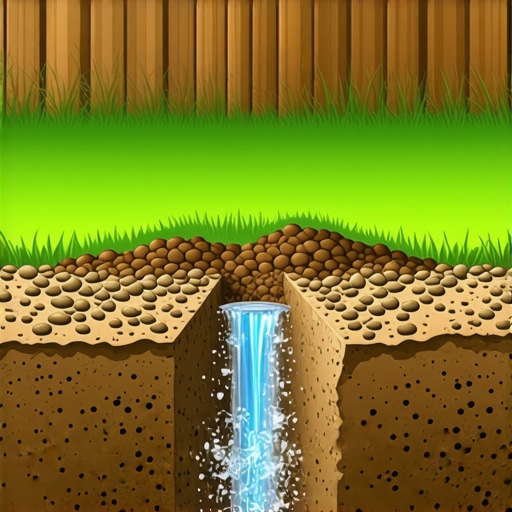
Build a $200 French Drain to Stop Yard Flooding
The Critical Failure of Surface Drainage
Building a French drain for under $200 is a matter of prioritizing geotechnical principles over expensive, unnecessary contractor markups while ensuring your yard’s topography effectively redirects hydrostatic pressure away from your home’s foundation. Water is the most destructive force in the residential landscape. It does not just sit; it migrates, erodes, and exerts pressure. I recently got called out to tear up a $30,000 patio that was sinking because the previous contractor ignored the basic hydrology of the site. They laid beautiful pavers over a saturated clay subgrade without a single linear foot of drainage. Within two seasons, the hydrostatic pressure pushed the fines out from the bedding layer, and the entire hardscape collapsed into a mud pit. That $30,000 investment was killed by the absence of a $200 pipe. If you don’t control the water, the water will control your property. It is that simple. This guide is about doing it right the first time using engineering standards that the ‘mow-and-blow’ crews can’t even pronounce.
“A retaining wall doesn’t fail because of the stone; it fails because of the water trapped behind it.” – Hardscape Engineering Axiom
The Physics of Subsurface Water Movement
To stop yard flooding, you must understand the difference between surface runoff and subsurface saturation. Surface runoff is the water you see sheeting across your lawn during a downpour. Subsurface saturation is the invisible water table that rises within your soil pores. When the soil reaches its field capacity, any additional moisture creates a swamp. A French drain acts as a path of least resistance. We are creating a void in the earth—filled with high-porosity aggregate—that invites water to enter the pipe rather than sitting in your topsoil. We are manipulating gravity. If your trench does not have a consistent 1 percent to 2 percent slope, you aren’t building a drain; you’re building a long, skinny pond. Don’t skip the transit or the laser level. Guessing at the pitch is how you end up with a mosquito breeding ground under your turf.
How to Design Your Drainage Path
Designing a French drain requires identifying the lowest point of your property and calculating the watershed area to ensure the discharge point can handle the volume of stormwater runoff during peak precipitation events. You need to know where the water is coming from. Is it a neighbor’s downspout? Is it an underground spring? Or is it simply a low spot in the yard where the heavy clay soil prevents percolation? In most residential settings, the goal is to intercept water before it reaches the foundation. This is called an interceptor drain. You dig the trench perpendicular to the flow of water. It captures the ‘sheet flow’ and redirects it. If you are dealing with a localized swamp in the middle of the lawn, you might need a curtain drain. Know your enemy before you buy the shovel.
| Material | Quantity/Type | Estimated Cost |
|---|---|---|
| Perforated Pipe | 100ft 4-inch Corrugated | $75 |
| Geotextile Fabric | Non-woven (4oz) | $40 |
| 3/4 Inch Clean Stone | 1.5 Tons (Bulk) | $60 |
| PVC Fittings/Outlet | Pop-up Emitter | $25 |
| Total | Subsurface System | $200 |
How deep should a French drain be?
A standard residential French drain should be between 12 and 18 inches deep to effectively intercept surface water and shallow groundwater while remaining above the frost line in most temperate climates to prevent ice heaving. If you go too shallow, the water will simply flow over the top. If you go too deep, you might run into utility lines or enter a soil layer with even poorer drainage. I always aim for the ‘sweet spot’ where the pipe sits at least 6 inches below the bottom of the problem area’s root zone. This ensures the turf remains dry enough to prevent root rot while the pipe stays protected from the weight of lawn equipment. Use a trenching shovel, not a standard spade. You want clean, vertical walls to minimize the amount of gravel needed.
The Anatomy of a High-Performance Trench
The success of a subsurface drain depends entirely on the aggregate gradation and the mechanical properties of the geotextile filter fabric used to prevent soil migration from clogging the perforated pipe. Most DIYers make the fatal mistake of using ‘sock’ pipe—that cheap corrugated pipe with a thin fabric sleeve. It is garbage. The fabric is too thin and clogs with fines within three years. Instead, use a heavy-weight non-woven geotextile to line the entire trench. This is the ‘burrito wrap’ method. You lay the fabric in the trench, add a 2-inch base of clean stone, lay your pipe, fill with more stone, and then fold the fabric over the top. This creates a permanent filter. Soil stays out; water gets in. If you skip the fabric, the silt from your soil will eventually fill the gaps between the stones, and the system will fail. It will rot. Period.
[image_placeholder]
Can I use a French drain without an outlet?
No, a French drain must have a functional discharge point, such as a daylight outlet, a dry well, or a bubbler pot, otherwise, the system will simply store water until it reaches saturation and overflows back into the yard. Water has to go somewhere. If your property is flat, you have a problem. You might need to exit the system into a dry well—a large underground structural tank that allows water to slowly dissipate into the deeper soil layers. However, in a $200 budget scenario, ‘daylighting’ the pipe is your best bet. This means the pipe literally comes out of the ground at a lower elevation, usually at the curb or a wooded area. Make sure you check local municipal codes. Many cities hate it when you dump your backyard water onto the street. Use a pop-up emitter at the end to keep rodents and debris out of the line. It opens under pressure and snaps shut when the flow stops.
“Soil permeability is not a suggestion; it is a mathematical constraint on the drainage capacity of any landscape design.” – USDA Soil Conservation Service Manual
The Installation Protocol: A Foreman’s Checklist
Installing a French drain involves a specific sequence of excavation, grading, and backfilling to ensure the pipe invert maintains a steady gravitational flow toward the point of discharge. If you mess up the order, you’re just moving dirt for fun. I tell my crews: ‘Dig once, measure twice, or you’ll be back here with a shovel on Saturday.’ Follow this checklist to ensure the system lasts 30 years instead of 30 days.
- Mark the Utilities: Call 811. Don’t be the guy who hits a gas line for a $200 drain.
- Calculate the Pitch: Use a string line and a line level. Aim for 1 inch of drop for every 8 feet of run.
- The Clean Stone Rule: Only use 3/4 inch clean crushed stone. Never use ‘crusher run’ or stone with fines. You need the air gaps for water flow.
- Pipe Orientation: If using perforated pipe, the holes face DOWN. This seems counter-intuitive to rookies, but water enters from the bottom as the water table rises.
- Mechanical Compaction: Once the fabric is closed and the topsoil is replaced, tamp it down. Don’t leave a mound that will settle into a trench later.
Maintenance and Long-Term Performance
Proper landscape maintenance for a French drain involves periodic inspection of the discharge outlet and ensuring that siltation has not compromised the permeability of the overburden soil. Even the best-built system needs an eye on it. Every spring, take a garden hose and run it through the clean-out port if you installed one. If you see clear water coming out the other end, the system is healthy. If the water is muddy or doesn’t come out at all, you have a blockage. Most likely, it’s a crushed pipe from someone driving a truck over the lawn or a root intrusion. This is why we use SDR-35 rigid pipe if the drain has to cross a driveway. Corrugated pipe is for the lawn; rigid pipe is for structural areas. Don’t confuse the two or you’ll be digging it up by year two.
The Reality of Year One
In the first year, expect the soil over the trench to settle. This is normal. The ‘fluffed’ soil you put back over the burrito wrap will lose its air pockets. Keep a bag of topsoil handy to level it out. Don’t plant deep-rooted trees directly over the line. Their roots will find the water source and infiltrate the perforations. Stick to turf grass or shallow-rooted perennials. If you follow these engineering steps, your $200 investment will save your foundation and your sanity. Landscaping isn’t just about the flowers; it’s about the infrastructure underneath them. Stop being a hack and start being an engineer of your own backyard. Dig the trench. Lay the stone. Fix the problem.
![Build a $50 2026 Rain Barrel System [Save Water]](https://lawnmajesty.com/wp-content/uploads/2026/07/Build-a-50-2026-Rain-Barrel-System-Save-Water.jpeg)