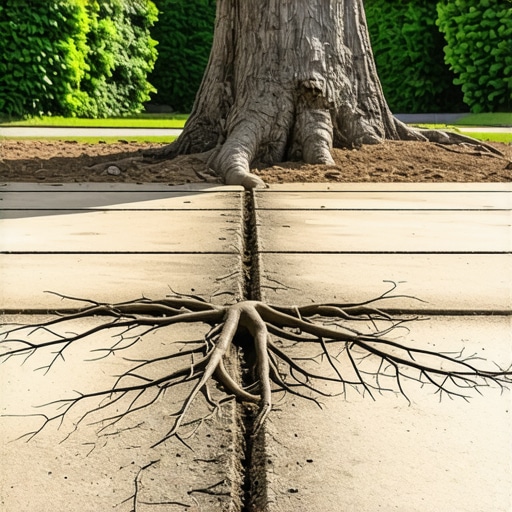
Stop 2026 Tree Root Heave in Concrete Driveways
I always drill into my new crew members: if you don’t fix the soil grading and account for root expansion first, every yard of concrete you pour is just an expensive ticking time bomb. Last year, I stood on a driveway in a high-end development where a 15-year-old Silver Maple had lifted a four-ton slab by nearly three inches. The homeowner was furious, but the fault lay with the original installer who ignored the biological reality of root flares. You cannot fight biology with a standard 4000 PSI mix. It will lose. Every single time.
The Critical Mechanism of Root Heave in Hardscaping
Tree root heave occurs when lateral roots grow beneath concrete driveways, expanding in diameter and exerting upward pressure that exceeds the tensile strength of the slab. To stop this by 2026, you must install physical root barriers, utilize structural soil, or perform selective root pruning under the guidance of a certified arborist to redirect growth away from the sub-base.
When we talk about root heave, we are discussing the radial growth of woody roots. As a tree matures, its roots thicken annually, much like the trunk. If those roots are trapped between a compacted sub-grade and a rigid concrete slab, they have nowhere to go but up. The force is slow, constant, and irresistible. I have seen 6-inch reinforced slabs snapped because the installer didn’t understand the capillary action of the soil beneath. Water pools under the concrete, the roots find that moisture, and they thrive. Your driveway becomes a greenhouse for the very thing that will destroy it.
“Tree roots do not grow toward water; they grow where conditions are most favorable for growth, including oxygen and moisture, which often exist in the sub-grade of pavement.” – International Society of Arboriculture (ISA)
How much modified gravel do I need for a patio or driveway base?
For a standard driveway prone to root issues, you need a minimum of 6 to 8 inches of compacted 21A or 411 modified gravel. This base must be mechanically compacted in 2-inch lifts to ensure a 98% Proctor density. Anything less allows roots to easily navigate the voids in the stone and reach the concrete’s underside.
The Forensic Autopsy: Why Concrete Fails Near Trees
Concrete is incredibly strong under compression but weak under tension. When a root pushes up, it creates a point load on the bottom of the slab. This creates tension on the top surface, leading to the characteristic hair-line fractures that eventually become 2-inch wide gaps. Most hacks will tell you to just pour thicker concrete. They are wrong. A thicker slab just creates a heavier weight for the root to lift until the pressure builds enough to cause a catastrophic shear failure.
| Tree Species | Root System Type | Heave Risk Level | Minimum Setback |
|---|---|---|---|
| Silver Maple | Aggressive Lateral | Critical | 20 Feet |
| Willow Oak | Deep/Spreading | High | 15 Feet |
| American Beech | Shallow/Fibrous | Medium | 12 Feet |
| Japanese Maple | Non-Invasive | Low | 5 Feet |
The table above isn’t a suggestion; it is a law of physics. If you plant a Silver Maple five feet from a driveway, you are signing a contract for a demolition crew in ten years. The soil pH also plays a role. Concrete leaches lime, which raises the pH of the surrounding soil. Certain species thrive in this alkaline micro-environment, actually encouraging roots to grow toward the driveway rather than away from it. It is a biological feedback loop that ends in cracked stone.
Can I cut tree roots without killing the tree?
You can safely prune up to 25% of a tree’s root zone if the cuts are made cleanly and at least three to five times the trunk diameter away from the base. However, removing structural anchor roots can destabilize the tree, making it a fall hazard during high-wind events in 2026 and beyond.
The Ground-Up Remediation Strategy
If you are looking at a cracked slab right now, you have three options. None of them are cheap. First, you can perform a full excavation. This involves removing the concrete, air-spading the soil to expose the roots without damaging them, and installing a linear root barrier. These are high-density polyethylene (HDPE) sheets that force roots to grow vertically downward rather than laterally under your drive.
“A concrete slab is only as stable as the sub-base beneath it. Hydrostatic pressure and root expansion create upward forces that exceed the tensile strength of unreinforced concrete.” – Hardscape Engineering Axiom
- Step 1: Saw-cut the damaged section 2 feet beyond the visible crack.
- Step 2: Excavate the sub-base to a depth of 12 inches.
- Step 3: Install an 18-inch deep HDPE root barrier along the edge of the slab.
- Step 4: Backfill with 3/4-inch clean crushed stone to improve drainage.
- Step 5: Re-pour using 4000 PSI concrete with fiber mesh reinforcement.
Don’t skip the fiber mesh. While it won’t stop a massive root, it holds the slab together during the initial years of pressure, preventing the