5 2026 Succulents for Full-Sun Rock Gardens
Why Rock Gardens Fail Before the First Rain
A successful full-sun rock garden requires a porous substrate with at least 50% inorganic aggregate to prevent root-zone hypoxia and ensure rapid drainage. Most DIY enthusiasts fail because they treat a rock garden as a decorative feature rather than a drainage-first engineering project. Without managing the hydrostatic pressure and pore space within the soil, succulents will succumb to fungal pathogens within one season.
I always drill into my new crew members: if you don’t fix the soil grading first, every plant you put in the ground is just expensive compost. I remember a job in 2022 where we had to excavate three tons of heavy clay because a previous contractor thought ‘rock garden’ just meant throwing some river rocks over topsoil. They planted $4,000 worth of specimen Agaves. Six months later, the roots were black slime. The soil had a bulk density so high that oxygen couldn’t penetrate the root flare. We spent a week installing a tiered French drain system and a custom-blended mineral substrate just to make the site viable. Real landscaping isn’t about the greenery you see on top; it’s about the invisible 12 inches of geology underneath. If the base isn’t right, the plant dies. It is that simple. Don’t be the person who buys a $200 plant and puts it in a $2 hole.
“Succulents require a soil medium with at least 50% inorganic material to prevent root-zone hypoxia and allow for rapid gas exchange at the root level.” – Arizona Cooperative Extension
The Physics of Thermal Mass in Garden Design
The thermal mass of large boulders in a rock garden creates a micro-climate that stores infrared radiation during the day and releases it at night, which can either protect or scorch your 2026 succulent selections. When you place a calcified limestone or granite boulder in the ground, it acts as a heat sink. In full-sun environments, surface temperatures on the rock can exceed 130 degrees Fahrenheit. This is why plant placement relative to the rock’s solar aspect is critical. You are not just gardening; you are managing thermal conductivity.
How much gravel do I need for a succulent rock garden?
For a standard 100-square-foot rock garden, you should calculate for a 4-to-6-inch drainage layer, which typically requires approximately 1.5 to 2 cubic yards of angular crushed stone or decomposed granite. Avoid rounded pea gravel for the base, as it lacks the interlocking structural integrity needed to support larger decorative boulders. Use non-woven geotextile fabric to separate the aggregate from the subsoil to prevent sediment migration from clogging your drainage pores.
Top 5 Succulent Cultivars for 2026 Installations
These selections represent the hardiest genetics moving into the 2026 season, chosen for their UV resistance, structural integrity, and low-maintenance requirements in high-exposure hardscaping environments.
| Plant Species | Max Height | USDA Hardiness Zone | Soil Drainage Requirement |
|---|---|---|---|
| Agave ovatifolia ‘Frosty Blue’ | 3-4 Feet | 7-11 | Extreme (70% Grit) |
| Mangave ‘Red Wing’ | 18 Inches | 8-11 | Moderate-High |
| Euphorbia rigida | 2 Feet | 7-10 | High (Inorganic) |
| Opuntia ellisiana | 4-5 Feet | 6-10 | Very High |
| Sedum ‘Lemon Ball’ | 6 Inches | 4-9 | Adaptive |
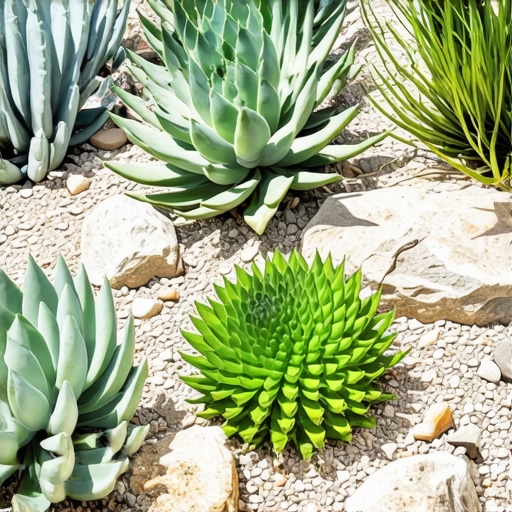
1. Agave ovatifolia ‘Frosty Blue’ (Whale’s Tongue Agave). This is the gold standard for structural landscaping. Unlike many Agaves, it does not produce offset pups, meaning the geometric symmetry of your garden design remains intact for its entire lifespan. It features a high anthocyanin content which gives it that distinctive blue hue, serving as a biological sunscreen against high UV-index exposure. Plant the root flare slightly above the grade to avoid crown rot.
2. Mangave ‘Red Wing’. A 2026 favorite because it combines the fast growth of Manfreda with the skeletal durability of Agave. The ‘Red Wing’ cultivar is particularly notable for its stomata behavior; it remains turgid even during 40-day droughts by utilizing Crassulacean Acid Metabolism (CAM) more efficiently than older hybrids. Its deep burgundy spotting is a reaction to direct sunlight—the more sun, the better the color. No shade needed. Ever.
“The structural integrity of a rock garden is dependent on the angle of repose of the chosen aggregate and the mitigation of hydrostatic pressure through subsurface drainage.” – Hardscape Engineering Axiom
3. Euphorbia rigida (Silver Spurge). While technically a succulent-like sub-shrub, its xeric properties make it a mandatory inclusion for full-sun rock gardens. The architectural spiraling of its leaves provides texture contrast against heavy boulders. Note: The milky sap is latex-based and toxic. Wear gloves. Its alkaline tolerance makes it perfect for planting near concrete walkways or limestone rocks where pH leaching occurs.
What is the best soil pH for rock garden succulents?
Most full-sun succulents thrive in a slightly acidic to neutral pH between 6.0 and 7.0, although species like Euphorbia can tolerate alkaline conditions up to 8.0. High calcium carbonate levels in rock gardens can cause nutrient lockout, particularly iron and magnesium. Testing your soil chemistry before installation prevents interveinal chlorosis, which presents as yellowing leaves with green veins.
4. Opuntia ellisiana (Spineless Prickly Pear). This is the utility player of lawn care alternatives. It is almost entirely spineless, making it safer for residential landscaping near foot traffic. It handles freeze-thaw cycles better than almost any other cactus. In the winter, it will appear to wilt or ‘deflate’ as it moves water out of its cells to prevent intracellular freezing. Don’t touch it. It’s not dead. It’s just smart. It will rehydrate in spring.
5. Sedum ‘Lemon Ball’. Every rock garden needs a ‘spiller’ to soften the edges of hardscaping. ‘Lemon Ball’ is a high-visibility groundcover that can tolerate the radiant heat of stone better than the more common ‘Angelina’ variety. It functions as a living mulch, keeping the soil temperature lower for the larger specimen plants while suppressing weed germination in the gaps between pavers.
The Professional Installation Checklist
- Site Grading: Ensure a minimum 2% slope away from any permanent structures.
- Utility Marking: Call 811 before excavating for drainage pipes. No exceptions.
- Substrate Mixing: 40% coarse sand, 40% crushed granite, 20% organic compost.
- Boulder Set: Bury 1/3 of each boulder’s height to ensure geological stability and a natural appearance.
- Root Flare Check: Never bury the neck of a succulent. It will rot.
- Initial Watering: Deep soak once after planting to settle the air pockets, then leave it alone for 14 days.
- Top-Dressing: Apply 2 inches of decomposed granite to prevent soil splashing on leaves.
Proper garden design is a marriage of biology and civil engineering. If you treat these plants like tropical ferns, you will kill them. They want starvation-level nutrients and arid-dry roots. Most ‘mow-and-blow’ guys will try to put these on a standard irrigation zone with the turf. That is a death sentence. Succulents need their own low-flow drip emitters or, in many climates, no supplemental water at all once established. Focus on the mineral composition of your soil and the azimuth of the sun. The rest is just watching them grow. Don’t over-manage. Don’t over-water. Just let the geology do the work.