
Build a $400 2026 Stone Fire Pit Area for Small Backyard Patio
The $400 Reality Check: Engineering a Fire Pit Area That Doesn’t Sink
Building a $400 stone fire pit area requires precise excavation, a compacted 4-inch modified gravel base, and heat-resistant masonry. Success depends on soil grading and hydrostatic pressure management rather than aesthetics, ensuring the structure remains stable through freeze-thaw cycles and avoids structural settling. Most homeowners assume the stone is the expensive part. They are wrong. The dirt is where your money—and your effort—lives.
I recently got called out to tear up a $30,000 patio that was sinking because the previous contractor skipped the compaction phase on a clay-heavy subgrade. Water sat under the pavers, turned the base into soup, and the whole thing migrated three inches south in one winter. If a $30k job can fail that spectacularly, your $400 DIY project doesn’t stand a chance if you just toss stones on the grass. You aren’t just making a place to roast marshmallows; you are performing a minor civil engineering feat. You have to fight gravity and water. Gravity wants to pull your pit into the earth. Water wants to heave it out. You win by controlling the base.
“A retaining wall doesn’t fail because of the stone; it fails because of the water trapped behind it.” – Hardscape Engineering Axiom
The Engineering of the Base: Beyond the Surface
Before you buy a single block, you need to understand the proctor density of your soil. If you are dealing with heavy clay, your drainage is non-existent. If you have sandy loam, you have better drainage but less stability. For a $400 budget, you cannot afford a geo-grid, but you can afford 2A modified gravel. This is a mix of crushed stone and fines that, when wet and tamped, locks together like concrete while still allowing microscopic drainage paths. Do not use pea gravel for a base. It is essentially a pit of ball bearings. It will shift. It will fail. You need angular stone that bites.
How much modified gravel do I need for a patio base?
To calculate your gravel needs, multiply the square footage of your fire pit area by the depth of the base (minimum 4 inches for stability) and divide by 27 to get cubic yards. For a standard 10-foot diameter circular area, you are looking at approximately 1.25 tons of modified stone. Don’t eyeball this. Under-building the base is the primary cause of stone migration. You need a solid 4-inch lift, compacted in 2-inch increments. If you don’t feel the tamper vibrating your teeth, you aren’t compacting hard enough.
| Material Component | Estimated Quantity | Projected Cost (2026) | Function |
|---|---|---|---|
| 2A Modified Gravel | 1.5 Tons | $65 – $85 | Structural Load Bearing |
| Levelling Sand | 10 Bags | $50 – $60 | Final Grade Adjustment |
| Trapezoidal Wall Blocks | 36 – 48 Units | $180 – $220 | Fire Pit Enclosure |
| Landscape Fabric (Non-woven) | 1 Roll | $40 | Soil/Aggregate Separation |
| Steel Fire Ring | 1 Unit | $60 | Heat Shielding for Masonry |
The $400 Inventory: What Actually Matters
- Non-woven geotextile fabric: This prevents your expensive gravel from disappearing into the sub-base.
- Hand Tamper (or Rental Plate Compactor): Compaction is non-negotiable.
- Leveling Strings and Stakes: A 1% pitch away from any structures is mandatory.
- Marking Paint: For the initial 12-foot diameter excavation ring.
- High-Heat Masonry Adhesive: To keep the top cap from sliding when someone kicks it.
[image_placeholder_1]
What is the best stone for a budget fire pit?
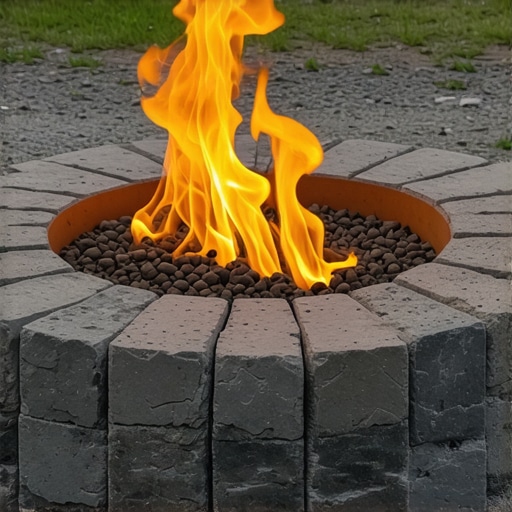
The best stone for a budget fire pit is tumbled concrete wall block or natural fieldstone, provided you use a steel fire ring insert. Using standard landscape blocks without a steel liner is a safety hazard; the direct heat causes the moisture trapped inside the concrete to expand, leading to spalling or explosive cracking. The steel ring acts as a heat sink, protecting the stone from the 300+ degree temperatures of a bed of coals. It makes the stone last decades instead of two seasons.
“Standard concrete masonry units (CMU) are not designed for direct fire exposure; thermal expansion without a refractory liner leads to structural disintegration.” – International Concrete Paver Institute (ICPI) Standards
Step-by-Step Installation: The Forensic Approach
First, clear the site. Use a sod cutter or a flat-head spade. Go down 6 to 8 inches. You aren’t just removing grass; you are removing the organic layer. Grass and roots rot. Rotting creates voids. Voids create sinkholes. If you see black dirt, keep digging until you hit the harder subsoil. Once excavated, lay your geotextile fabric. This is your insurance policy against the mud. If you skip the fabric, your gravel will eventually mix with the dirt and lose its structural integrity. It will turn into a mess. Don’t skip this.
Next, add your gravel in 2-inch layers. Spray it lightly with water. This lubricates the stones so they slide into a tighter configuration. Tamp it until the sound changes from a dull thud to a sharp crack. That is the sound of 95% compaction. Once your 4-inch base is level, add a 1-inch layer of coarse sand. This is your screeding layer. Use a straight 2×4 board to make it perfectly flat. This is the only part of the project that should be perfectly level; the surrounding patio area should still have that slight 1% pitch for drainage. Lay your stones. Use a rubber mallet. Check every stone with a level. If one is high, don’t hit it harder—remove it, adjust the sand, and reset. Precision pays.
Long-Term Maintenance: The 2026 Outlook
In the first year, expect minor settling. If you compacted correctly, this will be less than a quarter inch. Check your polymeric sand joints. If the sand has washed out, replace it immediately. Open joints allow water to enter the base, which leads to frost heave. In the winter, do not use rock salt near your stone pit. The sodium chloride will eat the face off the concrete blocks through a process called subflorescence. Use sand for traction instead. Clean the steel ring once a year and check for rust. A coat of high-heat spray paint can extend its life by five years. Hardscaping isn’t a ‘set it and forget it’ deal. It’s an asset. Treat it like one.
![Build a $400 Flagstone Fire Pit [2026 Guide]](https://lawnmajesty.com/wp-content/uploads/2026/06/Build-a-400-Flagstone-Fire-Pit-2026-Guide.jpeg)