How to Build a Rain Garden That Actually Drains
Why Most DIY Rain Gardens Fail Within the First Year
A functional rain garden is a precision-engineered depression designed to manage stormwater runoff by capturing, filtering, and infiltrating water back into the soil within 24 to 48 hours. Most homeowners fail because they mistake a muddy hole for a biological filter; without the correct soil percolation rate and sub-surface engineering, you are not building a garden—you are building a mosquito-breeding pond. True landscaping requires understanding hydraulic conductivity. You must calculate the drainage area of your roof or driveway to determine the specific volume of water your basin needs to hold. It is pure physics.
I recently got called out to tear up a $30,000 patio that was sinking because the previous contractor completely ignored the hydrostatic pressure and surface runoff from the client’s gutter downspouts. They thought a few bags of river rock would solve the problem. It didn’t. The water just sat there, liquefying the subgrade until the whole thing tilted two inches toward the foundation. This is why I am obsessed with drainage. If the water has nowhere to go, it will find a way to destroy your hardscaping. Most ‘pros’ don’t even own a soil probe. They just dig and hope. Hope is not a drainage strategy.
“A rain garden’s performance is fundamentally limited by the saturated hydraulic conductivity of the underlying soil and the engineered media used to replace it.” – USDA NRCS Technical Manual
The Science of Soil Percolation and Infiltration Rates
To ensure your garden design actually works, you must perform a standard percolation test to determine if your site can handle the volume. Dig a hole 12 inches deep, fill it with water, and let it saturate overnight. Refill it the next morning and measure how fast it drops. If it drains less than 0.5 inches per hour, you have heavy compaction or high clay content. You cannot build a standard rain garden here without a French drain or an underdrain system. Don’t skip this. If the soil doesn’t move water, the roots will rot.
What is the ideal soil mix for a rain garden?
An effective bio-retention soil mix typically consists of 50-60% clean sand, 20-30% topsoil (low clay content), and 20% well-aged compost to facilitate microbial activity and nutrient sequestration. This specific ratio ensures that the garden remains porous enough to prevent standing water while providing enough organic material to sustain native plants. Most people use cheap bagged potting soil. That is a mistake. Potting soil is too light and will float away during the first heavy rain event. You need density and grit. I prefer a coarse washed sand—specifically ASTM C-33—to prevent the mix from clogging over time.
| Material Type | Hydraulic Conductivity | Recommended Use |
|---|---|---|
| Bank Run Sand | High | Primary drainage layer / Bio-mix base |
| Sandy Loam | Medium | Planting medium for native species |
| River Cobble (2-4″) | Extreme | Inflow/Outflow energy dissipation |
| Shredded Hardwood Mulch | Low | Surface layer to prevent erosion |
The Ground-Up Build: Step-By-Step Installation
Proper lawn care and site preparation are the foundation of a successful build. You are essentially creating a biological sponge. Start by marking out the ‘ponding area.’ This should be at least 10 feet away from your home’s foundation to prevent basement seepage. Use a transit level to ensure the bottom of the basin is perfectly flat. If it slopes, the water will pool at one end, causing localized saturation and plant death. Use a flat-head shovel. No rounded edges here.
How deep should a rain garden be excavated?
A professional-grade rain garden requires an excavation depth of 18 to 36 inches to account for the engineered soil media, a 2-3 inch mulch layer, and a maximum ponding depth of 6-12 inches. Any deeper and you risk creating a safety hazard; any shallower and you won’t have enough volume to manage a 1-inch rain event. Once you’ve excavated, do not walk in the basin. Your weight will compact the subsoil and kill the infiltration rate. Work from the edges. Stay off the floor.
- Step 1: Utility Check. Call 811. Never dig without knowing where your gas and water lines are.
- Step 2: Excavation. Remove all turf and soil to the calculated depth.
- Step 3: Inflow Management. Install a 4-inch PVC or HDPE pipe from the downspout to the garden. Use a flared end section.
- Step 4: Soil Backfill. Layer your engineered mix in 6-inch lifts, lightly tamping but not compacting.
- Step 5: Plant Selection. Focus on deep-rooted native perennials like Blue Flag Iris or Swamp Milkweed.
- Step 6: Mulching. Use triple-shredded hardwood mulch. Do not use wood chips; they float.
“The primary cause of failure in bio-retention systems is the lack of pretreatment to remove suspended solids, which leads to surface sealing of the soil media.” – Maryland Department of the Environment
How much gravel do I need for a rain garden inflow?
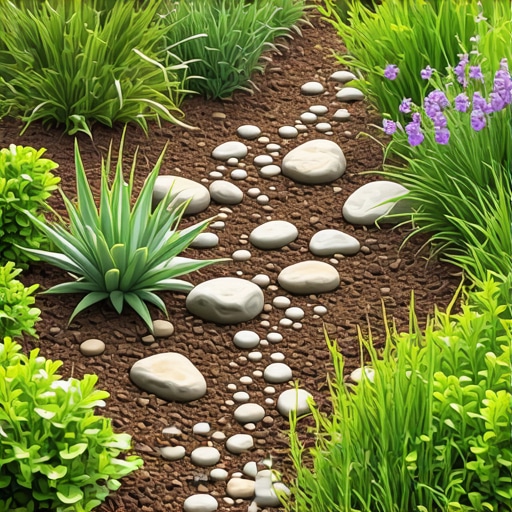
For a standard residential inflow point, you need approximately 0.5 to 1 cubic yard of 2-to-4-inch river cobble to create a ‘splash pad’ that dissipates the energy of incoming water. Without this, the concentrated flow from your downspouts will carve a channel through your mulch and wash out your plants. Think of it as an energy dampener. It must be heavy enough that the water cannot move it. Small pea gravel is useless here. It will wash away like sand.
Plant Selection and Maintenance for Long-Term Drainage
In landscaping, plants are your pumps. Native plants with deep taproots create macro-pores in the soil, which maintain the infiltration rate over years of service. Avoid ‘pretty’ annuals from big-box stores. They lack the root structure to survive the dry-wet cycles of a rain garden. You want species that can handle ‘wet feet’ for 48 hours but survive a mid-August drought. My crew uses a mix of grasses and sedges on the slopes and moisture-loving perennials in the basin floor. This mimics a natural prairie or wetland edge.
Maintenance is non-negotiable. During the first year, you must weed aggressively. Once the natives fill in, they will outcompete the invasives, but that first season is critical. Check the inflow for sediment buildup. If you see a layer of fine silt, scrape it off. That silt is what clogs the system. It will fail if you let it sit. Also, never use chemical fertilizers in a rain garden. The whole point is to filter pollutants, not add them. The organic matter in your soil mix is all the food the plants need. Don’t overthink it. Just keep the weeds out and the sediment clear.