The Best Way to Level a Bumpy Yard Without Tilling
Why Tilling is the Absolute Last Resort for Your Lawn
To level a bumpy yard without tilling, you must apply a specific 70/30 or 50/50 blend of screened masonry sand and high-quality topsoil directly to the surface in thin, half-inch lifts. This method, known as topdressing, preserves existing soil structure and avoids the long-term settling issues caused by mechanical tilling and soil inversion.
I always drill into my new crew members: if you don’t fix the soil grading first, every plant you put in the ground is just expensive compost. I remember an apprentice who thought he could save time by just throwing a few bags of big-box store mulch over a drainage dip near a client’s foundation. Three months later, that mulch had decomposed, the dip was back, and the client had two inches of standing water against their basement wall. We had to rip out the entire bed, fix the grade with structural fill, and start over. Soil physics doesn’t care about your schedule. If you don’t respect the compaction and the slope, the water will find the path of least resistance every single time. Tilling a yard might look like a quick fix, but you are effectively waking up a decade’s worth of dormant weed seeds and destroying the fungal networks that keep your turf healthy.
“Soil structure is the arrangement of soil particles into aggregates. Tilling destroys these aggregates, leading to surface crusting and reduced water infiltration.” – Penn State Extension
The Science of Topdressing: Why Sand and Soil Matter
Topdressing is the process of adding a thin layer of material over the grass to fill in low spots without killing the existing turf. It is a biological engineering feat. When you use angular masonry sand, you are creating a stable framework that resists further compaction. Unlike round beach sand, angular grains interlock, providing a firm surface that still allows for oxygen exchange. If you use pure soil, it will eventually compress and sink again. If you use pure sand, you risk drying out the roots. The magic is in the mix. You are looking for a substrate that matches the hydrostatic conductivity of your existing soil while providing enough structural integrity to hold a level line.
How much soil and sand do I need for leveling?
To calculate your material needs, measure the square footage of the bumpy area and multiply it by the depth of the fill (keep it under 0.5 inches per application). One cubic yard of material covers roughly 324 square feet at a 1-inch depth; for leveling, you typically need half that volume to avoid smothering the grass crowns.
| Material Type | Best Use Case | Pros | Cons |
|---|---|---|---|
| Pure Masonry Sand | Golf-course style lawns | Excellent drainage, stays level | No nutrients, dries fast |
| 70/30 Sand/Soil Mix | Residential Turf | Balance of stability and nutrients | Requires manual mixing |
| Compost/Soil Mix | Flower Beds/Gardens | High microbial activity | Settles significantly over time |
The Step-by-Step Restoration Protocol
[image_placeholder_1]
The first step is a low mow. You need to see the ground, not the grass. Scalp the area to about 1 inch. This feels wrong to most homeowners, but you need the grass out of the way so the leveling mix can reach the actual soil surface. Next, you must address core aeration. If your yard is bumpy, it is likely compacted. You need to pull 3-inch plugs of soil out of the ground to create space. Without aeration, your new leveling mix will just sit on top like a scab, never integrating with the root zone.
“A retaining wall doesn’t fail because of the stone; it fails because of the water trapped behind it.” – Hardscape Engineering Axiom
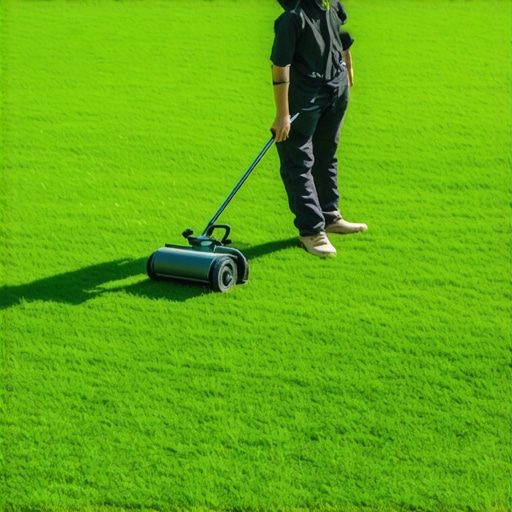
Once aerated, spread your 70/30 mix using a shovel, then use a 36-inch Levelawn or a landscape rake to work the material into the low spots. You are looking for the tips of the grass blades to still be poking through. If you bury the grass completely, it will die from lack of photosynthesis. You are building a matrix. Work in circular motions. The tamper should literally bounce off the compacted base if you were doing hardscaping, but here, the rake should glide, filling the voids. Repeat this process every 4 to 6 weeks during the growing season. It is a slow game. You cannot fix a 3-inch hole in one day without tilling; you fix it over a season, half an inch at a time.
Can I level a yard that has drainage problems?
Leveling will not fix a drainage failure. If you have standing water, you don’t have a bumpy yard problem; you have a grade and discharge problem. You may need to install a French drain or a dry creek bed before you even think about topdressing. Filling a swamp with sand just creates a sandy swamp. Always check your exit strategy for water runoff before you start adding material.
- Scalp the grass to 1 inch.
- Core aerate to a depth of 3 inches.
- Mix 70% masonry sand with 30% screened topsoil.
- Spread mix in 0.5 inch lifts.
- Use a leveling rake to work material into low spots.
- Water deeply to settle the material.
Maintenance and Year-One Expectations
After your first application, the yard will look like a construction site. This is normal. Within 14 days, the grass will grow through the sand-soil matrix. Do not apply pre-emergent herbicides during this window, as you want the turf to be as aggressive as possible. Focus on deep, infrequent watering. You want to force the roots to chase the moisture down through your new leveling layer into the original soil. This binds the two layers together. If you water lightly every day, the roots will stay in the top half-inch, making the lawn susceptible to heat stress and fungal pathogens like Rhizoctonia solani. Check your pH levels. If you brought in new soil, you might have shifted your acidity. Aim for a 6.5 pH to ensure nutrient availability. This is not a one-and-done project. It is an annual maintenance task for those who want a true, flat grade. Skip the rototiller. Keep the soil structure. Work with the biology, not against it.