Why Your Branson West Patio Needs This Specific Drainage Fix
Why Your Branson West Patio Needs This Specific Drainage Fix
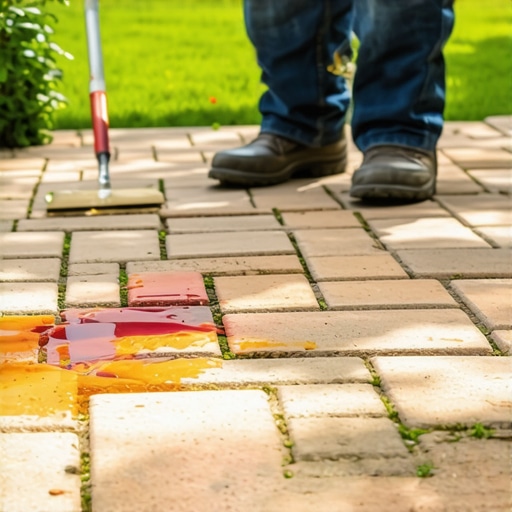
If you live in Branson West or Reeds Spring, you know that weather in the Ozarks isn’t just a topic of conversation; it’s a force of nature. We don’t just get “rain”; we get what I call the “Ozark Monsoon.” One minute you’re enjoying a quiet afternoon overlooking the hills, and the next, the sky opens up, dumping inches of water in a matter of minutes. For many homeowners, this is the moment of truth for their outdoor living spaces. A beautiful, expensive patio can quickly transform into an accidental swimming pool, or worse, a launching pad for water to infiltrate your home’s foundation.
The primary complaint I hear from homeowners across the region – from the heights of Branson West to the lakeside properties in Lampe – is standing water. You’ve invested in high end landscaping, yet your yard remains a soggy mess for days after a storm. The “Specific Fix” isn’t just a single pipe or a bag of gravel from a big-box store. To truly protect your investment, you need an Integrated French Drain and Dry Creek Bed System. This isn’t just a recommendation; in our rocky terrain, it is a necessity for functional hardscaping and landscaping.
In this guide, I’m going to break down why standard drainage attempts fail in our area and how a professional approach – the kind we specialize in at sharper edge landscaping – ensures your patio remains an asset rather than a liability. If you’re looking for 7 Branson Hardscaping Tactics for Managing Heavy Ozark Rain, understanding the synergy between sub-surface and surface drainage is the place to start.
Why Branson West Soil is a Drainage Nightmare
To understand why your patio is flooding, you first have to understand what’s beneath your feet. In Branson West, Reeds Spring, and Lampe, we aren’t dealing with the rich, absorbent topsoil you find in the Midwest plains. We are dealing with “Chert” and limestone. This rocky, compacted material acts more like concrete than soil. When the rain hits, it doesn’t soak in; it moves laterally across the surface or gets trapped in the small layer of clay sitting atop the rock shelf.
This is why achieving a sharp lawn in the Ozarks is so difficult. You can have the best professional lawn care services in the world, but if your soil is constantly oversaturated because the water has nowhere to go, your grass will drown, and your patio stones will shift. Sub-surface management is the “secret sauce” of landscaping services in our region. Without it, the hydrostatic pressure building up behind your retaining walls or under your pavers will eventually cause structural failure.
Furthermore, our proximity to Table Rock Lake means that runoff isn’t just your problem – it’s an environmental one. Unmanaged runoff carries silt and pollutants into our local waterways. A sharp edge landscaping plan takes this into account, using professional excavation to redirect water safely. If you’re wondering why professional excavation services are the first step to a perfect patio, it’s because we have to literally carve a path through the Ozark rock to give that water a destination.
The “Specific Fix” Revealed: The Integrated French Drain
When we talk about a “specific fix,” we are talking about a professional-grade French drain. Many people think a French drain is just a trench with some rocks in it. If that’s how yours was built, that’s likely why it isn’t working. A sharper edge landscaping solution involves a multi-layered technical approach designed to last for decades, not just a single season.
The Anatomy of a Professional French Drain
- Precision Trenching: In Branson West, this often requires heavy machinery to break through the limestone shelf. We maintain a minimum 1% slope – a feat nearly impossible to achieve by hand in this terrain.
- Non-Woven Geotextile Fabric: This is the most skipped step in DIY projects. This fabric acts as a filter, allowing water in but keeping the fine Ozark silt and clay out. Without it, your drain will clog within two years.
- Perforated Rigid Pipe: We avoid the cheap, corrugated “black pipe” whenever possible. Rigid PVC pipe with pre-drilled holes is more durable and easier to clean out if maintenance is ever needed.
- Clean 1-Inch River Rock: We fill the trench with clean, washed stone. This creates the “void space” necessary for water to move quickly away from your patio.
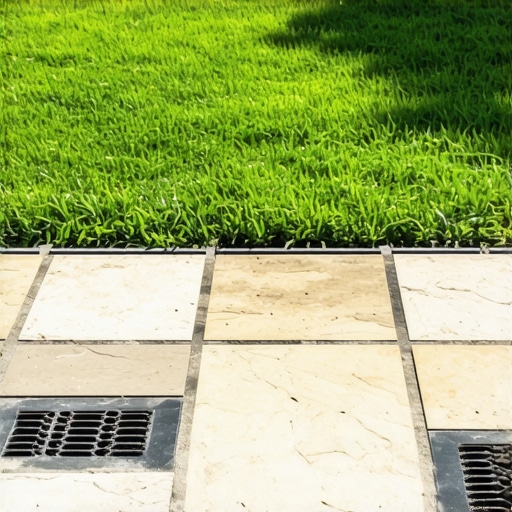
The goal of landscape design services is to make this system invisible. By integrating the drain at the edge of the patio and covering it with decorative stone or sod, we maintain that sharp lawn aesthetic while moving thousands of gallons of water underground. This is essential for fixing 2026 drainage issues with French drains before they lead to costly foundation repairs.
Consider the physics: A 1-inch rain on a 1,000 sq. ft. patio produces roughly 623 gallons of water. In a heavy Branson storm, you might see 3 or 4 inches in an hour. That is over 2,000 gallons of water dumped right next to your home. Without a French drain, that water is looking for the path of least resistance – which is often your basement or crawlspace.
Aesthetic Integration: The Dry Creek Bed
While the French drain handles the sub-surface water, a Dry Creek Bed handles the surface deluge. This is where high end landscaping meets extreme functionality. In the Ozarks, a dry creek bed isn’t just a decoration; it’s a high-capacity spillway for when the “Monsoon” exceeds the capacity of the underground pipes.
A dry creek bed uses a variety of stone sizes – from large boulders to small river stones – to mimic a natural Ozark stream bed. This serves two purposes. First, it slows down the velocity of the water, preventing erosion. Second, it adds incredible visual texture to your property. When you combine this with sharp lawns, the contrast between the manicured grass and the rugged stone creates a stunning professional look.
When we design these for clients in Reeds Spring and Branson West, we often use them to channel water toward natural drainage easements or lower parts of the property away from structures. If you’re looking to build a $200 dry creek bed for heavy rain, keep in mind that the “DIY” price tag often ignores the cost of the heavy equipment needed to move the boulders that make the bed stable during a flood. A professional sharp lawn approach ensures the creek bed doesn’t just wash away during the first big storm.
The Danger of DIY in the Ozarks
I’ve seen many well-intentioned homeowners in Lampe and Branson West try to tackle drainage themselves. The problem is almost always “The Rock.” Without a mini-excavator and a jackhammer attachment, you simply cannot get deep enough to create the necessary 1% fall for gravity to do its job. If a drain is flat, it’s just a long, skinny pond in your yard.
Furthermore, landscape design services require an understanding of “watershed.” You aren’t just managing the water that hits your patio; you’re managing the water that rolls off your roof and down the hill from your neighbor’s property. Professional hardscaping and landscaping firms use laser levels to ensure the water is moving exactly where it needs to go.
Common DIY mistakes include:
- Using the wrong type of gravel (using “crushed” stone with “fines” that pack down and block water).
- Failing to use a basin or “pop-up” emitter at the end of the line, causing water to back up.
- Not checking for underground utilities – a major risk in Reeds Spring.
If you have a flat yard, the challenge is even greater. You might need to read up on how to fix drainage issues in a flat yard to understand why a sump pump or a more aggressive excavation strategy might be required.
Maintaining the “Sharp Lawn” Look
Once your drainage is installed, the work doesn’t stop. To keep your property looking like a sharp lawn year-round, you need a plan for lawncare and snow removal. In the winter, ice can block drainage outlets, and in the fall, leaves can clog the surface of your dry creek bed.
Utilizing professional lawn care services ensures that your gutters are clean and your drainage basins are clear of debris. This is part of a holistic approach to property management. When the drainage is right, your grass stays healthier, your soil stays in place, and your patio remains level. You might even find that how to get a sharp lawn edge that lasts all season in Reeds Spring becomes much easier when the ground isn’t a marshy mess.
Additionally, consider the other elements of your landscape. If you have paths, you might wonder why flagstone is worth the extra cost for paths – it’s because, when properly drained, flagstone handles the Ozark freeze-thaw cycle much better than poured concrete. And if you have slopes, you must know how to stop your retaining wall from leaning: the answer, 99% of the time, is better drainage behind the wall.
Conclusion: Protect Your Ozark Investment
In the Ozarks, we don’t just move dirt; we fight rock. As I always say, “If your drainage isn’t designed for a 100-year flood, it’s not designed for a Branson spring.” A patio without a drainage plan isn’t an outdoor living space; it’s a liability waiting to happen. By implementing an integrated French drain and dry creek bed, you are choosing a permanent solution that protects your home, your soil, and your peace of mind.
Don’t wait for the next “Ozark Monsoon” to find out where your patio’s weak spots are. Contact a professional for a consultation. Whether you need landscaping services, lawncare and snow removal, or a complete hardscape overhaul, getting the water right is the first and most important step to a sharp lawn that lasts for decades.
Ready to fix your drainage for good? Contact Eric Friga and the team at sharper edge landscaping today to schedule your site evaluation.