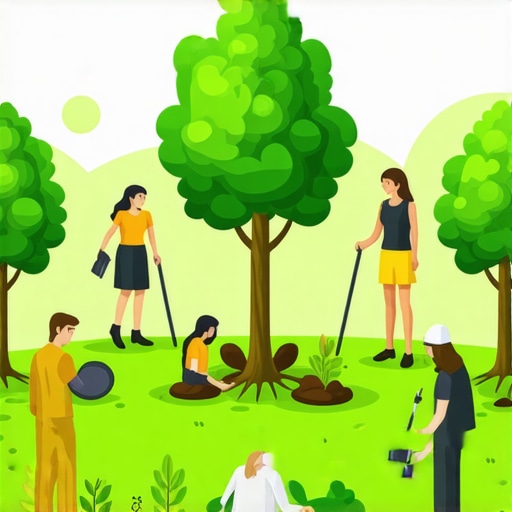
The smell of damp earth in Fauquier County is distinct. It is heavy, metallic, and promises a garden that will rival any estate in Middleburg. Yet, walk through any subdivision in Warrenton and you will see the skeletons of young maples and oaks. Their bark peels like a bad sunburn. Editor’s Take: Tree mortality in Northern Virginia is rarely a mystery. It is a mechanical failure caused by ‘teacup’ planting and suffocation. Preparing for a successful 2026 growing season means shifting our focus from decoration to biology immediately.
Stop Tree Loss: 5 Warrenton VA Planting Fixes for 2026
The red clay of the Piedmont. It clings. It stains. It kills. To the uninitiated, this soil looks like a challenge to be overcome with a bag of topsoil. To those providing Tree and shrub planting Warrenton VA, it is a living medium that requires a specific touch. Most homeowners dig a hole, drop the root ball in, and walk away. This creates a bathtub effect. In our heavy rains, that hole fills with water that cannot drain through the compacted clay walls. The roots drown in days. We see this often when Lawn care services Warrenton VA are called to revive a yellowing willow that was doomed the moment the shovel hit the ground.
The Death of the Mulch Mountain
Walk down any street. You see them. Piles of dyed wood chips stacked six inches high against the trunk of a cherry tree. It looks tidy. It is also a slow-motion execution. These ‘mulch volcanoes’ trap moisture against the bark. This moisture causes the bark to rot, which allows fungi and insects to enter the tree’s vascular system. Real Mulching services Warrenton VA should follow the donut rule. Mulch should extend to the drip line but never touch the trunk. The root flare, that beautiful widening where the tree meets the earth, must remain visible. Oxygen needs to reach the base. Without it, the tree’s gas exchange fails. Landscape maintenance Warrenton VA is as much about what you don’t do as what you do.
The tension between the hard and the soft is where many yards fail. When Hardscaping contractors Warrenton VA install a new walkway, they often compact the soil within feet of a prize oak. This crushes the microscopic pores roots need to breathe. We have to coordinate. If you are planning a new terrace, talk to your Warrenton VA landscape design team about root protection zones. You cannot have a healthy patio if the shade tree beside it dies within three years from root crush. It’s a holistic system. A Patio installation Warrenton VA should enhance the garden, not serve as its tombstone.
The Myth of the Perfect Hole
Old wisdom suggested digging a deep hole. New science from the International Society of Arboriculture (ISA) suggests the opposite. Wide is better than deep. If you are doing Sod installation Warrenton VA, you know that surface area matters for establishment. The same applies to trees. The hole should be three times the width of the root ball but no deeper than the root ball itself. We want the roots to move outward into the native clay, not sit in a deep pit of amended soil. When roots hit that clay wall after living in soft potting soil, they often turn inward, eventually girdling the tree and strangling it. If the slope is steep, Landscaping services in Warrenton VA might suggest Retaining wall builders Warrenton VA to create a level planting shelf, ensuring water doesn’t just sheet off the surface before it can reach the root zone.
Modern forestry data suggests that Virginia’s climate is shifting toward more intense, short-duration rain events. This makes drainage the primary factor for tree survival. A study by Virginia Tech’s Urban Forestry department emphasizes that soil compaction is the leading cause of tree decline in developed areas. We have to break that cycle. Stop digging deep. Start digging wide.
Common Tree Survival Questions
How often should I water a new tree in Warrenton? It depends on the heat, but generally, five gallons per inch of trunk diameter once a week is the standard. If we have a dry spell, increase this. Is fall or spring better for planting? In Virginia, fall is often superior. It allows the roots to establish without the immediate stress of our humid July heat. Should I stake my tree? Only if it’s in a high-wind area. Trees need to sway slightly to develop ‘trunk taper,’ which makes them stronger over time.
Fixing your yard for 2026 is about patience. It is about looking at the soil and seeing a living thing rather than a blank canvas. If you want a canopy that lasts for decades, you have to get the foundation right today. Don’t let your investment become another skeleton in the neighborhood. Reach out to local experts who understand the nuances of our specific Piedmont ecology. Ready to transform your property into a thriving ecosystem? Contact us to schedule a consultation for your next project.

![5 Sun-Tough Perennials for No-Water 2026 Gardens [List]](https://lawnmajesty.com/wp-content/uploads/2026/03/5-Sun-Tough-Perennials-for-No-Water-2026-Gardens-List.jpeg)
![5 Clay-Soil Shrubs That Won't Die in 2026 [Low Maintenance]](https://lawnmajesty.com/wp-content/uploads/2026/03/5-Clay-Soil-Shrubs-That-Wont-Die-in-2026-Low-Maintenance.jpeg)
![7 Native Trees for Instant 2026 Backyard Privacy [List]](https://lawnmajesty.com/wp-content/uploads/2026/02/7-Native-Trees-for-Instant-2026-Backyard-Privacy-List.jpeg)