The Forensic Autopsy of a Dying Lawn
The fescue is crunching under your boots like dried parchment. It is not just brown; it is a necrotic collapse of the leaf tissue. You see those straw-colored patches and assume it needs more water. You are likely wrong. Most fescue lawns in 2026 will die not from a lack of hydration, but from a total failure of soil hydraulics and osmotic regulation. When I walk onto a property and see a lawn that looks like a scorched desert, I do not look at the sky; I look at the dirt. I recently saw a homeowner in a total panic after they completely torched their front lawn by applying a high-nitrogen ‘turf builder’ during a 90-degree heatwave without checking the soil moisture levels first. They did not just burn the grass; they chemically salted the rhizosphere, causing a total cellular shutdown. This is what happens when you treat a living biological system like a carpet. Fescue, specifically Festuca arundinacea, is a cool-season grass that requires a specific thermal and hydrologic balance to survive the transition into the harsh summer months.
How to stop fescue burn in 2026
To stop fescue burn, you must implement deep-soil water fixes that focus on root zone saturation, core aeration, and soil pH balancing to ensure nutrient uptake. By forcing roots to grow deeper than 6 inches, the grass can access cooler moisture reserves during peak evapotranspiration periods.
The Physics of Deep-Soil Hydraulic Forcing
Stop watering your lawn for fifteen minutes every morning. That is the quickest way to grow a fungus farm. Instead, you need to apply one inch of water in a single session once per week. This forces the water to percolate through the A-horizon of the soil and into the subsoil. Roots are lazy. If the water is always on the surface, the roots stay on the surface. When the sun hits 95 degrees, those surface roots cook. Deep watering creates a hydraulic gradient that pulls the root tips downward. We measure this in soil tension. If your roots are only two inches deep, your lawn is a ticking time bomb. You want eight-inch roots. That is the difference between a lawn that survives and one that requires a full renovation in September. Check your soil compaction. If you cannot shove a screwdriver six inches into the ground with ease, your roots are suffocating. They cannot breathe, and they certainly cannot drink.
“A lawn does not fail because of the sun; it fails because the soil structure cannot support the plant’s metabolic demands under heat stress.” – Agronomy Manual of Turfgrass Science
Fix 1: Core Aeration and Pore Space Management
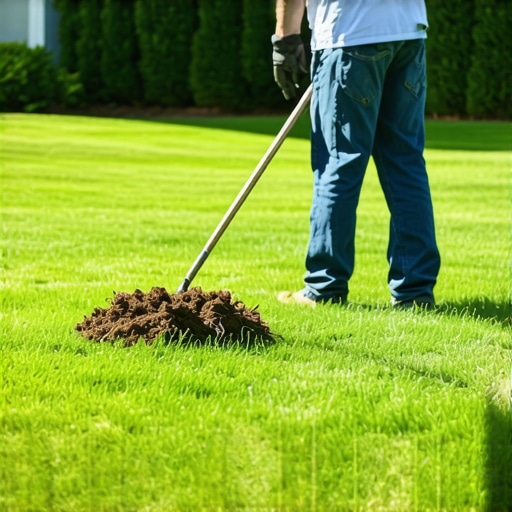
Core aeration is the process of removing soil plugs to reduce compaction and improve oxygen exchange within the rhizosphere. This mechanical intervention allows water and nutrients to bypass the thatch layer and reach the root zone directly, preventing the hydrophobic soil conditions that lead to fescue burn. I tell my crew: if you are not pulling three-inch plugs, you are just making holes. We need to break the surface tension. Most yards have been compacted by years of lawn mowers and foot traffic, turning the soil into something resembling concrete. Water cannot penetrate concrete. It runs off into the gutter, taking your expensive fertilizer with it. Aeration creates the necessary voids for microbial life to thrive.
| Condition | Mow-and-Blow Standard | Professional Management |
|---|---|---|
| Watering Frequency | Daily (Light) | Weekly (Deep) |
| Mowing Height | 2.0 Inches | 4.0 Inches |
| Soil Structure | Compacted Clay | Aerated Loam |
| Root Depth | 1-2 Inches | 6-8 Inches |
How much water does fescue need in summer?
Tall fescue requires exactly 1 to 1.5 inches of water per week, delivered in heavy, infrequent intervals to encourage deep rooting. During extreme heat spikes above 90 degrees, a light “syringing” at midday for 5 minutes can lower canopy temperatures, but this does not replace the weekly deep soak. Measurement is key. Use a rain gauge or a tuna can to verify your irrigation output. Don’t guess. Logic dictates that more is better, but over-watering leads to Pythium blight, a fungal pathogen that will melt your turf faster than any drought ever could.
Fix 2: Soil pH and Nutrient Lockout Remediation
If your soil pH is below 6.0, your fescue is starving regardless of how much fertilizer you throw at it. Acidic soil causes nutrient lockout. The phosphorus and potassium are there, but the plant’s roots cannot chemically bond with them. I have seen guys spend thousands on nitrogen while their soil was sitting at a 5.2 pH. It is a waste of money. You need to apply pelletized lime to buffer the acidity. We are looking for a sweet spot between 6.2 and 6.7. This is where the microbiology is most active. Use a professional soil test; do not rely on a cheap probe from a big-box store. Those things are toys. You need a lab report that breaks down your cation exchange capacity (CEC).
Fix 3: Strategic Shading and Landscape Design Integration
Garden design plays a massive role in turf survival through micro-climate modification and evapotranspiration reduction. By strategically placing ornamental trees or hardscape features, you can create dappled shade that protects fescue from the solar zenith, significantly lowering the thermal stress on the grass blades. Think about the heat island effect. Your concrete driveway is a radiator. The fescue sitting next to that concrete is going to burn first because the hardscape is leaching heat into the soil. We call this the ‘scorch zone.’ Consider a transition strip of river rock or drought-tolerant shrubs between your turf and your pavement. It saves the grass and looks better. Don’t fight the physics of heat transfer; design around it.
“Water movement in soil is governed by matric potential; without adequate pore space, gravity is insufficient to overcome surface tension in compacted clays.” – USDA Soil Conservation Service Guide
How do I fix brown patches in my lawn?
To fix brown patches, first determine if the cause is drought, fungus, or grubs by performing a ‘tug test’ on the grass. If it pulls up easily like a carpet, you have grubs; if it is rooted but brown, it is likely heat stress or fungus. For heat stress, apply a liquid soil surfactant to break surface tension and follow with a deep watering cycle. If it is fungus, stop watering at night immediately. Night watering leaves the leaf blade wet for 10+ hours, which is an invitation for brown patch disease (*Rhizoctonia solani*). Always water at 4:00 AM. This allows the grass to drink before the sun hits, but ensures the blades dry off quickly once the day starts.
The Fescue Survival Checklist
- Test soil pH and adjust to 6.5 using pelletized dolomitic lime.
- Perform core aeration to a depth of 3 inches minimum.
- Calibrate irrigation to deliver 1 inch of water in a single weekly session.
- Raise mower deck to 4 inches to shade the soil surface.
- Apply a slow-release potassium-heavy fertilizer to strengthen cell walls.
Stop treating your lawn like a decoration and start treating it like a crop. If you skip the soil prep, you are just buying expensive compost. The biology doesn’t care about your weekend plans; it cares about nitrogen cycles, moisture tension, and gas exchange. Fix the soil, and the grass will follow. Ignore it, and you’ll be staring at a dirt lot by August. It is that simple.
![Stop 2026 Lawn Mold: 4 Culpeper Grass Pickup Fixes [Tested]](https://lawnmajesty.com/wp-content/uploads/2026/03/Stop-2026-Lawn-Mold-4-Culpeper-Grass-Pickup-Fixes-Tested.jpeg)