The Physics of Airflow: Why Your 2026 AC Unit Needs to Breathe
To hide a 2026 AC unit effectively, you must balance aesthetics with mechanical ventilation and equipment access. A proper screen uses breathable materials like louvered wood or vented masonry, maintained at a 12-inch minimum clearance to prevent compressor overheating and system failure.
I recently got called out to tear up a $30,000 patio that was sinking because the previous contractor ignored the basic laws of physics and drainage. The homeowner wanted their HVAC unit hidden, so the hack contractor built a solid stone box right against the foundation. Not only did the lack of airflow burn out the compressor within two seasons, but the trapped condensate water saturated the subgrade. By the time I arrived, the soil PSI had dropped so low that the expensive pavers were tilting into the house. We had to excavate 24 inches of mud, replace it with compacted 57 stone, and install a proper French drain before we could even think about the screen. It was a textbook case of form over function failing both the equipment and the landscape. Don’t be that homeowner. If you don’t account for the 400 to 1,200 cubic feet per minute (CFM) of air your condenser needs to move, you’re just building a very expensive coffin for your HVAC system. Modern units using R-454B refrigerants are highly efficient, but they are also sensitive to head pressure increases caused by heat recycling. If the hot air coming out the top hits a solid wall and bounces back into the intake coils, your electric bill will skyrocket before the motor finally seizes.
Option 1: The Vented Hardscape Enclosure
A vented hardscape enclosure utilizes perforated masonry units or shadowbox stone patterns to provide a structural, permanent solution that matches your existing architecture. This method relies on hydrostatic pressure relief and a compacted gravel base to ensure the screen does not settle or heave during freeze-thaw cycles. It is the most durable option for 2026 homes.
“A retaining wall doesn’t fail because of the stone; it fails because of the water trapped behind it.” – Hardscape Engineering Axiom
When I build these, I use a 21A or 3/4-inch modified stone base, compacted in 2-inch lifts with a plate tamper. You need a minimum of 4 inches of stone to prevent the weight of the wall from compressing the soil near the AC pad. I prefer using a “hit-and-miss” pattern with dimensional wall stone. This means leaving a 2-inch gap between every other stone in the middle courses. This isn’t just for looks. It allows lateral airflow across the condenser coils. If you’re using concrete blocks, look for decorative breeze blocks which have a 40 percent to 60 percent open-air ratio. Always ensure the screen is three-sided, leaving the side facing away from the house open for technician access. No HVAC guy wants to play Tetris with your landscape when a capacitor blows in mid-July. [IMAGE_PLACEHOLDER]
How far should a screen be from an AC unit?
Industry standards and manufacturer warranties generally require a minimum of 12 inches of clearance on all sides, though 24 inches is preferred for optimal airflow. This distance prevents the unit from drawing in its own exhausted hot air. If you provide less than 12 inches, you risk voiding the equipment warranty and significantly increasing the mechanical wear on the compressor.
Option 2: The Living Green Screen
A living green screen uses strategic horticultural placement of evergreen shrubs to create a natural privacy buffer that filters noise and provides transpiration cooling. By selecting species with non-invasive root systems and maintaining a clear drip line, you can hide the unit without creating a moisture trap against the house.
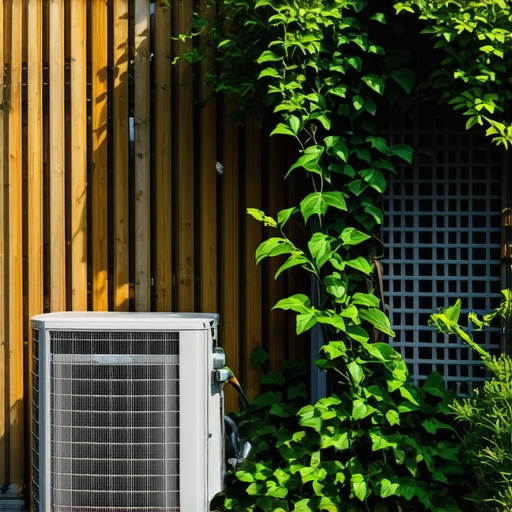
I see too many “mow-and-blow” guys throw a bunch of Arborvitae right against the condenser. That is a death sentence. The heat from the AC will desiccate the foliage on the unit-side, leaving you with a half-dead, brown eyesore within a year. Instead, you need to use plants like ‘Otto Luyken’ Cherry Laurel or ‘Steeds’ Japanese Holly, spaced at least 3 feet from the unit’s center. This allows for air circulation and gives the roots room to spread without lifting the AC pad. You must also avoid “mulch volcanoes.” Piling mulch against the base of these shrubs traps moisture against the root flare, leading to crown rot and fungal pathogens. Keep the mulch 2 inches deep and 3 inches away from the stems. This isn’t just gardening; it’s environmental engineering. You are creating a micro-climate. High-density foliage can actually help dampen the decibel levels of the fan, but only if the plants are healthy. If the soil pH is off (aim for 6.0 to 6.5 for most hollies), the plant will stress and thin out, ruining the screen. Use a slow-release granular fertilizer with a 10-10-10 NPK ratio in early spring, and never more than that.
| Screen Type | Airflow Rating | Maintenance Level | Est. Lifespan |
|---|---|---|---|
| Vented Masonry | Moderate | Low | 30+ Years |
| Living Screen | High (if pruned) | High | 10-15 Years |
| Louvered Wood | High | Moderate | 12-18 Years |
Option 3: Modular Louvered Privacy Panels
Modular louvered panels are engineered timber or PVC systems designed with angled slats that permit maximum CFM throughput while completely obscuring the visual profile of the HVAC unit. These systems are ideal for modern garden designs where a clean, linear aesthetic is required without sacrificing mechanical integrity.
“Restricting airflow to a condenser coil increases head pressure, which shortens the compressor’s lifespan by up to 50%.” – HVAC Field Manual
If you go the wood route, use Western Red Cedar or Ipe. Do not use cheap pressure-treated pine from a big-box store; it will warp, twist, and look like a pretzel within twelve months. Cedar has natural tannins that resist rot, which is crucial because the area around an AC unit is often damp from condensate. The slats should be angled at 45 degrees, sloping away from the unit. This forces the air up and out while blocking the view from eye level. I tell my crew to use stainless steel fasteners only. Standard galvanized nails will react with the cedar and leave ugly black streaks down your screen. For the posts, don’t just stick them in the dirt. Dig a 24-inch hole, fill the bottom with 3 inches of gravel for drainage, and then set the post in concrete. This prevents the wood from sitting in standing water and rotting from the bottom up. It’s a simple step that separates the professionals from the hacks. Don’t skip it.
What is the best material for a breathable AC cover?
The best material for a breathable AC cover is Western Red Cedar or high-grade aluminum louvers due to their durability and high open-air ratio. Wood provides a natural look that integrates with landscaping, while aluminum offers a zero-maintenance solution that won’t warp or degrade under the intense heat generated by the condenser unit.
Installation Checklist for AC Privacy Screens
- Verify 12-inch minimum clearance from the unit on all three sides.
- Call 811 to mark underground utility lines before digging any post holes or trenches.
- Level the subgrade and install a 4-inch base of compacted aggregate for masonry or posts.
- Ensure the screen design includes a removable panel or wide gate for technician access.
- Check local HOA and municipal codes for height restrictions on landscape structures.
- Confirm that the screen does not block the primary electrical disconnect box for the HVAC unit.
Proper landscape engineering is about long-term system integrity. Whether you choose stone, plants, or wood, the goal is to create a barrier that serves the eye without strangling the machine. Every year, I see homeowners spend thousands on repairs because they prioritized a “clean look” over the mechanical requirements of their home. A 2026 AC unit is a sophisticated piece of equipment. Treat it like one. If you follow these specs, you’ll have a screen that lasts decades and a cooling system that runs at peak efficiency. It’s about doing the job right the first time so you don’t have to pay me to fix it the second time.