The Engineering of Privacy: Why Soil Grading Trumps Plant Selection
Selecting drought-proof hedge plants like Texas Privet or Skyrocket Juniper requires analyzing soil drainage and hydrostatic pressure before digging. Proper landscaping starts with grading to ensure root zones are not submerged during rare heavy rains, preventing root rot and structural failure. I always drill into my new crew members: if you do not fix the soil grading first, every plant you put in the ground is just expensive compost. I have seen guys drop 15-gallon specimens into holes that were essentially clay pots with no drainage. By the first heat wave, those plants were toasted because the roots could not breathe. It is not just about the green on top; it is about the 18 to 24 inches of soil chemistry and physics beneath the surface. You cannot cheat the dirt. A privacy hedge is a living wall, and like any wall, its foundation determines its lifespan. If your soil is compacted at 300 PSI, no root system on earth will penetrate it. You have to break that surface tension or you are just wasting the client’s money. We use a penetrometer to test compaction before a single shovel hits the ground. Anything over 200 PSI gets ripped and amended with expanded shale or coarse organic matter. That is the difference between a pro install and a mow-and-blow hack job.
“Proper planting depth is the single most important factor in the long-term survival of woody ornamentals in urban environments.” – Texas A&M AgriLife Extension Service
The Strategic Selection: Top 3 Privacy Species for 2026
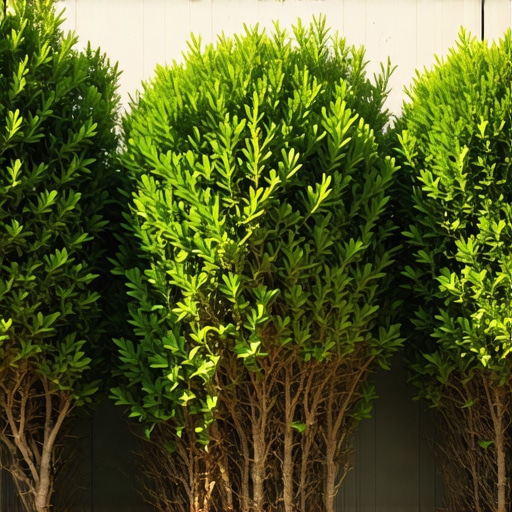
The best drought-tolerant shrubs for 2026 include Texas Privet, Skyrocket Juniper, and Carolina Cherry Laurel because of their high transpiration efficiency and deep root potential. These species offer evergreen privacy while surviving on less than one inch of water per week once established in USDA Zones 7-9. Let’s look at the specs. Texas Privet (Ligustrum japonicum) is a workhorse. It has a thick, waxy cuticle on the leaf that prevents moisture loss. You can shear it into a formal box or let it go natural. Next is the Skyrocket Juniper. It is the king of tight spaces. It grows 15 feet tall but only 2 or 3 feet wide. It is perfect for those zero-lot-line properties where you need a screen but do not have the square footage for a massive footprint. Then you have the Carolina Cherry Laurel. It is a native beast. It handles the heat like a champ and provides a dense screen that even a nosy neighbor cannot see through. Use 10-gallon or 15-gallon containers. Do not buy the 1-gallon scraps from big-box stores. They are root-bound and weak. You want nursery-grade stock with a visible root flare and a healthy terminal leader. Check the table below for the performance breakdown.
| Plant Species | Growth Rate (Annual) | Water Needs (Established) | Max Height (Unpruned) |
|---|---|---|---|
| Texas Privet | 12-24 inches | Low/Moderate | 10-12 feet |
| Skyrocket Juniper | 10-15 inches | Very Low | 15 feet |
| Carolina Cherry Laurel | 18-24 inches | Low | 15-20 feet |
How deep should I dig a hole for a privacy hedge?
You must dig a hole that is twice as wide as the root ball but no deeper than the root ball’s height to prevent settling. The root flare must remain 1-2 inches above the surrounding grade to ensure oxygen exchange and prevent stem-girdling roots from killing the specimen. Digging a deep, narrow hole is a death sentence. The roots will hit that hard clay sidewall and start circling. It is called pot-bound syndrome, even if the plant is in the ground. You have to scarify the edges of the hole with a pickaxe. Make it ugly. Smooth walls in a planting hole act like a ceramic vase, trapping water and drowning the roots. I have seen $50,000 installs fail in three years because the crew used a power auger and left the holes as smooth as glass. The roots could not break out into the native soil. It is basic biology. If the roots cannot expand, the top growth stalls. Then the homeowner thinks it needs more water, so they drown it. It is a cycle of failure that is 100% preventable with proper garden design and installation techniques.
The 7-Step Professional Planting Checklist
- Test soil pH and compaction levels before ordering inventory.
- Mark all underground utilities via 811 to avoid catastrophic strikes.
- Excavate holes to 2x width of the nursery container.
- Expose the root flare by removing excess soil from the top of the root ball.
- Backfill with 70% native soil and 30% organic compost.
- Install a 3-inch layer of triple-shredded hardwood mulch (no mulch volcanoes).
- Set up a dedicated drip irrigation line with 2-GPH pressure-compensating emitters.
Irrigation Logistics: The Drip Line Standard
Drip irrigation is the only way to establish privacy hedges efficiently because it delivers water directly to the root zone at a rate of 2.0 gallons per hour. This method reduces evaporative loss by 60% compared to overhead sprays and prevents fungal pathogens like Cercospora leaf spot from taking hold on the foliage. Most homeowners over-water. They see a drooping leaf and think the plant is thirsty. Usually, it is the opposite. The roots are suffocating because the soil is a swamp. We install rain sensors and smart controllers that calculate evapotranspiration (ET) rates. You want deep, infrequent watering. This forces the roots to dive deep into the subsoil to find moisture. If you water every day for five minutes, you get shallow roots that fry the first time the temperature hits 100 degrees. For a new hedge, we run the drip for 45 minutes, three times a week. After the first year, we cut it back to once a week. This build-up of root mass is what makes a plant truly drought-proof. It is not just the species; it is the training of the root system.
“A retaining wall doesn’t fail because of the stone; it fails because of the water trapped behind it.” – Hardscape Engineering Axiom
How far apart should I space privacy hedge plants?
Spacing for privacy hedges depends on the species’ mature width, typically ranging from 3 feet for Skyrocket Junipers to 5 or 6 feet for Texas Privet. For immediate screening, use a staggered double-row layout, which provides better wind resistance and structural density than a single linear line of plants. If you cram them too close, you get poor air circulation. Poor air circulation leads to powdery mildew and scale. I have seen 200-foot screens of Photinia destroyed by Entomosporium leaf spot because the installer spaced them 2 feet on center. There was no airflow. It was a Petri dish. You have to account for the air. A hedge needs to breathe. Give it the space the tag says it needs at maturity. If the client is impatient, sell them larger specimens, not more plants. Quality lawn care and landscaping require a long-term vision, not a short-term fix. We use a triangular spacing pattern for our hedges. This creates a denser visual barrier with fewer plants. It is more efficient and looks better from both sides of the property line. It also allows for easier maintenance access for future pruning. Don’t skip the layout phase. Use a string line and marking paint. Precision is professional.
![7 Native Trees for Instant 2026 Backyard Privacy [List]](https://lawnmajesty.com/wp-content/uploads/2026/02/7-Native-Trees-for-Instant-2026-Backyard-Privacy-List.jpeg)

![5 Rabbit-Proof Shrubs for a Maintenance-Free 2026 Garden [List]](https://lawnmajesty.com/wp-content/uploads/2026/02/5-Rabbit-Proof-Shrubs-for-a-Maintenance-Free-2026-Garden-List.jpeg)
![5 Clay-Soil Shrubs That Won't Die in 2026 [Low Maintenance]](https://lawnmajesty.com/wp-content/uploads/2026/03/5-Clay-Soil-Shrubs-That-Wont-Die-in-2026-Low-Maintenance.jpeg)
![4 Salt-Tolerant Plants for 2026 Coastal Garden Privacy [List]](https://lawnmajesty.com/wp-content/uploads/2026/02/4-Salt-Tolerant-Plants-for-2026-Coastal-Garden-Privacy-List.jpeg)
![5 Sun-Tough Perennials for No-Water 2026 Gardens [List]](https://lawnmajesty.com/wp-content/uploads/2026/03/5-Sun-Tough-Perennials-for-No-Water-2026-Gardens-List.jpeg)