![Stop Hillside Soil Washout for $200 [2026 DIY Fix]](https://lawnmajesty.com/wp-content/uploads/2026/05/Stop-Hillside-Soil-Washout-for-200-2026-DIY-Fix.jpeg)
Stop Hillside Soil Washout for $200 [2026 DIY Fix]
The High Cost of Gravity: Why Your Hillside is Failing
Hillside soil washout is a failure of structural engineering and hydraulic management where water velocity exceeds the shear strength of the soil surface. To fix a sloping yard for under $200, you must manage hydrostatic pressure and surface friction using biodegradable armoring and native root systems rather than expensive masonry. Failure to address the physics of the slope leads to foundation undermining and localized environmental collapse. I always drill into my new crew members: if you don’t fix the soil grading first, every plant you put in the ground is just expensive compost. I have seen guys throw $5,000 worth of nursery stock at a 30-degree incline only to find it all at the bottom of the culvert after a three-inch rain event. Dirt is heavy. Water is heavier. If you do not respect the weight, you will lose the war. Most homeowners think they need a massive retaining wall, but for $200, we can use the same principles as the DOT to lock that dirt in place permanently.
The Forensic Breakdown of Soil Erosion
Surface erosion on hillsides occurs when kinetic energy from raindrops dislodges soil particles, which are then transported by laminar flow that quickly turns into rill erosion. To stop this for $200, you must install jute netting and straw wattles to break the water’s momentum and force it to infiltrate the soil. This is a game of friction. Every inch of bare soil is a liability. Soil particles like silt and fine sand are the first to go because they lack the cohesive properties of clay. If your hillside feels ‘mushy’ after rain, you have a drainage problem; if it looks ‘carved,’ you have a velocity problem. We fix both by decreasing the speed of the runoff.
“Soil erosion is a physical process that occurs when the impact of raindrops or the flow of runoff dislodges soil particles, leading to significant loss of topsoil and nutrient depletion.” – Penn State Extension
How do you stop soil from washing away on a steep hill?
To stop soil washout, you must implement the Slow, Spread, and Sink method using mechanical stabilization like wattles and biological stabilization like deep-rooted fescues. By creating mini-terraces with biodegradable materials, you interrupt the gravity-fed flow of water, allowing it to percolate into the rhizosphere rather than stripping the topsoil. This process requires a $200 material kit consisting of 70% mechanical barriers and 30% seed and soil amendments.
The $200 Materials Manifest
You are not buying decorative mulch. You are buying engineering components. High-end landscaping firms don’t shop at big-box garden centers for these projects; we go to contractor supply yards. For $200, you can secure roughly 500 square feet of moderate slope. Here is the cost breakdown:
| Item | Quantity | Estimated Cost | Function |
|---|---|---|---|
| 9-inch Straw Wattles (12ft) | 3 units | $75.00 | Velocity breaks / Sediment capture |
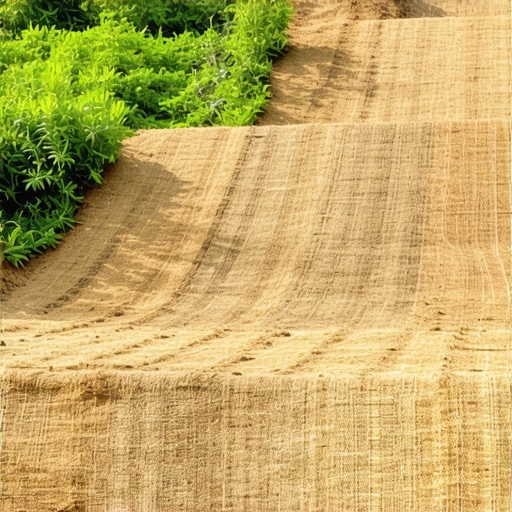
| Jute Netting Roll (4ft x 50ft) | 2 rolls | $60.00 | Surface armoring / Friction |
| 6-inch Steel Sod Staples | 100 count | $20.00 | Anchoring netting to substrate |
| Native Riparian Seed Mix | 2 lbs | $35.00 | Long-term biological anchoring |
| Fast-acting Lime/Starter Fert | 1 bag | $10.00 | pH adjustment for root speed |
The Step-by-Step Installation: Blueprint for Stability
Start with the prep work. You cannot lay netting over weeds. You must scalp the area. If you leave thatch or debris, the netting will ‘bridge’ over the soil, leaving gaps where water will channel. This is how DIY projects fail. The netting must have 100% intimate contact with the dirt. Step 1: Rough Grade. Use a heavy rake to smooth out rills. Do not pack the soil down too hard; you need pore space for seeds to germinate. Step 2: The Trench. At the very top of the hill, dig a 6-inch deep trench. This is your anchor point. Tuck the top of your jute netting into this trench and staple it every 12 inches. Step 3: Seeding. Apply your seed before the netting. The netting acts as a greenhouse cover, keeping the seeds moist and protected from birds. Use a mix with Creeping Red Fescue or Annual Ryegrass for immediate stabilization. Step 4: Roll and Staple. Roll the jute down the hill. Do not pull it tight; it should follow the contours of the land. Use a ‘U’ pattern for staples, placing them every 2 feet. Overlap the edges of the rolls by 4 inches. Step 5: Wattle Installation. Lay your straw wattles horizontally across the slope. These are your speed bumps. You must dig a shallow ‘smile’ trench for the wattle to sit in, or water will just run under it. Stake them with wood or rebar.
“A retaining wall doesn’t fail because of the stone; it fails because of the water trapped behind it.” – Hardscape Engineering Axiom
What is the cheapest way to stabilize a slope?
The cheapest stabilization method is hydro-seeding simulation using jute blankets and bulk mulch. While a professional hydro-seeding rig costs thousands, the $200 DIY version uses open-weave fibers to create a micro-climate that facilitates rapid root growth. This is far more effective and cheaper than buying individual plants, which often suffer from root girdling in heavy slope soils.
The Biology of the Fix: Why Roots Matter
Mechanical fixes like netting are temporary. Jute will rot in 12 to 24 months. That is intentional. By the time the jute biodegrades, your biological mat should be established. We are looking for plants with fibrous root systems that create a 3D web in the top 12 inches of soil. Avoid ‘clumping’ plants; you want rhizomatous species that spread underground. In 2026, climate patterns are trending toward high-intensity, short-duration rain events. Your hillside must be able to handle 2 inches of rain in 30 minutes. This requires root density, not just top-growth. If you see yellowing, your nitrogen is leaching. Hit it with a slow-release organic fertilizer. Keep the pH between 6.0 and 7.0. If the soil is too acidic, the roots will stay shallow and the whole ‘mat’ will peel off the hill like a carpet. Don’t skip the lime. It is cheap. It works.
Slope Stability Checklist
- Check for Utility Lines: Call 811. Don’t drive a stake into a gas line.
- Calculate the Pitch: If the slope is greater than 2:1 (50%), you need more than netting; you need geogrid.
- Trench the Top: If water starts under your fix, the fix is gone. Anchor the top.
- Overlap Joints: Water finds the path of least resistance. Overlap your rolls.
- Hydration: Water the seed daily for 14 days. If the seed dies, the hill dies.
Stop looking at the hill as a landscape feature and start looking at it as a levee. Every choice you make must be about energy dissipation. The $200 you spend now on wattles and jute will save you $10,000 in foundation repair later. It won’t be pretty for the first three weeks. It will look like a construction site. But once that fescue breaks through the jute, you’ll have a reinforced soil mass that can withstand anything the sky throws at it. Don’t be the homeowner who buys a flat of flowers and expects them to hold back 40 tons of moving dirt. Use your head. Use the physics.
![Stop Your 2026 Retaining Wall from Leaning [Drainage Fix]](https://lawnmajesty.com/wp-content/uploads/2026/07/Stop-Your-2026-Retaining-Wall-from-Leaning-Drainage-Fix.jpeg)