Build a $200 2026 Rock Garden for Clay Soil Areas
I always drill into my new crew members: if you don’t fix the soil grading first, every plant you put in the ground is just expensive compost. I have spent two decades watching homeowners dump thousands of dollars into nursery stock only to have it die within six months because they planted in a clay bowl. Clay is not your enemy, but your lack of engineering is. When you deal with clay soil, you are dealing with microscopic particles less than 0.002 millimeters in size. These particles pack together so tightly that they create a literal waterproof barrier. If you dig a hole in clay and fill it with rocks and a plant, you have not made a garden; you have made a bathtub. Without an exit strategy for water, your plant roots will drown in 48 hours of standing water. This is why we focus on structural integrity before we look at the aesthetics of garden design.
The Clay Soil Crisis: Why Your Garden Is Currently a Bathtub
To fix clay soil compaction for a rock garden, you must address drainage and pore space. Clay lacks the hydraulic conductivity of sand, leading to root rot. Successful landscaping on clay requires adding angular gravel and organic matter to break up the dense structure. You cannot simply ignore the physical properties of the earth. Clay soil has a high cation exchange capacity, meaning it holds nutrients well, but its physical structure is a nightmare for gas exchange. If oxygen cannot reach the roots, the plant dies. Period. This is why we excavate rather than just piling rocks on top of the lawn. You need a transition zone between the heavy native clay and your new rock garden environment.
“The clay fraction of the soil consists of particles less than 0.002 mm in diameter, which creates a high surface area but extremely low permeability.” – Soil Science Society of America Manual
How much modified gravel do I need for a rock garden base?
For a standard 50-square-foot rock garden, you will need approximately 0.5 to 0.75 cubic yards of #57 limestone or crushed granite. This provides a 3-inch stable base. Do not use rounded pea gravel for the base layer. Rounded stones act like ball bearings and will shift under the weight of larger boulders. You need angular stone that locks together under compaction. I calculate this by multiplying square footage by depth in feet, then dividing by 27 to get cubic yards. If your math is wrong, your garden will settle unevenly within the first two freeze-thaw cycles. This is the difference between a professional install and a DIY failure.
The $200 Material Breakdown: Strategic Procurement in 2026
Building a budget-friendly rock garden in 2026 requires sourcing local materials and avoiding the middleman markups at big-box retailers. By purchasing bulk aggregate and salvaged fieldstone, you can keep hardscaping costs under $200 while maintaining engineering standards. Retail bags of stone are a scam. A single bag of decorative rock might cost $8, while a full ton of the same material at a quarry costs $40. You do the math. If you have a truck, you are already ahead of the game. If not, pay the $50 delivery fee for a bulk drop; it still beats the bag price. Below is how I would allocate a $200 budget for a 10×5 foot area.
| Material | Quantity | Estimated Cost | Source |
|---|---|---|---|
| #57 Crushed Limestone | 0.5 Cubic Yard | $35 | Local Quarry |
| Native Fieldstone/Boulders | 400 lbs | $60 | Local Stone Yard / Salvage |
| Gypsum (Soil Conditioner) | 40 lbs | $15 | Ag Supply Store |
| Drought-Tolerant Plants | 6 Units | $75 | Wholesale Nursery |
| Non-Woven Geotextile | 50 sq ft | $15 | Landscape Supply |
The Engineering of Drainage: Moving Water Away
Proper drainage engineering for a rock garden involves creating a 2 percent slope to prevent hydrostatic pressure buildup. In clay soil areas, you must install a weep path or a French drain if the garden sits at the base of a hill. Water is the most destructive force in hardscaping. It weighs 62.4 pounds per cubic foot. When it gets trapped behind a rock or under a garden bed, it will move those stones. I have seen 500-pound boulders shifted by nothing but water pressure and ice. You must provide a clear path for that water to exit the garden area. We use non-woven geotextile fabric because it allows water through while keeping the silt from clogging our drainage stones. Woven fabric is for driveways; non-woven is for gardens. Don’t mix them up.
“A retaining wall doesn’t fail because of the stone; it fails because of the water trapped behind it.” – Hardscape Engineering Axiom
Can I put a rock garden over clay?
Yes, you can build a rock garden over clay, but you must avoid the “bowl effect” by ensuring the sub-grade is sloped toward a lower point of the yard. If you dig a flat-bottomed hole in clay, it will hold water like a swimming pool. You must carve a slight pitch into the clay floor before adding your drainage gravel. This ensures that any water that percolates through the rocks hits the clay layer and immediately slides away from the plant roots. I suggest a 1/4 inch drop for every foot of horizontal distance. It is simple physics. Water follows the path of least resistance. Make that path lead away from your plants.
Step-by-Step Installation: From Excavation to Edge
Execution of a rock garden installation starts with mechanical excavation of the sod layer and 2 inches of the topsoil. For lawn care enthusiasts, this is the part where you remove competition from invasive grass species. Use a sharp spade. Cut clean edges. If you leave grass roots behind, they will find the nutrients in your rock garden and take over within one season. This is the manual labor phase that most people skip. Don’t skip it. The tamper should literally bounce off the compacted base when you are done. If the ground feels soft, the rocks will sink. You want a 95 percent compaction rate on that sub-base.
- Mark the perimeter using high-visibility marking paint.
- Excavate the area to a total depth of 6 inches, maintaining a slope.
- Spread 20 lbs of gypsum over the clay to help flocculate the particles.
- Lay down non-woven geotextile fabric, overlapping seams by 12 inches.
- Backfill with 3 inches of #57 stone and compact with a hand tamper.
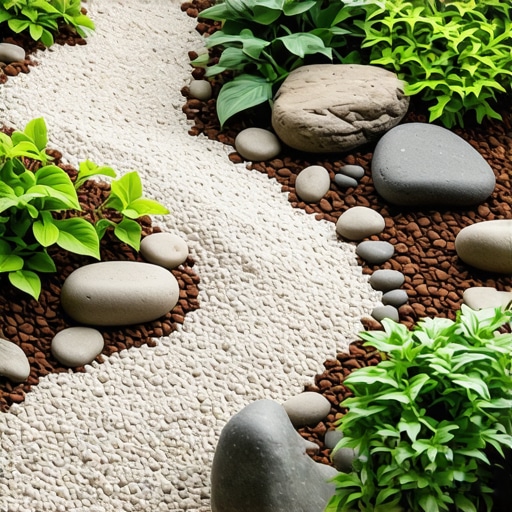
- Place your largest “anchor” rocks first, burying the bottom 1/3 of the stone.
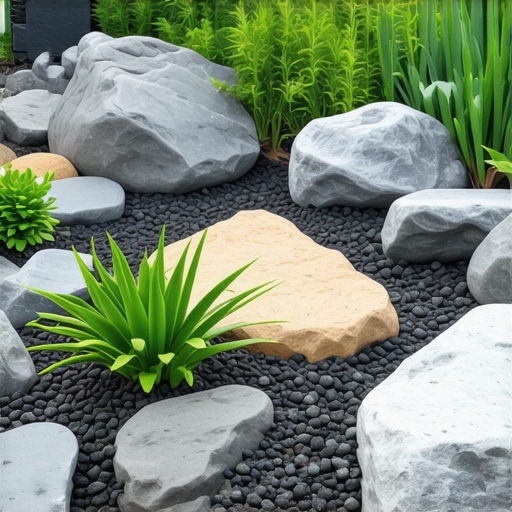
- Fill gaps with smaller stones and drought-tolerant perennials like Sedum or Creeping Thyme.
Maintenance and the 2026 Outlook
A rock garden is low maintenance, not zero maintenance. Over time, organic matter like leaves and dust will settle between the rocks. This creates a seed bed for weeds. Once a year, you need to blow out the debris with a high-velocity leaf blower. If you let the organic matter build up, you are just inviting the clay-loving weeds back into the space. In 2026, we are seeing a shift toward more functional rock gardens that act as bio-retention cells. This means your garden isn’t just for looks; it is actually managing the stormwater runoff for your entire property. It is smart engineering. It is responsible land management. Stick to the measurements. Watch the pH of your stone choice. Limestone will raise pH; Granite is neutral. Choose your plants accordingly. Now get to work.