
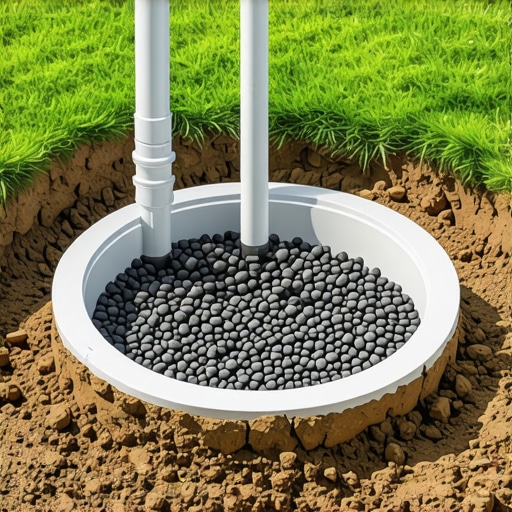
How to Build a Dry Well to Solve Yard Flooding
Understanding Subsurface Hydrodynamics and Yard Drainage Solutions
A dry well is a subsurface drainage system designed to manage excess stormwater by capturing it in a centralized basin and allowing it to slowly percolate back into the soil. It mitigates hydrostatic pressure, prevents surface ponding, and protects your home foundation from water intrusion by utilizing gravity and soil permeability. Use this system when gravity-fed surface drains have nowhere else to discharge.
I recently got called out to tear up a $30,000 patio that was sinking because the previous contractor failed to account for subsurface water. The pavers were literally floating on a soup of saturated clay. They didn’t install any drainage, thinking that a slight pitch on the surface was enough. It wasn’t. Water trapped beneath the surface exert immense pressure, and if it has no place to go, it will move your hardscape. I had to excavate five feet down, install a massive dry well system, and rebuild the entire base from scratch. This is why we do it right the first time. It is not about the stone you see; it is about the engineering you don’t see. Most ‘landscape’ guys are really just lawn mowers with a shovel. They don’t understand compaction rates or percolation. If you ignore the science of soil, your yard will eventually reclaim your investment. We build to last decades, not just until the check clears.
“A retaining wall doesn’t fail because of the stone; it fails because of the water trapped behind it.” – Hardscape Engineering Axiom
The Physics of Soil and Water Management
To build a dry well that actually works, you have to understand Darcy’s Law, which describes the flow of a fluid through a porous medium. Your soil is that medium. If you have heavy clay with a low infiltration rate, your dry well needs to be significantly larger than it would be in sandy loam. You cannot just dig a hole and fill it with rocks. You need to calculate the void space. Clean #57 crushed stone typically has a void space of about 40%. This means for every 10 cubic feet of gravel, you can store 4 cubic feet of water. If you use a plastic dry well tank (like an NDS Flo-Well), you get nearly 100% void space within the tank itself, which is far more efficient for smaller footprints.
How deep should a dry well be for effective drainage?
A dry well must be deep enough to reach more permeable soil layers while remaining above the local water table. Typically, this means excavating 4 to 6 feet deep, ensuring the base is below the frost line to prevent heaving during freeze-thaw cycles. In many regions, you must maintain at least 2 feet of separation between the bottom of the well and the seasonal high water table to ensure the water has a place to go. If you dig into a high water table, you haven’t built a drain; you’ve built a permanent pond that will never empty.
| Material Type | Storage Capacity (Void Space) | Best Use Case |
|---|---|---|
| #57 Crushed Stone | 40% | Large area infiltration, low-cost projects |
| Pre-fabricated Plastic Tank | 95-100% | High-volume runoff, tight footprints |
| #3 Ballast Rock | 35% | Heavy-duty structural support |
| River Jack | 30% | Decorative but low efficiency for drainage |
Step-By-Step Engineering: The Ground-Up Build
Phase 1: The Percolation Test. Before you buy a single bag of stone, you must perform a perc test. Dig a hole 12 inches deep, fill it with water, and see how long it takes to drain. If it takes more than 24 hours, a standard dry well will fail. You may need to auger down deeper to find a sand or gravel seam. Phase 2: Excavation and Siting. The well must be at least 10 feet from any foundation. Do not compromise on this. Hydrostatic pressure near a basement wall is a recipe for a flooded cellar. Phase 3: The Geotextile Lining. Line the hole with a non-woven geotextile filter fabric. Do not use cheap ‘weed barrier’ from a big-box store. You need a fabric rated for at least 100 gallons per minute per square foot. This fabric prevents silt and fines from migrating into your gravel and clogging the system. If it clogs, the well dies. Phase 4: Aggregate and Piping. Use 4-inch SDR-35 or Schedule 40 PVC pipe to carry water from your downspouts or catch basins to the well. Corrugated pipe is for hacks; it catches debris and collapses under load. Phase 5: The Cap and Overflow. Every dry well needs an overflow emitter. In a 100-year storm event, the well will fill up. You need a designated spot for that excess water to exit safely without eroding your landscape.
How much modified gravel do I need for a patio base or dry well?
To calculate gravel needs, multiply the length x width x depth of your trench to get cubic feet, then divide by 27 to get cubic yards. For a dry well, ensure you are using ‘clean’ stone with no fines. Modified gravel (like 21A or CR6) contains dust and small particles that pack tight—great for a patio base, but terrible for drainage because it eliminates the void space necessary for water storage. For a standard 500-square-foot roof section during a 1-inch rain event, you need to manage about 300 gallons of water. That requires a dry well with roughly 40 cubic feet of effective storage.
“Effective stormwater management requires a minimum of 24 hours of drawdown time to ensure aerobic conditions in the surrounding soil.” – Agricultural Extension Drainage Manual
- Call 811 before digging to mark underground utilities.
- Ensure a minimum 1% slope (1/8 inch per foot) for all inlet pipes.
- Use a level and a transit to verify the bottom of the well is perfectly flat.
- Wrap the top of the well with fabric before backfilling with soil.
- Install a clean-out leaf trap on the downspout to prevent organic debris from entering the well.
Stop looking at your yard as a garden and start looking at it as a watershed. Every square inch of roof and pavement is a collection plate. If you don’t provide a path of least resistance, the water will find its own, usually through your foundation or under your expensive pavers. Dig deep. Use the right stone. Don’t skip the fabric. Water wins every time unless you build a better exit strategy.


![Build a $50 2026 Rain Barrel System [Save Water]](https://lawnmajesty.com/wp-content/uploads/2026/07/Build-a-50-2026-Rain-Barrel-System-Save-Water.jpeg)