How to Clean Oil Stains Off Your Concrete Driveway Fast
The Forensic Reality of Hydrocarbon Penetration
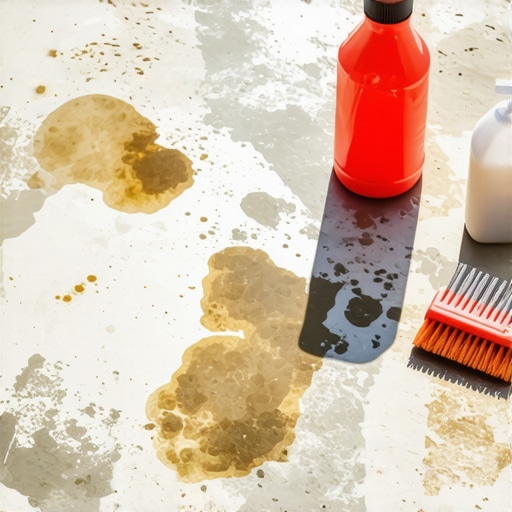
I recently got called out to tear up a $30,000 driveway that was supposedly ruined beyond repair because the previous contractor tried to hide deep oil saturations with a cheap topical sealer. The sealer bubbled and peeled within three months because they didn’t understand the molecular bond between petroleum and cementitious pores. Concrete is not a solid, impermeable slab; it is a rigid, mineralized sponge with a complex network of capillary voids. When you leak 10W-30 or power steering fluid, the weight of the vehicle and gravity pull those hydrocarbons deep into the substrate. If you don’t extract the oil before treating the surface, your hardscape is effectively a ticking time bomb of delamination. Cleaning it fast requires more than a garden hose; it requires a chemical assault on the oil’s surface tension.
How to Clean Oil Stains Off Your Concrete Driveway Fast
To clean oil stains off concrete fast, apply a heavy-duty alkaline degreaser or microbial cleaner to the surface, scrub vigorously with a stiff-bristled nylon brush, and rinse using a pressure washer at 3000 PSI. For deep, set-in stains, a poultice made of absorbent material and solvent must be applied to draw the oil out of the concrete’s internal pores through capillary action.
“Concrete is a porous material that acts like a sponge, drawing liquids deep into its matrix through capillary suction, which can lead to long-term structural and aesthetic degradation if not addressed.” – Concrete Polishing Council Technical Bulletin
The Physics of the Pore: Why Speed Matters
Concrete density is measured by its water-to-cement ratio. The higher the ratio, the more porous the slab. When oil hits the surface, it begins its descent through the paste. The first hour is critical. At this stage, the oil is mostly topical. By hour twenty-four, it has achieved deep penetration. You are no longer cleaning a surface; you are performing an extraction. As a professional, I look at the contact angle of the oil droplet. If it’s flat, the surface tension has already broken, and the oil is migrating. We use surfactants to re-emulsify that oil, breaking it down into smaller droplets that can be lifted out of the voids. High-pressure water alone is often insufficient and can actually drive the oil deeper if used at the wrong angle.
Professional Extraction Methods Compared
Different stains require different mechanical or chemical approaches. You cannot treat a fresh spill the same way you treat a three-year-old asphaltic residue. We categorize these by their chemical reactivity and the required dwell time for the cleaning agents. Below is a breakdown of the most effective professional methods used in the hardscaping industry.
| Method | Active Agent | Dwell Time | Best For |
|---|---|---|---|
| Alkaline Degreasing | Sodium Metasilicate | 15-30 Mins | Fresh to moderate stains |
| Poultice Extraction | Acetone & Diatomaceous Earth | 24 Hours | Deep, ancient oil shadows |
| Bio-Remediation | Oil-Eating Microbes | 7-14 Days | Eco-sensitive areas |
| Steam Pressure Washing | 200°F Water + 3500 PSI | Instant | Large commercial areas |
The Step-by-Step Professional Restoration Process
Follow this checklist to ensure you don’t just move the oil around, but actually remove it from the driveway matrix. Skip one step and the ghost of the stain will return when the concrete gets damp. Ensure you have the following gear ready: high-alkaline degreaser, a stiff nylon brush (never wire), safety goggles, and an absorbent like cat litter or sawdust.
- Initial Absorption: Cover fresh oil with a clay-based absorbent. Grind it in with your boots. Let it sit for 30 minutes to pull the surface liquids up.
- Chemical Pre-Treat: Sweep away the absorbent and apply the degreaser at a 1:1 ratio. Do not let it dry on the concrete.
- Mechanical Agitation: Scrub in a circular motion. You are looking for a thick, gray slurry. This indicates the oil is suspending in the cleaning solution.
- Pressure Extraction: Use a 25-degree nozzle. Keep the wand 8 inches from the surface. Work from the center of the stain outward to prevent spreading.
- Secondary Poultice: If a shadow remains, mix a paste of baking soda and acetone. Spread it 1/4 inch thick, cover with plastic wrap, and let it sit for 24 hours.
How much pressure is too much for concrete?
Residential concrete is typically rated at 3,000 to 4,000 PSI. Using a commercial-grade pressure washer with a 0-degree red tip can literally carve a hole in your driveway or strip the cream coat off the surface. Always use a fan tip. If you see the aggregate (the small rocks inside the concrete) becoming visible, you are destroying the slab. Stop immediately. The goal is to flush the pores, not sandblast the finish. I’ve seen too many DIYers leave permanent zebra stripes on their driveway because they were too aggressive with the wand. Consistency is better than raw power.
Will vinegar or baking soda remove old oil stains?
Vinegar is an acid and baking soda is a base. While they are great for kitchen counters, they are often too weak for deep hydrocarbon extraction. Vinegar can actually etch the concrete if left too long, making it more porous and susceptible to future staining. Baking soda works well as a mild abrasive and part of a poultice, but it lacks the surfactants necessary to break the chemical bond of motor oil. For real results, you need a dedicated hardscape cleaner designed to handle the high pH of concrete. Using the wrong chemicals can shift the soil pH of your surrounding lawn care area, killing the turf at the edge of the driveway.
“Failure to remove petroleum-based contaminants before applying a topical treatment will result in delamination of the topcoat and permanent discoloration of the concrete substrate.” – ICPI Technical Manual
Hardscape Longevity: The Sealer Defense
The best way to clean oil fast is to make sure it never enters the pores in the first place. After a thorough cleaning, you must seal the concrete. I recommend a penetrating Silane-Siloxane sealer. Unlike topical acrylics that sit on top and make the driveway slippery, penetrating sealers work at a molecular level to line the pores. They create a hydrophobic and oleophobic barrier. When oil leaks onto a sealed driveway, it beads up like water on a waxed car. You can wipe it up with a paper towel. This is the difference between a high-end landscape installation and a homeowner headache. If you haven’t sealed your driveway in the last three years, you are leaving your hardscape vulnerable to every drop of fluid your vehicle sheds.
The Environmental Impact of Runoff
Never wash oil and degreasers directly into the storm drain. Most municipal codes forbid this because storm drains often lead directly to local waterways. Use a shop vac to suck up the slurry or create a berm using sand to catch the runoff. Once the water evaporates, you can dispose of the solid waste in the trash. Being a professional means respecting the biology of the landscape as much as the engineering of the hardscape. Heavy degreasers can also scorch the roots of nearby ornamental plants or trees if they leach into the drip line. Always pre-wet the surrounding grass and plants to prevent them from absorbing the cleaning chemicals. Don’t sacrifice your garden design for a clean driveway. Balance is key. Clean it right, clean it once, and then seal it so you never have to do it again. It is about working smarter, not just harder with a pressure wand.
![Why Your 2026 Cedar Fence is Turning Gray [Fix]](https://lawnmajesty.com/wp-content/uploads/2026/06/Why-Your-2026-Cedar-Fence-is-Turning-Gray-Fix.jpeg)