How to Clean Your Garden Tools to Prevent Plant Disease
The Invisible Vectors: Why Your Shears Are Biological Weapons
Cleaning garden tools prevents the spread of fungal spores, bacterial cankers, and viral pathogens like Fusarium or Fire Blight between plants. Professionals use 70% isopropyl alcohol or 10% bleach solutions to neutralize microbes that survive on carbon steel surfaces for weeks, ensuring landscape health.
I always drill into my new crew members: if you don’t fix the soil grading first, every plant you put in the ground is just expensive compost. It is a technical wisdom I learned 20 years ago when I saw a $50,000 landscape design collapse because the gardener used a pair of bypass pruners infected with Phytophthora on every single shrub in the hedge. You wouldn’t want a surgeon using a scalpel they just used to cut a steak. The same logic applies to your boxwoods. If you are not cleaning, you are just a high-paid delivery service for plant death. When we talk about lawn care and landscaping, we usually focus on the green stuff we can see, but the microscopic reality on your trowel is what determines the lifespan of the garden. Sap acts as a nutrient buffet for spores. It sticks. It dries. It builds a bio-film that resists a simple water rinse. You have to be more aggressive than that.
“Pathogens like Verticillium can persist on steel surfaces for up to 15 days in the absence of a host, making tool sterilization mandatory between every plant.” – Nursery Disease Management Manual
The Forensic Anatomy of a Contaminated Blade
A contaminated blade harbors microscopic pathogens within sap residue and rust pits that bypass basic cleaning methods. These micro-reservoirs of bacteria can survive high-temperature fluctuations, meaning your tools are biological hazards until they undergo a chemical denaturing process or mechanical abrasion to remove the bio-film.
Look at the surface of a rusted shovel. It is not just orange metal; it is a landscape of microscopic caves. Rust is iron oxide, and it is porous. Those pores trap moisture and fungal spores like Botrytis. You can’t just wipe it. You have to understand the physics of the tool. In garden design, we select plants for their aesthetics, but we kill them with our lack of maintenance. When you make a cut with a dull, dirty pair of shears, you are crushing the vascular tissue of the plant instead of slicing it. This creates a jagged wound that cannot heal properly, essentially leaving the door open for every airborne pathogen in the county. It will rot. Do not skip the mechanical cleaning phase. You need to use a stiff wire brush to remove the physical debris before you even think about the chemicals. If there is dirt on the blade, the disinfectant won’t reach the metal. It is basic civil engineering for your tool kit.
How much alcohol do I need to sanitize my pruners?
You do not need a gallon. You need a 70% concentration of isopropyl alcohol. Higher concentrations like 91% actually evaporate too quickly to kill certain hardy bacteria. The 70% mix has enough water content to slow evaporation, allowing the alcohol to penetrate the cell walls of the pathogenic microbes and destroy them effectively.
| Cleaning Agent | Contact Time Required | Corrosivity Level | Effectiveness on Spores | |
|---|---|---|---|---|
| 70% Isopropyl Alcohol | 30 Seconds | Low | High | |
| 10% Bleach Solution | 2 Minutes | High (Must Rinse) | Extreme | |
| Pine Oil (Lysol) | 5 Minutes | Medium | Moderate |
The Three-Stage Decontamination Protocol
The three-stage decontamination protocol involves mechanical removal of organic debris, chemical sterilization with a disinfectant, and a final moisture-barrier application. This process ensures that carbon steel tools remain sterile and protected from oxidization, which is critical for preventing pathogen harborages in pitted metal surfaces.
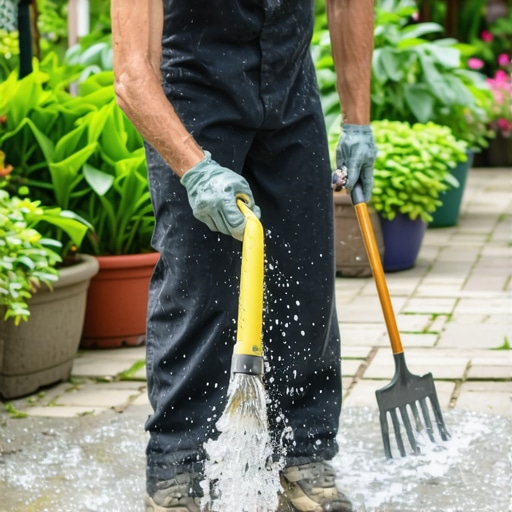
First, get the grit off. Use a PSI-focused water stream or a wire brush. Second, submerge or wipe the tool with your chosen disinfectant. If you use bleach, you better rinse it off within two minutes. Bleach is a salt-based oxidizer; it will eat your tools if you let it sit. I have seen guys ruin $200 Japanese pruning saws in a single afternoon because they thought a bleach soak was a good idea. It isn’t. Third, apply a light coat of 3-in-1 oil or camellia oil. This prevents rust. Rust is the enemy of hygiene. Clean tools should feel smooth to the touch. If they are sticky, they are dirty. If they are orange, they are dangerous. This is how we maintain a hardscaping and landscaping business that lasts decades. We don’t take shortcuts.
“A retaining wall doesn’t fail because of the stone; it fails because of the water trapped behind it.” – Hardscape Engineering Axiom
While that axiom refers to walls, the same principle of hydrostatic pressure and moisture applies to tool care. Water trapped in the hinge of your pruners will cause internal corrosion that you can’t see until the tool snaps in your hand. That snap usually happens when you are halfway through a critical cut, leading to plant damage.
Can I use vinegar to clean my garden tools?
Vinegar is a weak acetic acid. While it can help remove some surface rust, it is not an EPA-registered disinfectant for most serious plant pathogens. For professional-grade disease prevention, rely on alcohol or bleach. Vinegar is for salad, not for stopping Canker or Blight.
Sharpening as a Sanitary Measure: The Physics of the Clean Cut
Sharpening garden tools is a sanitary necessity because a sharp blade creates a smooth surgical wound that the plant can callus over rapidly. Dull blades cause tissue crushing and tearing, which increases the surface area for opportunistic infections and slows the plant’s natural healing response.
I use a diamond whetstone. I keep the angle at exactly 20 degrees for most bypass pruners. You want a serration-free edge. When the blade is sharp, the plant’s vascular system stays intact. It’s like the difference between a clean cut from a razor and a scrape from a sidewalk. The razor cut heals in days; the scrape gets infected. In the world of high-end garden design, we can’t afford to have plants die from preventable infections. Check your blades every 50 cuts. If you feel resistance, you are dull. Stop. Sharpen. Clean. Then continue.
- Step 1: Scrape off caked-on soil and sap using a putty knife or wire brush.
- Step 2: Use a 120-grit sandpaper to remove any surface rust or oxidation.
- Step 3: Wipe the entire tool with a rag soaked in 70% isopropyl alcohol.
- Step 4: Check the hinge for movement and apply a drop of machine oil.
- Step 5: Hone the edge with a sharpening stone to ensure a surgical slice.
Don’t be the hack who buys a new shovel every spring because the old one is a rusted mess. A well-maintained tool is a signature of a professional. If you want a yard that looks like a botanical garden, start acting like a curator. The tools are the bridge between your intent and the plant’s reality. Keep the bridge clean.